Reactivity Fundamentals
|
This section documents the current Vue 3.x release line as published at
the official Vue.js documentation, which is the reference these pages are written and
verified against. No specific patch version is pinned. The Composition API with This content was generated with the assistance of AI and should be verified against the official documentation before being relied on in production, since Vue and its ecosystem iterate quickly. This section’s bibliography lists the reference material consulted while preparing these pages. |
Reactive state is state that Vue watches: when it changes, every component and computed value that read it
re-runs. The Composition API declares this state with two functions, ref() and reactive(). This page
covers both and the rules around them, then a final section on the Proxy machinery that makes it work,
drawn from Reactivity Fundamentals,
the core API and
the utilities API.
ref()
ref() wraps any value — primitive or object — in a reactive container with a single .value property.
<script setup>
import { ref } from 'vue'

const count = ref(0)
const user = ref({ name: 'Ada', roles: ['admin'] })

function bump() {
  count.value++            // .value in script
  user.value.name = 'Bo'   // deep: nested mutation is tracked too
}
</script>

<template>
  <!-- no .value in the template: top-level refs are auto-unwrapped -->
  <button @click="bump">{{ count }} / {{ user.name }}</button>
</template>
.value vs. template auto-unwrap. In JavaScript you always read and write count.value. In the template,
a ref used as a top-level property is unwrapped automatically, so \{\{ count }} works. The unwrap is only
shallow — \{\{ object.someRef }} is not unwrapped, and \{\{ someRef + 1 }} fails because someRef is
resolved before the +. Give such refs a const alias or wrap them in a reactive object.
Deep reactivity. A ref holding an object makes the whole object graph reactive via reactive() internally.
Use shallowRef() (below) to opt out.
reactive()
reactive() returns a Proxy of an object; reads and writes on the proxy are intercepted.
<script setup>
import { reactive } from 'vue'

const state = reactive({ count: 0, items: [] })
state.count++              // no .value -- it is a proxy, not a wrapper
</script>
Its limits shape when you reach for it:
-
Objects only.
reactive()does nothing for primitives — useref()for a number or string. -
Keep the reference. Replacing the variable (
state = reactive(\{ … })) drops the link to the proxy the template holds. Mutate the existing object instead. -
Destructuring loses reactivity.
const \{ count } = statecopies a plain number. Convert the properties to refs first withtoRefs(), or grab one withtoRef():
import { reactive, toRefs, toRef } from 'vue'

const state = reactive({ x: 1, y: 2 })

const { x, y } = toRefs(state)   // x, y are refs linked back to state
const xRef = toRef(state, 'x')   // single property as a ref

x.value++                        // updates state.x
ref vs. reactive: which to use
Prefer ref() as the default. It works for every type, survives destructuring and function boundaries when
passed as a whole, and makes the reactive boundary visible through .value. Use reactive() for a tightly
scoped group of related fields where the .value noise outweighs its caveats. Do not mix a reactive
wrapper around ref`s unless you need the ergonomics — nested refs inside a `reactive object are unwrapped,
but refs inside a reactive array or Map are not.
DOM update timing and nextTick()
State changes do not touch the DOM synchronously. Vue buffers them and flushes once per tick, so multiple
mutations cost one re-render. To read the updated DOM, await nextTick():
<script setup>
import { ref, nextTick } from 'vue'

const count = ref(0)
const el = ref(null)

async function bump() {
  count.value++
  console.log(el.value.textContent)   // still the old text

  await nextTick()
  console.log(el.value.textContent)   // now updated
}
</script>

<template>
  <p ref="el">{{ count }}</p>
</template>
<script setup> bindings and the template
Every top-level binding declared in <script setup> — imported names, const / let, function
declarations — is exposed to the template with no return. Reactive state stays reactive; a plain value is
just a constant the template can read. This is why the examples above never list what they expose.
How reactivity works
This section corresponds to Reactivity in Depth and the advanced API.
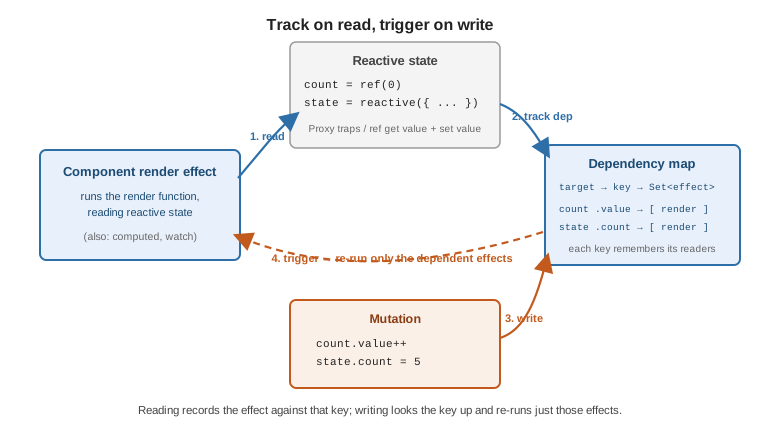
Track on read, trigger on write
reactive() uses a Proxy
to intercept property access; ref() uses get value() / set value() accessors. A stripped-down ref
shows the shape:
function ref(value) {
  const r = {
    get value() {
      track(r, 'value')      // record: the running effect depends on this
      return value
    },
    set value(newValue) {
      value = newValue
      trigger(r, 'value')    // re-run every effect that read it
    }
  }
  return r
}
An effect is a function whose reactive reads are tracked — a computed getter, a watch / watchEffect
callback, and above all a component’s render effect (its render function). While an effect runs it is the
"active" effect; every reactive value it reads adds it to that value’s dependency set. A later write to that
value looks the set up and re-runs only those effects.
Reactivity caveats
-
Adding properties — a Proxy tracks new root-level keys on a
reactiveobject (unlike Vue 2). Refs sidestep the question by holding the whole object in.value. -
Replacing an array or object —
state.list = […]is tracked; reassigning the top-levelreactivevariable itself is not. -
Index and length writes —
arr[5] = xandarr.length = 0on areactivearray are tracked. -
Collections —
MapandSetare supported, but arefstored as aMapvalue is not unwrapped. -
Destructuring — pulls plain values out; use
toRefs()/toRef().
Advanced reactivity APIs
import {
  shallowRef, triggerRef, customRef,
  shallowReactive, shallowReadonly,
  toRaw, markRaw,
  effectScope, onScopeDispose,
} from 'vue'

// Shallow: only the top level is reactive
const big = shallowRef({ rows: [] })
big.value.rows.push(1)   // NOT tracked
big.value = { rows: [] } // tracked (assignment to .value)
triggerRef(big)          // force dependents to run after a deep mutation

const opts = shallowReactive({ nested: { a: 1 } }) // opts.nested is a plain object
const frozen = shallowReadonly({ a: 1 })           // top-level writes warn, nested allowed

// Escape hatches
const original = toRaw(reactive({ a: 1 }))  // the un-proxied object
const external = markRaw({ sdk: thirdParty }) // reactive() / ref() will never proxy this

// customRef: full control over track / trigger -- here, a debounced ref
function debouncedRef(value, delay = 200) {
  let timer
  return customRef((track, trigger) => ({
    get() {
      track()
      return value
    },
    set(next) {
      clearTimeout(timer)
      timer = setTimeout(() => {
        value = next
        trigger()
      }, delay)
    },
  }))
}

// effectScope: own a group of effects and dispose them together
const scope = effectScope()
scope.run(() => {
  watchEffect(() => {/* ... */})
  onScopeDispose(() => {/* cleanup when the scope stops */})
})
scope.stop()  // stops every effect created inside run()
Integrating external and immutable state
For a large object you never mutate in place — an immutable data structure, a snapshot from another store — hold it in shallowRef and assign a new value on each change, calling triggerRef only if you mutate the
same reference deeply. Wrap third-party class instances in markRaw so Vue does not deep-proxy them. State
managers such as Pinia are built on exactly these primitives.
See also
-
Computed Properties — cached derived state built on these refs.
-
Template Syntax — how templates read reactive state.
-
Getting Started —
<script setup>and the Composition API in context.