Vector Search and GenAI
|
This section documents the current Neo4j This content was generated with the assistance of AI and should be verified against the official documentation before being relied on in production, as Neo4j iterates quickly. This section’s bibliography lists the reference material consulted while preparing these pages. |
Neo4j stores an embedding as a native vector property and indexes it for approximate nearest-neighbor (ANN) search like any other document or vector store, but the property graph underneath is what turns plain vector similarity into GraphRAG — retrieval that also walks relationships for context a bag of nearest embeddings cannot capture on its own.
The VECTOR type and vector indexes
An embedding is stored as a VECTOR-typed property, built with the vector() function from a list of
numbers, a dimension count and a coordinate type:
MATCH (m:Movie {title: "The Matrix"})
SET m.embedding = vector($embedding, 1536, FLOAT);
A VECTOR property only becomes ANN-searchable once a vector index exists over it — see
Indexes and constraints for the full CREATE VECTOR INDEX
syntax, the vector.dimensions / vector.similarity_function options, and how a vector index compares to
Neo4j’s other index types. This page assumes that index already exists and focuses on querying it, and on
what a graph adds once retrieval has to go beyond a flat top-k list. Full details on the type itself are in
the Cypher manual’s Vector type
reference.
Querying with the Cypher SEARCH clause
The modern way to run an ANN query in Cypher is the SEARCH clause: it binds a variable from a MATCH
pattern to the nearest neighbors of a query vector inside a named vector index, optionally yielding a
similarity score:
MATCH (m:Movie)
  SEARCH m IN (
    VECTOR INDEX movie_plot_embedding
    FOR vector($queryEmbedding, 1536, FLOAT)
    LIMIT 5
  ) SCORE AS similarity
RETURN m.title AS title, similarity
ORDER BY similarity DESC;
Older code may still call the db.index.vector.queryNodes(indexName, k, queryVector) procedure for the same
lookup — it still runs, but SEARCH is the current, superseding way to express a vector query as a normal
part of a Cypher pattern rather than a separate procedure call. See
the Cypher manual’s SEARCH clause reference for
the full grammar, including combining SEARCH with WHERE pre-filters and other clauses in the same query.
GraphRAG: vector retrieval plus graph expansion
GraphRAG is the pattern of following a vector-similarity retrieval step with a graph traversal step before handing context to an LLM: the vector search finds the chunks or entities most similar to the query embedding, and the graph expansion pulls in the neighbors, related entities, or provenance those hits connect to — context a nearest-neighbor list alone has no way to express. The combined result, not just the raw matches, becomes the context passed to the LLM prompt.
// 1. vector retrieval: the chunks most similar to the query embedding
MATCH (chunk:Chunk)
  SEARCH chunk IN (
    VECTOR INDEX chunk_embedding
    FOR vector($queryEmbedding, 1536, FLOAT)
    LIMIT 5
  ) SCORE AS similarity
// 2. graph expansion: entities each chunk mentions, and their close neighbors
MATCH (chunk)-[:MENTIONS]->(entity)-[:RELATED_TO*1..2]-(context)
RETURN chunk.text AS chunk, similarity, collect(DISTINCT context.name) AS relatedContext
ORDER BY similarity DESC;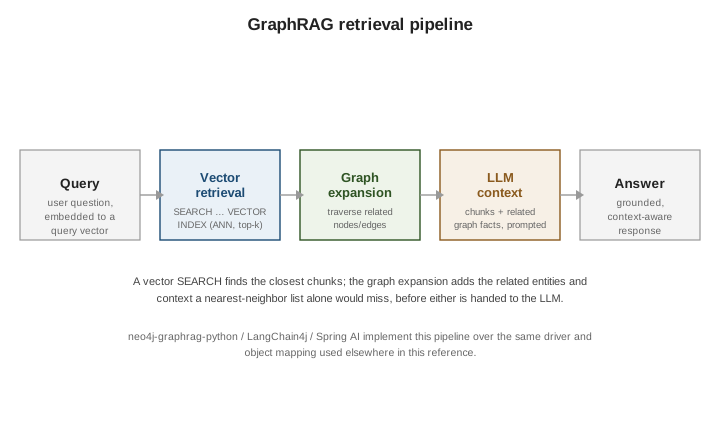
The official neo4j-graphrag-python package packages
this pattern — embedding, vector retrieval, optional graph expansion, and prompt assembly — as a Python
library purpose-built for Neo4j. On the JVM side, the
LangChain4j integration wires Neo4j in as a vector store
and graph-augmented retriever for LangChain4j pipelines, and the
Spring AI integration does the same for Spring AI’s
VectorStore abstraction — both sit above the same driver and object mapping described in
Spring Data Neo4j rather than replacing it. The broader
catalog of drivers, frameworks and tools in this space is indexed at
the Neo4j GenAI Ecosystem, and
the Vector Search developer guide walks through
the retrieval half of the pattern end to end.
A dedicated treatment of building LLM-powered applications on Neo4j exists — see the bibliography.