Delegates, Lambdas and Events
|
This section documents C# 14 on .NET 10 (LTS), as published at learn.microsoft.com/dotnet/csharp, which is the reference these pages are written and verified against. Features introduced by C# 15 / .NET 11 are still in preview and are always flagged as such — never presented as baseline. This content was generated with the assistance of AI and should be verified against learn.microsoft.com before being relied on in production. This section’s bibliography lists the reference material consulted while preparing these pages. |
A delegate is a type whose values are methods. It is C#'s answer to "pass this behaviour along" — the foundation under LINQ, callbacks, asynchronous continuations and events. Lambdas are the compact syntax for writing a delegate’s body inline; events are a controlled way to publish one to subscribers.
Delegate Types
A delegate declaration defines a signature. Any method matching it can be assigned to a variable of that type:
// The declaration introduces a type, not a method.
public delegate decimal Discount(decimal amount);

public static class DelegateBasics
{
    public static decimal TenPercent(decimal amount) => amount * 0.9m;
    public static decimal FlatFive(decimal amount) => Math.Max(0m, amount - 5m);

    public static void Run()
    {
        Discount policy = TenPercent;          // method group conversion -- no parentheses
        Console.WriteLine(policy(100m));       // 90 -- invoked like a method

        policy = FlatFive;                     // any matching method will do
        Console.WriteLine(policy.Invoke(100m));// 95 -- Invoke is the explicit form
    }
}
Delegates are reference types deriving from System.MulticastDelegate. Assigning a method to one is a
method group conversion: the method’s name without an argument list is the "method group", and the compiler
picks the overload matching the delegate’s signature.
Func, Action and Predicate
Declaring a bespoke delegate type is rarely necessary. The BCL ships generic families that cover almost everything:
public static class BuiltInDelegates
{
    public static void Run()
    {
        Func<decimal, decimal> discount = amount => amount * 0.9m;  // returns a value
        Action<string> log = message => Console.WriteLine(message); // returns void
        Predicate<int> isEven = n => n % 2 == 0;                    // Func<int, bool> by another name

        Console.WriteLine(discount(100m));
        log("applied");
        Console.WriteLine(isEven(4));

        Func<int, int, int> add = (a, b) => a + b;        // up to 16 parameters
        Action noArguments = () => log("nothing to see"); // no parameters, no result
        Console.WriteLine(add(2, 3));
        noArguments();
    }
}
Prefer these over custom delegate types unless the name itself carries meaning (Discount documents intent in a
way Func<decimal, decimal> does not) or the signature needs ref/out parameters, which Func/Action
cannot express.
Multicast Delegates and Invocation Lists
Every delegate instance holds an invocation list. ` and `= append, - and -= remove:
public static class Multicast
{
    public static void Run()
    {
        Action<string> pipeline = m => Console.WriteLine($"console: {m}");
        pipeline += m => Console.WriteLine($"audit:   {m}");

        pipeline("saved");     // both run, in the order they were added

        Console.WriteLine(pipeline.GetInvocationList().Length);   // 2

        // Combining is not mutation: delegates are immutable, += builds a new instance.
        Action<string> single = m => Console.WriteLine(m);
        Action<string> combined = single + (m => Console.WriteLine(m.ToUpperInvariant()));
        Console.WriteLine(ReferenceEquals(single, combined));     // False
    }
}
Two traps follow from the invocation list:
-
For a delegate with a return value, only the last invocation’s result is returned; the rest are discarded. Multicast is really only meaningful for
void-returning delegates. -
An exception thrown by one subscriber abandons the remaining subscribers. To isolate them, walk
GetInvocationList()yourself and wrap each call.
public static class IsolatedInvocation
{
    public static void RaiseSafely(Action<string> handlers, string message)
    {
        foreach (Action<string> handler in handlers.GetInvocationList().Cast<Action<string>>())
        {
            try
            {
                handler(message);
            }
            catch (Exception ex)
            {
                Console.WriteLine($"subscriber failed: {ex.Message}");
            }
        }
    }
}
Removing a delegate that is not in the list is a silent no-op, and -= compares by target and method — which
is why removing a lambda you did not keep a reference to is impossible (see
Unsubscribing and memory leaks).
Lambda Expressions
A lambda is an inline function. Its body is either an expression or a statement block:
public static class LambdaForms
{
    public static void Run()
    {
        Func<int, int> square = x => x * x;                  // expression body

        Func<int, string> describe = x =>                     // statement body
        {
            if (x < 0) return "negative";
            return x == 0 ? "zero" : "positive";
        };

        Func<int, int, int> typed = (int a, int b) => a + b;  // explicit parameter types
        Func<int, int, int> inferred = (a, b) => a + b;       // inferred from the target type
        Action<int> discardIt = _ => { };                     // discard parameter

        Console.WriteLine($"{square(4)} {describe(-1)} {typed(1, 2)} {inferred(1, 2)}");
        discardIt(0);
    }
}
Natural Type, Default Parameters and Attributes
Since C# 10 a lambda has a natural type, so var works and the compiler infers Func/Action. Since C# 12 a
lambda parameter may have a default value, and attributes may be applied to lambdas and their parameters:
public static class LambdaNaturalType
{
    public static void Run()
    {
        var increment = (int x) => x + 1;             // inferred as Func<int, int>
        Console.WriteLine(increment.GetType().Name);  // Func`2

        // C# 12: default parameter values on lambdas.
        var pad = (string s, int width = 10) => s.PadLeft(width);
        Console.WriteLine($"[{pad("hi")}] [{pad("hi", 4)}]");

        // C# 11: attributes on lambdas and on their parameters.
        var parse = [return: NotNullIfNotNull(nameof(text))] (string? text) =>
            text is null ? null : text.Trim();
        Console.WriteLine(parse(" x ") ?? "<null>");
    }
}
A lambda without a target type still needs one to be inferable — var f = x ⇒ x; is an error, because nothing
says what x is.
static Lambdas
Marking a lambda static (C# 9) forbids it from capturing anything, which both documents intent and guarantees
the compiler can cache a single delegate instance rather than allocating per call:
public static class StaticLambdas
{
    public static void Run()
    {
        int outside = 5;

        Func<int, int> pure = static x => x * 2;   // cannot see `outside` -- by design
        Console.WriteLine(pure(outside));

        // Marking this one static would be a compile error: it captures `outside`.
        Func<int, int> capturing = x => x * outside;
        Console.WriteLine(capturing(3));
    }
}
Modifiers on Simple Lambda Parameters (C# 14)
Before C# 14, using ref, out, in, ref readonly or scoped on a lambda parameter forced you to spell out
every parameter type. C# 14 lifts that: modifiers may be applied to parameters whose type is still inferred.
public delegate bool TryParseDelegate<T>(string text, out T result);

public static class LambdaModifiers
{
    public static void Run()
    {
        // C# 14: `out result` needs no explicit type -- it is inferred from the delegate.
        TryParseDelegate<int> tryParse = (text, out result) => int.TryParse(text, out result);

        if (tryParse("42", out int value))
        {
            Console.WriteLine(value);   // 42
        }
    }
}
The one exception is params, which still requires the parameter type to be written out. This is a pure
convenience feature — the generated delegate is identical to the pre-C# 14 explicitly typed form.
Closures and Captured Variables
A lambda that references a variable from the enclosing scope captures it. The capture is by reference to the variable, not by copy of its value: the compiler hoists the variable into a compiler-generated class shared by the lambda and the enclosing method, so both see the same storage and it outlives the stack frame.
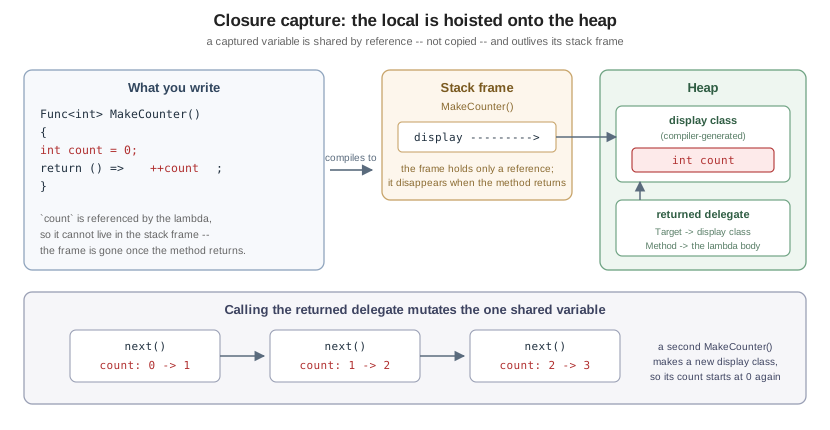
public static class Closures
{
    public static Func<int> MakeCounter()
    {
        int count = 0;                 // hoisted onto the heap because the lambda captures it
        return () => ++count;          // each call mutates the same storage
    }

    public static void Run()
    {
        Func<int> next = MakeCounter();
        Console.WriteLine(next());     // 1
        Console.WriteLine(next());     // 2
        Console.WriteLine(next());     // 3

        Func<int> other = MakeCounter();
        Console.WriteLine(other());    // 1 -- a separate closure, separate storage
    }
}
The Loop Variable Capture Rule
The classic surprise is capturing a loop variable. foreach and for behave differently, and `foreach’s
behaviour changed in C# 5:
public static class LoopCapture
{
    public static void Run()
    {
        var fromForeach = new List<Func<int>>();
        foreach (int i in Enumerable.Range(0, 3))
        {
            fromForeach.Add(() => i);        // since C# 5: a fresh `i` per iteration
        }
        Console.WriteLine(string.Join(",", fromForeach.Select(f => f())));   // 0,1,2

        var fromFor = new List<Func<int>>();
        for (int i = 0; i < 3; i++)
        {
            fromFor.Add(() => i);            // ONE `i` for the whole loop -- all see 3
        }
        Console.WriteLine(string.Join(",", fromFor.Select(f => f())));       // 3,3,3

        var fixedUp = new List<Func<int>>();
        for (int i = 0; i < 3; i++)
        {
            int copy = i;                    // a per-iteration local restores the intuition
            fixedUp.Add(() => copy);
        }
        Console.WriteLine(string.Join(",", fixedUp.Select(f => f())));       // 0,1,2
    }
}
The rule is mechanical: a variable declared inside the loop body is captured per iteration; a for loop’s
control variable is declared once, outside the body, so it is captured once. `foreach’s iteration variable was
changed to be per-iteration precisely because the old behaviour caused so many bugs.
The Cost of Capturing
Capturing allocates. A non-capturing lambda is cached by the compiler into a single static instance; a capturing
one allocates a display class per activation, and re-allocates a delegate each time it is converted. On a hot
path, prefer a static lambda plus an explicit state argument where the API offers one:
public static class AvoidingCapture
{
    public static void Run()
    {
        var cache = new Dictionary<string, int>();
        string key = "answer";

        // Captures `key` -- allocates a display class and a delegate on every call.
        int captured = cache.TryGetValue(key, out int found) ? found : ComputeFor(key);

        // Overloads taking a state argument let the lambda stay static.
        int viaState = cache.TryGetValue(key, out int hit)
            ? hit
            : StaticFactory(key, static k => ComputeFor(k));

        Console.WriteLine($"{captured} {viaState}");
    }

    private static int ComputeFor(string key) => key.Length;

    private static int StaticFactory(string key, Func<string, int> factory) => factory(key);
}
Anonymous Methods (Legacy)
C# 2’s delegate (…) { … } syntax predates lambdas and still compiles. It has one quirk worth recognising in old
code: a parameter list may be omitted entirely when the parameters are unused.
public static class AnonymousMethods
{
    public static void Run()
    {
        Func<int, int> old = delegate (int x) { return x * 2; };
        Action<string> ignoringParameters = delegate { Console.WriteLine("something happened"); };

        Console.WriteLine(old(21));
        ignoringParameters("unused");
    }
}
Write lambdas in new code; anonymous methods offer nothing lambdas do not.
Delegate Variance
Delegates are variant in the same way generic interfaces are: a delegate accepts a method that is more general in its parameters (contravariance) and more specific in its return type (covariance).
public class Animal { }
public class Dog : Animal { }

public static class DelegateVariance
{
    private static void HandleAnimal(Animal a) => Console.WriteLine("handled an animal");
    private static Dog CreateDog() => new Dog();

    public static void Run()
    {
        // Contravariance: a method taking Animal can serve where one taking Dog is expected.
        Action<Dog> onDog = HandleAnimal;
        onDog(new Dog());

        // Covariance: a method returning Dog can serve where one returning Animal is expected.
        Func<Animal> makeAnimal = CreateDog;
        Console.WriteLine(makeAnimal().GetType().Name);   // Dog
    }
}
This works because Action<in T> declares T as contravariant and Func<out TResult> declares its result
covariant. See Generics for the in/out rules in full.
Events
An event is a delegate field with the access rules a publisher actually wants: subscribers may add and remove handlers, but only the declaring type may raise it or clear the list.
public sealed class Downloader
{
    // `event` restricts outside code to += and -=.
    public event EventHandler<int>? ProgressChanged;

    public void Download()
    {
        for (int percent = 0; percent <= 100; percent += 50)
        {
            OnProgressChanged(percent);
        }
    }

    // The conventional raiser: protected virtual, named On<EventName>, null-checked.
    private void OnProgressChanged(int percent) => ProgressChanged?.Invoke(this, percent);
}

public static class EventConsumer
{
    public static void Run()
    {
        var downloader = new Downloader();
        downloader.ProgressChanged += (sender, percent) => Console.WriteLine($"{percent}%");
        downloader.Download();
    }
}
The ?.Invoke(…) pattern matters: an event with no subscribers is null, and between the null check and the
call another thread could unsubscribe. ?. reads the field once into a temporary, which closes that race.
The Standard .NET Event Pattern
The framework design guidelines fix the shape of an event so tooling and readers can rely on it:
-
the handler type is
EventHandlerorEventHandler<TEventArgs>; -
the first parameter is
object? sender, the second the event data; -
event data derives from
EventArgs(or, since .NET Core, is any type at all forEventHandler<T>); -
the raiser is a
protected virtual void OnXxx(…)method so derived classes can intercept; -
the event is named with a verb —
Changed,Closing,Completed.
public sealed class FileFoundEventArgs : EventArgs
{
    public FileFoundEventArgs(string path) => Path = path;

    public string Path { get; }
    public bool Cancel { get; set; }     // let a subscriber stop the operation
}

public class FileSearcher
{
    public event EventHandler<FileFoundEventArgs>? FileFound;

    public void Search(IEnumerable<string> candidates)
    {
        foreach (string candidate in candidates)
        {
            var args = new FileFoundEventArgs(candidate);
            OnFileFound(args);
            if (args.Cancel)
            {
                break;
            }
        }
    }

    protected virtual void OnFileFound(FileFoundEventArgs e) => FileFound?.Invoke(this, e);
}
Custom add and remove Accessors
The field-like event syntax is shorthand. Writing the accessors explicitly lets you control storage — useful
when a type has many rarely-subscribed events and a field each would be wasteful:
public sealed class SparseEvents
{
    private readonly Dictionary<string, Delegate?> _handlers = new();
    private readonly Lock _gate = new();          // System.Threading.Lock, C# 13 / .NET 9

    public event EventHandler? Saved
    {
        add
        {
            lock (_gate)
            {
                _handlers["Saved"] = Delegate.Combine(_handlers.GetValueOrDefault("Saved"), value);
            }
        }
        remove
        {
            lock (_gate)
            {
                _handlers["Saved"] = Delegate.Remove(_handlers.GetValueOrDefault("Saved"), value);
            }
        }
    }

    public void RaiseSaved()
    {
        Delegate? handler;
        lock (_gate)
        {
            handler = _handlers.GetValueOrDefault("Saved");
        }
        (handler as EventHandler)?.Invoke(this, EventArgs.Empty);
    }
}
Note that field-like events are already thread-safe for +=/-= — the compiler generates an interlocked
update. Writing accessors by hand means taking that responsibility on yourself.
Partial Events (C# 14)
C# 14 extends partial members to events (and constructors), so a source generator can declare an event in one
part and implement its accessors in another:
// One file -- typically hand-written -- declares the event.
public partial class Telemetry
{
    public partial event EventHandler<string> MessageLogged;

    public void Log(string message) => OnMessageLogged(message);
}

// Another file -- typically generated -- supplies the implementation.
public partial class Telemetry
{
    private EventHandler<string>? _messageLogged;

    public partial event EventHandler<string> MessageLogged
    {
        add => _messageLogged += value;
        remove => _messageLogged -= value;
    }

    private void OnMessageLogged(string message) => _messageLogged?.Invoke(this, message);
}
As with other partial members, the defining declaration carries no body and exactly one implementing declaration must supply the accessors.
Unsubscribing and Memory Leaks
An event holds a strong reference to each subscriber’s target object. A long-lived publisher therefore keeps every subscriber alive until it is unsubscribed — the most common managed memory leak in .NET:
public sealed class Window
{
    private readonly Downloader _downloader;
    private readonly EventHandler<int> _handler;

    public Window(Downloader downloader)
    {
        _downloader = downloader;

        // Keep the delegate in a field so the exact same instance can be removed later.
        _handler = (sender, percent) => Console.WriteLine(percent);
        _downloader.ProgressChanged += _handler;
    }

    public void Close() => _downloader.ProgressChanged -= _handler;
}
Two rules follow:
-
-=matches on target and method, sox.E -= (s, e) ⇒ …removes nothing — the new lambda is a different instance. Store the delegate, or subscribe with a named method. -
Whoever subscribes owns unsubscribing. Tie it to a lifetime you already have —
Dispose, a window’s close, a scope’s end. See Memory Management and Disposal.
Delegates versus Interfaces
Both express "call back into code I do not own". Choose by cardinality and cohesion:
| Use a delegate when | Use an interface when |
|---|---|
There is exactly one operation |
There are several related operations |
The callback is naturally written inline |
The implementation has state or its own identity |
Subscribers come and go at run time (events) |
The implementation is chosen once, by composition or DI |
The signature is the whole contract |
The contract deserves a name, documentation and tests |
IComparer<T> and Comparison<T> are the standard illustration — the same contract in both shapes, and the BCL
offers overloads for each.
See Also
-
LINQ — delegates as the engine behind every query operator.
-
Expression Trees and Dynamic — when a lambda should be inspected rather than executed.
-
Async and Await — continuations as delegates.
-
Generics — the variance rules delegates rely on.
-
Java Reference — for Java developers, delegates cover what functional interfaces and method references do, and events replace the listener-registration pattern.
References
-
Microsoft Learn — The
delegateoperator (anonymous methods). -
Microsoft Learn — What’s new in C# 14 — modifiers on simple lambda parameters, partial events.