Messaging Patterns in Practice
|
This content was generated with the assistance of AI and should be verified against the official documentation before being relied on in production; see the section bibliography for the reference material consulted while preparing these pages. |
The preceding pages each cover one broker in depth: how Kafka’s log and consumer groups work, how RabbitMQ’s exchanges and queues route and hold messages, and what reliability guarantees each one actually makes. This page sits a level above that — it is about patterns: recurring problems that show up in almost any messaging-based system, regardless of which broker carries the traffic, and the concrete shape each pattern takes once it meets Kafka’s partitioned log or RabbitMQ’s routed queues. Where a pattern’s mechanics are already covered in full on a broker-specific page, this page links to it rather than repeating it — the goal here is the synthesis: naming the pattern, explaining why it exists, and showing its Kafka realization side by side with its RabbitMQ realization.
Transactional outbox and why dual writes fail
A service that writes to its own database and also needs to tell the rest of the system about that write is tempted by the simplest possible approach: commit the database transaction, then call the broker client to publish an event, as two separate steps. This is the dual-write problem, and it fails in a very concrete way. Because the database commit and the publish call are not atomic with each other, a crash (or a network partition, or an out-of-memory kill) landing between the two steps produces a torn write: either the database transaction commits and the process dies before the publish call goes out, silently losing the event — other services never learn a state change actually happened — or the publish call is attempted before the database transaction is known to have committed, and a retry after a perceived failure double-publishes an event for a write that, from the database’s point of view, might not have happened at all. There is no ordering of "write to the database" and "publish to the broker" as two independent steps that closes this gap; one of the two operations is always at risk of running, or not running, independently of the other.
The transactional outbox pattern solves this by turning the event into an ordinary row, written to an
outbox table in the same local database transaction as the business change — so the business write and the
event record are atomic by construction, guaranteed by the database’s own transaction, not by anything
messaging-related — and then relying on a separate process to relay that row onward to the broker, independently
of whether the original request that created it is still running.
Kafka Connect already works through this pattern end to end, using
change data capture (Debezium tailing the database’s write-ahead log) and Debezium’s outbox event router SMT to
turn each inserted outbox row into a clean domain event on a Kafka topic, including the tradeoffs of that
approach versus a direct producer call — that treatment is not repeated here. The same shape applies with
RabbitMQ as the destination: a relay process (a small poller reading unpublished outbox rows, or a CDC connector
writing to an AMQP endpoint instead of a Kafka topic) publishes each row’s payload to the appropriate exchange and
only then marks or deletes the row, so a crash before that publish simply leaves the row for the next relay pass
to pick up, and a crash after a confirmed publish (paired with
RabbitMQ Publishing's publisher confirms) never re-publishes a
duplicate as long as the row is marked in the same step that observes the confirm. Either way, the relay’s own
delivery to the broker is only ever at-least-once — a crash between publishing and marking the row can
re-publish it — which is exactly why the next pattern, the idempotent consumer, has to sit on the receiving end.
For the domain-modeling side of the outbox — writing the row as part of an aggregate’s own transaction — see
The Transactional Outbox Pattern.
Idempotent consumers: dedup keys and INSERT … ON CONFLICT
Delivery Guarantees already introduces the idempotent-consumer idea in general terms: deduplicate by an application-assigned id, or rely on the operation’s natural idempotency. The concrete mechanism worth spelling out is the dedup table itself, because a naive "check if the id exists, then insert" does not actually close the race between two concurrent deliveries of the same message id — both can pass the check before either has inserted. A single atomic upsert closes it instead. On Postgres:
INSERT INTO processed_events (event_id, processed_at)
VALUES ($1, now())
ON CONFLICT (event_id) DO NOTHING
RETURNING event_id;
event_id carries a unique constraint, so a concurrent duplicate insert (from a redelivered Kafka record with the
same key, or a requeued RabbitMQ message) collides on that constraint instead of silently landing twice; ON
CONFLICT (event_id) DO NOTHING makes the collision a no-op rather than an error, and the RETURNING clause comes
back empty exactly when the row already existed — which is what the application checks to decide whether to
apply the message’s side effect at all. This is broker-agnostic by construction: nothing about the query cares
whether event_id arrived as a Kafka record’s key (or a header, if the key is used for partitioning instead) or a
RabbitMQ message’s message-id/correlation-id property, which is exactly why the same dedup table pattern works
identically on either broker’s consuming side, wiring into
Kafka Consumers' manual offset commits or
RabbitMQ Consuming's manual acknowledgements the same way in
either case: apply the effect and record the dedup row inside one local transaction, then acknowledge/commit only
after that transaction succeeds.
Retry with backoff and dead-letter handling
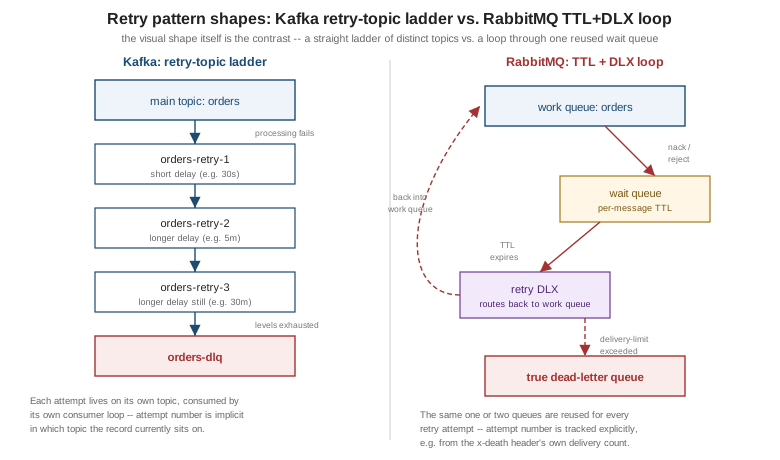
Both brokers need a way to give a failed message another chance, on a delay, before giving up on it entirely — but they build that behavior out of structurally different primitives, and the shapes are worth contrasting directly rather than treating "retry with backoff" as one universal mechanism.
Kafka has no built-in per-record delay or scheduling, so a delayed retry is built out of ordinary topics: a
failed record is produced onward to a retry topic instead of being reprocessed immediately, and a consumer of
that retry topic sleeps (or otherwise waits) for the desired backoff before processing it and, on failure,
forwards it again. The common refinement is a delay ladder: several retry topics
(orders-retry-1, orders-retry-2, orders-retry-3, …), each with a longer configured delay than the last, so
early attempts retry quickly and later attempts back off further, with a final DLQ topic at the end of the
ladder for records that exhaust every retry level. Kafka Connect's
errors.deadletterqueue.topic.name is the same DLQ idea applied specifically to a sink connector’s converter and
transform failures, not a general application-level retry ladder — it is the terminal topic a retry ladder like
this one would also feed into, not a substitute for the ladder itself.
RabbitMQ builds the equivalent delay out of TTL and dead-lettering instead of a chain of topics — RabbitMQ Reliability, Dead-Lettering and
TTL already covers that wait-queue-with-TTL-back-to-the-work-queue mechanism in full, including the exact queue
arguments, and is not repeated here. The structural difference is what matters for comparing the two: Kafka’s
retry ladder is a sequence of distinct topics, each processed by its own consumer loop, so "which attempt number
is this" is implicit in which topic the record currently sits on; RabbitMQ’s TTL+DLX approach is a loop through
the same one or two queues, where "which attempt number is this" has to be tracked explicitly (typically from the
x-death header’s count, as that page describes), because the same wait queue is reused for every retry level
rather than each level getting its own queue. Both converge on the same terminal state — a message that keeps
failing eventually lands in a true dead-letter topic or queue for manual inspection — but Kafka’s version scales
retry levels by adding topics, while RabbitMQ’s scales them by adding TTL/hop configuration to a loop that stays
structurally the same shape regardless of how many levels it represents.
Poison messages — a message that fails every attempt and would otherwise retry forever — are handled by a
built-in delivery-count cap on both brokers rather than needing to be detected by application logic.
Kafka Share Groups covers Kafka’s version: a share group’s
group.share.delivery.count.limit archives a record once it has been delivered that many times without an
ACCEPT, functioning as an automatic poison-message guard without a hand-built dead-letter topic. RabbitMQ’s
equivalent is a quorum queue’s delivery_limit, covered on
RabbitMQ Queue Types together with how exceeding it dead-letters
the message with reason delivery_limit, as
RabbitMQ Reliability, Dead-Lettering and
TTL lists among its four dead-lettering reasons. Neither mechanism is a replacement for the retry ladder or the
TTL+DLX loop above — it is the safety net underneath either one, bounding how many times a message can cycle
through that loop before the broker itself stops offering it for redelivery.
Ordering keys and hot partitions
Choosing how a message is keyed controls two things at once: whether related messages stay in order, and how evenly work spreads across consumers — and those two goals can pull in opposite directions. On Kafka, every record with the same key lands on the same partition (per Delivery Guarantees's ordering coverage), so a key that is supposed to guarantee ordering for, say, "all events for this customer" also concentrates every one of that customer’s events onto a single partition — if a handful of keys (a large customer, a popular product id) account for a disproportionate share of traffic, their partition becomes a hot partition: one consumer instance absorbs far more work than its peers while the rest of the consumer group sits comparatively idle, even though the topic overall is well provisioned. On RabbitMQ, the analogous skew shows up as a hot queue: a routing key (or binding pattern) that funnels a disproportionate share of messages into one queue overloads whichever consumer or consumers are attached to it, the same imbalance, one level up in the routing rather than the partitioning.
The practical mitigations are the same shape on both brokers. Better key selection — keying by something with
naturally higher cardinality and a flatter distribution (an order id instead of a customer id, if per-order rather
than per-customer ordering is actually what the consumer needs) — removes the skew at the source when the
domain allows it. Where ordering genuinely must be scoped coarser than the traffic distribution allows, salting
keys spreads a hot key across several partitions or queues on purpose: appending a bounded random or
round-robined suffix (customer-42#0, customer-42#1, … customer-42#7) turns one hot partition/queue into
several cooler ones, at the cost of only guaranteeing ordering within each salted sub-key rather than across the
whole original key — a tradeoff that is only acceptable when the consumer does not actually need strict ordering
across every event for that original key, only within a narrower grouping it can still reconstruct downstream.
Backpressure and consumer lag
Both brokers need a way to stop a fast producer from overwhelming a slow consumer, and both expose it as a
bounded window of outstanding, unprocessed work rather than an unbounded queue. On Kafka, that window is not
enforced by the broker at all — a consumer simply falls behind, and how far behind is measured as consumer
lag, the gap between a partition’s log-end offset and the group’s committed offset;
Kafka Operations and Monitoring covers lag in
detail, including the records-lag-max client metric and the operational alerting built around it. Lag is purely
observational on Kafka’s side — nothing stops a producer from continuing to publish while a consumer group falls
arbitrarily far behind, short of retention deleting data the group has not yet read. RabbitMQ, by contrast,
enforces backpressure directly at the broker: RabbitMQ Consuming's
prefetch (QoS) setting caps how many unacknowledged deliveries the broker will push to a given consumer before
pausing, and RabbitMQ Publishing's connection-level flow control
can block a publisher outright when the broker itself is under memory or disk pressure — both mechanisms actively
throttle one side of the pipeline rather than merely reporting how far it has fallen behind.
Correlation IDs and W3C Trace Context propagation
A correlation id ties together every message and service call that resulted from one originating request, so
logs and traces from different services can be joined back into a single end-to-end story — the correlation
identifier already appears in the Enterprise Integration Patterns catalogue on
Messaging Models and Patterns as a general messaging
concept. The interoperable, standardized way to carry that context is the
W3C Trace Context specification’s two fields: traceparent, which
carries a version, a 16-byte trace id, an 8-byte parent (span) id, and an 8-bit trace-flags byte as
dash-separated hex (for example 00-4bf92f3577b34da6a3ce929d0e0e4736-00f067aa0ba902b7-01), and tracestate,
an optional, vendor-extensible list of additional key-value trace state. Both are defined as HTTP headers in the
specification, but the same two field names and formats are what a tracing system propagates through any
transport, messaging included — the question for each broker is simply where those two values are attached to a
message.
On Kafka, traceparent and tracestate are carried as ordinary record headers — Kafka’s per-record
header list (already used elsewhere for metadata, as
Kafka Serialization and Schemas notes) is exactly
where an instrumented producer writes them before sending, and an instrumented consumer reads them back to
continue the same trace rather than starting a new one. On RabbitMQ, there is no reserved property for trace
context, so the same two values travel as entries in the message’s headers table (AMQP.BasicProperties.headers),
the general-purpose header map already used for routing metadata such as x-death — an instrumented publisher
sets traceparent/tracestate there, and an instrumented consumer reads them from the delivered message’s
properties. In both cases the propagation is manual unless a tracing/instrumentation library wires it in
automatically; the header names and value formats themselves are exactly what the W3C specification defines,
regardless of which broker’s header mechanism carries them.
Schema evolution across brokers
Kafka Serialization and Schemas already covers
schema registries and compatibility modes (BACKWARD, FORWARD, FULL) in depth for Kafka, where a schema
registry sits in front of the broker and can reject an incompatible schema change before a producer is even
allowed to publish it. The same compatibility-mode thinking applies just as well when RabbitMQ carries the
payload instead of Kafka — a message body is still Avro, Protobuf, or JSON Schema-encoded bytes, and adding an
optional field, never removing or repurposing a required one, and never changing a field’s type in place remain
exactly the same rules for keeping old and new consumers interoperable. What changes is only the enforcement
point: nothing in RabbitMQ itself validates a message body’s schema or blocks an incompatible publish the way a
schema-registry-backed Kafka producer can be configured to, so a schema registry used alongside RabbitMQ enforces
compatibility as an external, opt-in check the publisher and consumer both choose to call, rather than a
broker-enforced gate.
Saga choreography vs. orchestration
A saga coordinates a business transaction that spans several services, each committing its own local transaction, without a single distributed transaction across all of them — and there are two structurally different ways to sequence the steps.
Choreography has no central coordinator at all: each service publishes an event when it completes its own
step, and every other service that needs to react is simply subscribed to the events it cares about, deciding on
its own what to do next. On Kafka, this maps directly onto topics as an event bus — an order-created topic,
a payment-authorized topic, a shipment-scheduled topic, each published by the service that owns that step and
consumed by whichever downstream services react to it, with no service aware of the saga as a whole. On
RabbitMQ, the same shape is built from a topic exchange (or several) with each participating service both
publishing its own completion events and binding a queue to the events it reacts to — routing keys such as
order.created, payment.authorized standing in for Kafka’s topic names, per the routing patterns already
covered on RabbitMQ Routing Patterns.
Orchestration puts a central saga orchestrator in charge instead: it holds the saga’s state machine, issues explicit commands to each participant in turn, and reacts to each participant’s response by issuing the next command or triggering a compensating action if a step fails. On Kafka, the orchestrator is a service that consumes participants' reply/event topics and produces command records onto per-participant command topics, tracking saga state itself (often in a compacted topic, per the next section) rather than relying on any broker-side workflow feature. On RabbitMQ, the orchestrator instead publishes commands to per-participant command queues (typically via direct exchanges, since a command has exactly one intended recipient rather than many interested subscribers) and consumes each participant’s reply queue to decide the next step, using Messaging Models and Patterns's request/reply shape between the orchestrator and each participant rather than choreography’s fan-out of events. Choreography scales better with participant count, since adding a new reactive service costs nothing on the existing services, but makes the overall saga flow harder to see in one place; orchestration keeps the flow and its compensation logic centralized and easy to reason about, at the cost of the orchestrator becoming a coordination bottleneck and a single service that every participant now depends on. For the domain-model/consistency side of sagas — local transactions and compensating actions as an aggregate concern — see Sagas.
Event sourcing, CQRS, and why log compaction matters
Event sourcing stores every state change as an immutable event rather than overwriting a row in place, so a given entity’s current state is always derivable by replaying its events from the beginning; CQRS (Command Query Responsibility Segregation) pairs naturally with it by keeping the write side (append events) and the read side (one or more query-optimized projections built from those events) as separate models entirely, each scaled and shaped independently. On Kafka, the event log for a given entity is a natural fit for a topic keyed by entity id, and this is exactly where Kafka Architecture's log compaction coverage becomes relevant beyond its original changelog-topic use case: a compacted topic guarantees to retain at least the last known record for every key forever, which matters for event-sourced state specifically because an event-sourced topic is not really "the last value per key" the way a changelog topic is — it is the entire history of an entity that needs replaying to reconstruct current state. What compaction actually buys an event-sourced system is bounding storage, not replay semantics: without compaction, an infinitely append-only topic would need unbounded retention to preserve every entity’s full history, while with compaction, superseding a compactable "snapshot" event (or a per-entity tombstone, when the entity is deleted) lets Kafka reclaim space for entities that are no longer relevant without ever losing the ability to replay any entity’s still-relevant history. On RabbitMQ, there is no equivalent log-retention model to reach for — RabbitMQ’s queues are not durable logs with a replay/compaction story the way a Kafka topic is (streams come closest, but are still primarily consumed in delivery order rather than replayed from an arbitrary offset the way compaction assumes) — so an event-sourced system built on RabbitMQ instead persists its event log in a purpose-built event store (or an append-only database table) and uses RabbitMQ purely to notify interested projections that new events exist, rather than as the event log’s system of record. For the full treatment of each pattern, see Event Sourcing and CQRS.
The claim-check pattern for large payloads
A message carrying a large payload — a multi-megabyte document, an image, a bulk export — strains both brokers'
assumptions: Kafka’s default message.max.bytes/max.request.size and RabbitMQ’s practical throughput both
degrade well before a payload reaches tens of megabytes. The claim-check pattern sidesteps this by never
putting the large payload on the broker at all: the producer uploads it to out-of-band storage (typically object
storage such as S3 or an equivalent), then publishes a small message that carries only a claim check — a
reference (object key/URL, plus enough metadata to validate it) the consumer uses to fetch the payload separately,
by the time it actually needs it. On Kafka, this is a normal record whose value is a small JSON or Avro
envelope holding the object storage key rather than the payload itself, produced and consumed exactly like any
other record covered on Kafka Producers and
Kafka Consumers. On RabbitMQ, the same envelope travels as an
ordinary message body through whichever exchange and queue would otherwise have carried the full payload,
unchanged in every other respect — the pattern’s implementation is essentially identical on both brokers, since
its whole point is to keep the broker out of the large-payload business entirely, regardless of which broker is in
use.
The outbox pattern end to end
The sequence below ties the transactional-outbox section above together as one flow: the application writes its business row and its outbox row in a single local transaction, a relay process (a CDC connector, or a polling publisher) reads the outbox table independently of that request, publishes the event to the broker, and only then marks the outbox row as sent.
The figure below contrasts the two brokers' retry structures side by side: Kafka’s retry-topic ladder, a sequence of distinct topics with growing delay, versus RabbitMQ’s TTL+DLX loop, the same wait queue reused across every retry attempt.
A worked example of these patterns for media jobs (idempotent workers, retries with backoff, dead-letter queues and status tracking) is in Upload Pipelines, Queues and Jobs.