Versions & Release History
|
This content was generated with the assistance of AI and should be verified against the official documentation before being relied on in production. The reference material consulted while preparing these pages is listed in the Python Reference bibliography. |
This page summarises how pip is released and what changed between the 20.3 resolver release and 26.2.2 (2026-10-20), the release this section is written against. Each change links to the page that explains it. Dates are those of the pip changelog; the upload dates on PyPI differ by one day for 22.0 (2022-01-30 on PyPI), 25.3 (2025-10-25), 26.0 (2026-01-31) and 26.0.1 (2026-02-05).
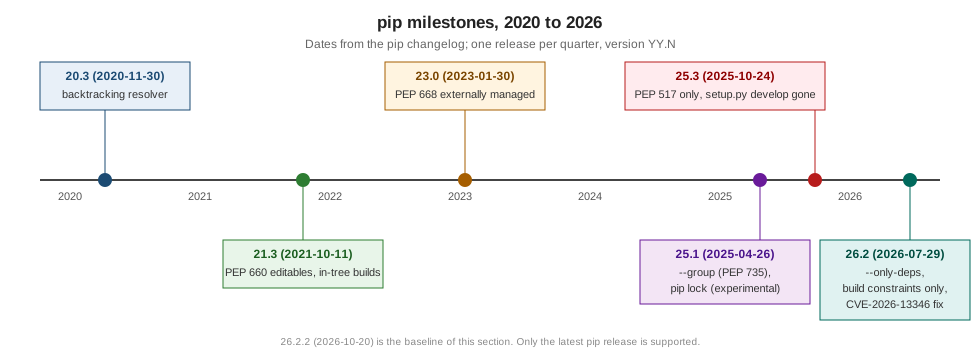
How pip is released
-
Cadence. pip releases whatever is on its main branch every three months, in January, April, July and October; a month with no changes is skipped. Bug-fix releases (
26.2.1,26.2.2) come in between when needed. -
Version numbers are
YY.N: the two-digit year and the release’s number within that year, starting at 0. 26.0 was January 2026, 26.2 July 2026. They are not semantic versions: a.0is not a "major" release. -
Supported versions. "The latest version of the pip is the only supported version." Upgrade pip in every environment you maintain; see Installing & Upgrading pip.
-
Python support. pip supports the CPython versions that are not end-of-life, and may keep older ones at the maintainers' discretion. pip 26.2.2 runs on CPython 3.10 to 3.15 and the latest PyPy3. Python 3.10 reached end of life on 2026-10-01 but is still listed. Pip 20.3 was the last release for Python 2.
Source: pip: Release cadence, pip: Supported versions, pip: Python support policy, Python developer’s guide: Status of Python versions.
When pip dropped each Python
| Python | Last pip that supports it |
|---|---|
2.7, 3.5 |
20.3.4 (dropped in 21.0) |
3.6 |
21.3.1 (dropped in 22.0) |
3.7 |
24.0 (dropped in 24.1) |
3.8 |
25.0.1 (dropped in 25.1) |
3.9 |
26.0.1 (dropped in 26.1) |
(The last releases are read from each release’s requires_python on PyPI.) An old interpreter keeps working with the last pip
that supported it, because pip’s Requires-Python makes the resolver pick that
version: python3.9 -m pip install --upgrade pip installs pip 26.0.1, not 26.2.2.
The deprecation policy and feature flags
Any change that removes or significantly alters user-visible behaviour described in the documentation is deprecated for at least six months first, with a warning when the feature is used. Two pip team members can fast-track a change to three months if no maintainer objects. Behaviour that is not documented can change without notice. Two flags carry features through this process:
-
--use-feature=<name>lets you try new behaviour before it becomes the default. After it becomes the default the flag may stay, with a warning that it is no longer needed (astruststoreandbuild-constraintdo in 26.2.2). -
--use-deprecated=<name>keeps old behaviour for a while after the default changed (legacy-resolver,legacy-certs). It must warn when the feature will be removed, and once it is removed the flag is an error.
The valid names in 26.2.2 are listed on
Running pip & General Options. The resolver
switch is the textbook case: an alpha behind --unstable-feature=resolver in 20.1, a beta behind --use-feature=2020-resolver in
20.2, the default with --use-deprecated=legacy-resolver as the way out in 20.3, and "no longer supported" from 21.0.
Release by release
| Release (date) | Changes | Explained on |
|---|---|---|
20.3 (2020-11-30) |
New backtracking resolver by default; |
|
21.0 (2021-01-23) |
Python 2 and 3.5 dropped. |
|
21.2 (2021-07-24) |
|
|
21.3 (2021-10-11) |
PEP 660 editable installs; in-tree builds by default; the sysconfig install scheme on Python 3.10+; Git partial clones. |
|
22.0 (2022-01-29) |
Python 3.6 dropped; Rich-based error output. |
|
22.1 (2022-05-11) |
The out-of-tree build option removed; config settings passed to backends. |
|
22.2 (2022-07-21) |
|
|
22.3 (2022-10-15) |
|
|
23.0 (2023-01-30) |
PEP 668 |
|
23.0.1 (2023-02-17) |
|
|
23.1 (2023-04-15) |
|
|
23.2 (2023-07-15) |
Legacy (non-PEP 440) versions deprecated; on Python 3.12+ |
|
23.3 (2023-10-15) |
The |
|
24.1 (2024-06-20) |
Python 3.7 dropped; legacy versions and specifiers removed. |
|
24.2 (2024-07-28) |
System certificates (truststore) by default on Python 3.10+, |
|
24.3 (2024-10-27) |
iOS wheel support. |
|
25.0 (2025-01-26) |
PEP 639 licence fields in |
|
25.1 (2025-04-26) |
Python 3.8 dropped; |
|
25.2 (2025-07-30) |
Python 3.14 support; automatic resume and retry of downloads; |
|
25.3 (2025-10-24) |
|
|
26.0 (2026-01-30) |
|
|
26.1 (2026-04-26) |
Python 3.9 dropped; experimental |
|
26.2 (2026-07-29) |
Python 3.15 support; |
|
26.2.1 (2026-08-04) |
Keyring |
|
26.2.2 (2026-10-20) |
certifi upgraded to 2026.10.19. |
Source: pip changelog.
Upgrade checklist for older projects
If a project was last touched before 2024, check these before moving its CI to pip 26.2.2:
-
setup.py developeditables. Since 25.3pip install -e .needs a backend with PEP 660 support. For setuptools, requiresetuptools>=64in[build-system] requires. -
--global-option,--build-option,--install-option. Removed. Use--config-settingswith the setting your backend documents, or move the configuration intopyproject.toml. -
--no-use-pep517,setup.py installfallbacks. Removed. A project with onlysetup.pystill builds, throughsetuptools.build_meta:__legacy__. -
--use-deprecated=legacy-resolver. Deprecated and unsupported. Fix the conflict it hides; see Dependency Resolution. -
Non-PEP 440 versions of your own or your dependencies' packages (
1.0-final). Ignored since 24.1. -
PIP_CONSTRAINTused to pin build dependencies. Ignored by builds since 26.2; usePIP_BUILD_CONSTRAINT. -
#egg=name[extra]fragments. Only bare names since 26.0; usename[extra] @ url. -
Custom CA bundles. Since 24.2 pip trusts the system store; a
PIP_CERTthat was only a workaround can probably go. -
Installing into a distribution Python. Since 23.0 PEP 668 blocks it; use a venv.
-
The Python version. 3.9 and older need an older pip; plan the interpreter upgrade.