Async HTTP Client
|
This content was generated with the assistance of AI and should be verified against the official documentation before being relied on in production. The reference material consulted while preparing these pages is listed in the section bibliography. |
This page is written against Tornado 6.5.10 on Python 3.13, checked on 2026-10-07. Tornado 6.6 is only available as an
alpha (6.6a1) at the time of writing, so everything described as "6.6" below is upcoming and may still change. Every
runnable example on this page was executed with those versions, always against a throw-away server bound to a loopback
port (or through AsyncHTTPTestCase): the "external" cover-metadata service of the Bookshelf Live scenario is a small
local fake, and no example touches the network. The two examples that need pycurl or an HTTP proxy are shown but not
run, and are marked as such.
An application that serves requests will sooner or later have to make requests: Bookshelf Live asks a cover-metadata
service for the cover of each book, calls an OAuth provider, posts a webhook when a loan is created. Tornado ships its
own non-blocking HTTP client for this, tornado.httpclient.AsyncHTTPClient, built on the same event loop as the server
(see Asynchronous I/O & the Event Loop). Because
fetch() returns an awaitable, a handler that calls an upstream service does not block other requests while it waits,
and several upstream calls can be overlapped with asyncio.gather (see
Coroutines & asyncio). The client is deliberately small: it has no
cookie jar, no connection pool and no retry logic, which is the main thing to weigh against HTTPX and aiohttp (the
comparison is at the end of the page).
For the Flask counterpart, where outgoing calls are usually made with a blocking library such as requests, see
Flask: Async, gevent & Quart; for FastAPI, which leaves the choice of
client to you, see FastAPI. The Tornado pages WebSockets, Streaming, Long Polling & SSE
and TCP Servers, IOStream & Low-level Networking cover those topics.
How a Fetch Travels
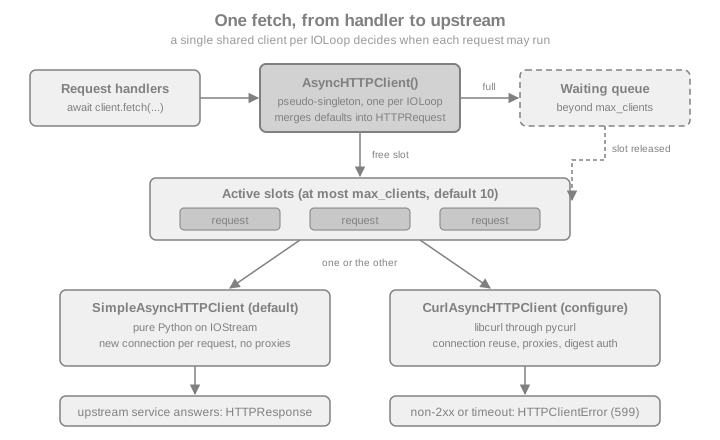
AsyncHTTPClient is a facade. Calling AsyncHTTPClient() does not create an instance of that class: it returns an
instance of an implementation subclass, SimpleAsyncHTTPClient by default, which is written in pure Python on top of
Tornado’s IOStream, or CurlAsyncHTTPClient, which delegates to libcurl through the optional pycurl package. The
facade also owns the two pieces of policy that are the same for both: the defaults applied to every request and the
max_clients limit on how many fetches run at once on one event loop. A fetch that arrives when the limit is reached
waits in a queue.
Source: Tornado: tornado.httpclient
The Fixture: a Fake Cover Service
The examples share one fixture, in the same style as the other Tornado pages: a fake upstream bound to an unused loopback port. Besides the cover lookups used elsewhere in the section it has a handful of routes that exist only to demonstrate client behaviour (redirects, status codes, a chunked download, an upload sink and a header echo).
import asyncio
import contextlib
import time

from tornado import gen, httpclient, httpserver, ioloop, netutil, web
from tornado.escape import json_decode, json_encode


class CoverHandler(web.RequestHandler):
    async def get(self, isbn):
        try:
            default_delay = "3" if isbn.startswith("slow") else "0.05"
            await gen.sleep(float(self.get_query_argument("delay", default_delay)))
        except asyncio.CancelledError:
            return  # the client gave up: nothing left to answer
        if isbn.startswith("bad"):
            raise web.HTTPError(502, reason="upstream failure")
        self.write({"isbn": isbn, "cover_url": f"https://covers.example/{isbn}.jpg"})


class StatusHandler(web.RequestHandler):
    def get(self, code):
        self.set_status(int(code))
        self.write({"status": int(code)})


class MovedHandler(web.RequestHandler):
    def get(self):
        self.redirect("/covers/moved-978-0")


class EchoHeadersHandler(web.RequestHandler):
    def get(self):
        self.write({k.lower(): v for k, v in self.request.headers.get_all()})


class ChunkHandler(web.RequestHandler):
    async def get(self):
        self.set_header("X-Total-Chunks", "3")
        for i in range(3):
            self.write(f"chunk-{i};")
            await self.flush()


class UploadHandler(web.RequestHandler):
    def post(self):
        self.write({"received": len(self.request.body), "type": self.request.headers.get("Content-Type")})


def make_upstream():
    return web.Application(
        [
            (r"/covers/([^/]+)", CoverHandler),
            (r"/status/(\d+)", StatusHandler),
            (r"/moved", MovedHandler),
            (r"/headers", EchoHeadersHandler),
            (r"/chunks", ChunkHandler),
            (r"/upload", UploadHandler),
        ]
    )


@contextlib.asynccontextmanager
async def fake_upstream():
    sockets = netutil.bind_sockets(0, address="127.0.0.1")
    server = httpserver.HTTPServer(make_upstream())
    server.add_sockets(sockets)
    port = sockets[0].getsockname()[1]
    try:
        yield f"http://127.0.0.1:{port}"
    finally:
        server.stop()
        await server.close_all_connections()
Source: Tornado: tornado.web
Fetching and Reading the Response
fetch() accepts either a URL string, in which case extra keyword arguments become HTTPRequest arguments, or a
ready-made HTTPRequest (in which case extra keyword arguments are rejected with ValueError). It returns a future
for an HTTPResponse. The response carries code, reason, headers (a tornado.httputil.HTTPHeaders), body (bytes,
built on demand from buffer), effective_url (the final URL after redirects), request_time (seconds from the start
of the request to the last byte, excluding queueing) and error.
async def demo_basic():
    async with fake_upstream() as base:
        client = httpclient.AsyncHTTPClient()
        response = await client.fetch(f"{base}/covers/978-0-13-468599-1")
        data = json_decode(response.body)
        print(response.code, response.reason, data["cover_url"])
        print(response.headers["Content-Type"], response.effective_url == f"{base}/covers/978-0-13-468599-1")
        print("fast enough:", response.request_time < 1.0)

        # string URL + kwargs, or an HTTPRequest object (but not both)
        request = httpclient.HTTPRequest(f"{base}/headers", headers={"X-Request-Id": "req-42"})
        echoed = json_decode((await client.fetch(request)).body)
        print(echoed["x-request-id"])
        try:
            await client.fetch(request, request_timeout=1)
        except ValueError as exc:
            print("ValueError:", exc)


asyncio.run(demo_basic())
Source: Tornado: AsyncHTTPClient.fetch
Since Tornado 6.0 fetch() returns only a future; the old callback= argument was removed.
The Pseudo-Singleton, force_instance, max_clients and defaults
The documentation describes the constructor as magic: instances are reused as a kind of pseudo-singleton, one per
IOLoop`. `AsyncHTTPClient() called twice on the same loop returns the same object, which is what you usually want:
the object holds the queue and the limit, so one shared instance is how max_clients is enforced across the whole
application. The pitfalls follow from that.
-
Constructor arguments are not meant to be used on the shared instance. The documentation says that unless
force_instance=Trueis used, no arguments should be passed to theAsyncHTTPClientconstructor: a later call returns the instance that already exists, so its arguments could not apply anyway. The implementation class and the arguments of its constructor (max_clients,defaults…) are set once, at start-up, withconfigure(). -
force_instance=Truecreates a private instance that does not share the queue, the limit or the defaults, and that accepts thedefaultsargument directly. It is the caller’s job toclose()it. It exists mostly for tests and for code that needs different defaults or a differentmax_clientsthan the rest of the process. -
One per loop also means that a client created on one
IOLoopis not usable from another; every thread that runs its own loop gets its own instance.
The module-level knob is the classmethod AsyncHTTPClient.configure(impl, **kwargs): impl is a class, its dotted
name, or None for the default SimpleAsyncHTTPClient, and the keyword arguments are passed to the constructor of
every instance created from then on, max_clients and defaults among them. Call it once, before the first
AsyncHTTPClient().
async def demo_singleton():
    a = httpclient.AsyncHTTPClient()
    b = httpclient.AsyncHTTPClient()
    private = httpclient.AsyncHTTPClient(force_instance=True, defaults=dict(user_agent="bookshelf-batch/1.0"))
    print(a is b, a is private, type(a).__name__)
    print(a.defaults["request_timeout"], private.defaults["user_agent"])
    private.close()


asyncio.run(demo_singleton())
Source: Tornado: AsyncHTTPClient
The built-in defaults of an HTTPRequest are 20 seconds for both connect_timeout and request_timeout,
follow_redirects=True, max_redirects=5, decompress_response=True and validate_cert=True. Anything you put in
defaults is merged over those, and anything set on a request wins over the defaults. Here is the application’s
start-up configuration for Bookshelf Live: a shorter timeout and a user agent that identifies the service, a lower
max_clients than the default of 10, and one fetch that overrides a default.
httpclient.AsyncHTTPClient.configure(
    None,  # SimpleAsyncHTTPClient, the default
    max_clients=2,
    defaults=dict(request_timeout=5.0, user_agent="bookshelf-live/1.0"),
)


async def demo_defaults_and_limit():
    async with fake_upstream() as base:
        client = httpclient.AsyncHTTPClient()
        print(client.max_clients, client.defaults["request_timeout"])
        sent = json_decode((await client.fetch(f"{base}/headers")).body)
        print(sent["user-agent"])
        sent = json_decode((await client.fetch(f"{base}/headers", user_agent="one-off/2.0")).body)
        print(sent["user-agent"])

        # four requests of about 0.3 s each, but only two run at a time
        started = time.perf_counter()
        responses = await asyncio.gather(
            *(client.fetch(f"{base}/covers/book-{i}?delay=0.3") for i in range(4))
        )
        elapsed = time.perf_counter() - started
        print(f"4 fetches with max_clients=2 took {elapsed:.1f}s")
        print("each request itself took", [round(r.request_time, 1) for r in responses], "(queueing excluded)")


asyncio.run(demo_defaults_and_limit())With max_clients=2 the four 0.3 second fetches take about 0.6 seconds in total: the second pair waited for a slot,
while the request_time of each response stays near 0.3 to 0.4 seconds because it does not include the time spent in the queue. The
time_info dictionary of a response is filled in only by the curl implementation (libcurl timings, plus the queue
delay); with the simple client it is empty, so measure queueing with a stopwatch around the fetch.
The limit has one sharp edge. A request that is still waiting in the queue is subject to a timeout too: the
SimpleAsyncHTTPClient starts a timer of the smaller of connect_timeout and request_timeout when the request is
queued, and a request that has not got a slot by then fails with the same 599 timeout error as a slow upstream,
reporting that it timed out "in request queue". A burst of requests bigger than max_clients times the timeout allows
therefore fails even though the upstream was never slow. Size max_clients for the expected concurrency, and bound
the number of in-flight fetches yourself (with a semaphore, see below) when a burst is possible.
Errors: raise_error and HTTPClientError
By default fetch() raises for any non-2xx outcome, and for transport failures:
-
An
HTTPClientError(tornado.httpclient.HTTPClientError, still importable under its old nametornado.httpclient.HTTPError, which was renamed in Tornado 5.1 to avoid a clash withtornado.web.HTTPError) carriescode(the HTTP status, or 599 when no response was received),messageandresponse(theHTTPResponse, orNone). Itsstr()isHTTP 404: Not Found. -
A timeout is an
HTTPTimeoutErrorfromtornado.simple_httpclient, a subclass ofHTTPClientErrorwith code 599 and no response. A connection dropped mid-response is anHTTPStreamClosedError, also with code 599. -
A refused connection or an unresolvable name surfaces as the underlying exception (
ConnectionRefusedError,socket.gaierror,ssl.SSLError…), not as anHTTPClientError.
raise_error=False changes only the first case: a response with a non-2xx code is returned instead of raised, and
response.error still describes it. Timeouts and connection errors are raised regardless (the behaviour changed in
Tornado 6.0; before that raise_error=False suppressed every error). A 3xx response that is not followed (for
example with follow_redirects=False) also counts as an error response.
async def demo_errors():
    async with fake_upstream() as base:
        client = httpclient.AsyncHTTPClient()

        try:
            await client.fetch(f"{base}/status/404")
        except httpclient.HTTPClientError as exc:
            print(exc, "| code", exc.code, "| body", exc.response.body)

        response = await client.fetch(f"{base}/status/503", raise_error=False)
        print(response.code, type(response.error).__name__, response.error)

        try:
            await client.fetch(f"{base}/covers/slow?delay=2", request_timeout=0.2, raise_error=False)
        except httpclient.HTTPClientError as exc:
            print("timeout:", type(exc).__name__, exc.code, exc.response)

        try:
            await client.fetch("http://127.0.0.1:1/")
        except OSError as exc:
            print("transport:", type(exc).__name__)


asyncio.run(demo_errors())
Source: Tornado: httpclient exceptions
A handler should translate these errors rather than let them become a 500: a timeout of an upstream is a 504 for the
caller, an upstream error status is a 502, and a refused connection is a 502 or 503. The section on handlers below does
that, and Error Handling shows where such a mapping belongs in the
write_error pipeline.
HTTPRequest Options
Every keyword of fetch() is an HTTPRequest argument; the table groups them. Only url is required.
| Option | Meaning | Notes |
|---|---|---|
|
HTTP method (default |
|
|
HTTP authentication. |
|
|
Seconds for the TCP/TLS connection and for the whole request. Default 20; |
|
|
Follow 301, 302, 303, 307 and 308 up to |
With |
|
Adds an |
A 304 response is an error unless |
|
Value of the |
The simple client sends |
|
Ask for |
|
|
TLS verification and client certificates. |
|
|
Receive body chunks and header lines as they arrive, instead of buffering. |
|
|
Send a body lazily; wait for |
Simple client only. Pass a |
|
Send the request through an HTTP proxy. |
curl only. The simple client raises |
|
Source address or interface; a hook that receives the |
|
|
Accept methods outside the standard list and the body/method combinations mentioned above. |
Default |
Source: Tornado: HTTPRequest
Redirects, authentication and a JSON POST are the options used daily. The example below follows the redirect from the
fake service, then shows that with follow_redirects=False the response is an error response whose Location header
tells where it pointed, and finally posts JSON the way a webhook sender would. Header names in an HTTPHeaders are
case-insensitive.
import base64
import secrets


async def demo_request_options():
    async with fake_upstream() as base:
        client = httpclient.AsyncHTTPClient()

        followed = await client.fetch(f"{base}/moved")
        print(followed.code, followed.effective_url.replace(base, ""))

        raw = await client.fetch(f"{base}/moved", follow_redirects=False, raise_error=False)
        print(raw.code, raw.headers["Location"])

        # Basic authentication sends an Authorization header
        password = secrets.token_hex(8)  # in production: read it from the environment or a secrets store
        sent = json_decode(
            (await client.fetch(f"{base}/headers", auth_username="bookshelf", auth_password=password)).body
        )
        print(base64.b64decode(sent["authorization"].split()[1]).decode().split(":")[0])

        # POST a JSON document
        reply = await client.fetch(
            f"{base}/upload",
            method="POST",
            headers={"Content-Type": "application/json"},
            body=json_encode({"event": "loan.created", "isbn": "978-0-13-468599-1"}),
        )
        print(json_decode(reply.body))


asyncio.run(demo_request_options())
Source: Tornado: HTTPRequest
The password above is generated on the spot for the demonstration. In a real application read credentials and API tokens from the environment or a
secrets store, for example os.environ["COVERS_API_TOKEN"], and send them in an Authorization header you build.
For HTTPS, certificate validation is on by default and validate_cert=False turns it off. Do not use it outside a
throw-away experiment. To trust a private CA, give the request a ca_certs file (PEM) or, with the simple client, an
ssl.SSLContext built with ssl.create_default_context(cafile=...). A client certificate for mutual TLS is
client_cert plus client_key, or an SSLContext loaded with load_cert_chain().
import ssl


def tls_request_for_internal_api():
    context = ssl.create_default_context()  # verifies against the system trust store
    context.minimum_version = ssl.TLSVersion.TLSv1_2
    # context.load_verify_locations(cafile="/etc/bookshelf/internal-ca.pem")
    # context.load_cert_chain("/etc/bookshelf/client.pem", "/etc/bookshelf/client.key")
    return httpclient.HTTPRequest("https://covers.internal.example/v1/covers/1", ssl_options=context)


request = tls_request_for_internal_api()
print(request.url, type(request.ssl_options).__name__)
Source: Tornado: HTTPRequest
Streaming Downloads and Uploads
By default the whole response body is held in memory and fetch() returns it in response.body. Two limits bound
that: max_buffer_size (default 100 MB) for how much is read into memory at once, and max_body_size, the largest body
accepted, which defaults to max_buffer_size and is a constructor argument of the implementation, passed through
configure(). A body above the limit fails the fetch instead of exhausting memory. To handle large downloads, give
streaming_callback a function that receives each chunk as it arrives; with it only max_body_size applies, and the
final HTTPResponse has an empty body. header_callback receives each header line, including the status line and the
terminating blank line, and is the only way to see headers while a streamed transfer is still running. Both callbacks
are ordinary functions, not coroutines: a callback must not block, and anything slow belongs in a queue it feeds (see
Queues & Locks).
async def demo_streaming_download():
    async with fake_upstream() as base:
        client = httpclient.AsyncHTTPClient()
        chunks, header_lines = [], []
        response = await client.fetch(
            f"{base}/chunks",
            streaming_callback=chunks.append,
            header_callback=header_lines.append,
        )
        print(b"".join(chunks).decode(), len(response.body))
        print(header_lines[0].strip(), "|", [h.strip() for h in header_lines if h.startswith("X-Total")])


asyncio.run(demo_streaming_download())For uploads, body_producer is called with a write function and must return a future. The producer calls write()
with each piece, awaits the future that write() returns for flow control (the client does not read ahead of what the
socket accepts), and finishes by returning. Provide Content-Length when you know it, because chunked request bodies
are rejected by many servers. body_producer is not supported by the curl implementation, and cannot be combined with
body.
async def demo_streaming_upload():
    async with fake_upstream() as base:
        client = httpclient.AsyncHTTPClient()
        pieces = [b"%PDF-1.7 " + b"x" * 1000 for _ in range(3)]

        async def producer(write):
            for piece in pieces:
                await write(piece)  # awaiting gives flow control

        reply = await client.fetch(
            f"{base}/upload",
            method="POST",
            headers={"Content-Type": "application/pdf", "Content-Length": str(sum(map(len, pieces)))},
            body_producer=producer,
        )
        print(json_decode(reply.body))


asyncio.run(demo_streaming_upload())The server side of the same problem (receiving a large upload without buffering it) is stream_request_body, covered
in Streaming, Long Polling & SSE.
Concurrent Fetches
Because fetch() returns a future, several fetches are overlapped by awaiting them together. asyncio.gather returns
the results in order and raises the first exception; with return_exceptions=True it returns exceptions as values so
one failing lookup does not discard the others. Tornado’s own tornado.gen.multi is the equivalent. Remember that a
global max_clients still limits the real parallelism, and that a Semaphore (from tornado.locks or asyncio) is the
way to bound a loop of fetches to a limit smaller than the client’s own.
from tornado import locks


async def fetch_cover(client, base, isbn):
    response = await client.fetch(f"{base}/covers/{isbn}", request_timeout=2)
    return json_decode(response.body)["cover_url"]


async def demo_gather():
    async with fake_upstream() as base:
        client = httpclient.AsyncHTTPClient(force_instance=True, max_clients=10)
        isbns = ["978-0-13-468599-1", "bad-978-0-00", "978-1-49-195-0"]

        started = time.perf_counter()
        results = await asyncio.gather(*(fetch_cover(client, base, i) for i in isbns), return_exceptions=True)
        print(f"{time.perf_counter() - started:.2f}s", [r if isinstance(r, str) else f"error {r.code}" for r in results])

        # bound a large batch to 3 simultaneous upstream calls
        gate = locks.Semaphore(3)

        async def limited(isbn):
            async with gate:
                return await fetch_cover(client, base, isbn)

        covers = await asyncio.gather(*(limited(f"book-{n}") for n in range(12)))
        print(len(covers), "covers fetched")
        client.close()


asyncio.run(demo_gather())
Source: Tornado: Coroutines, parallelism
There is no retry or backoff in the client. A retry loop is a few lines around fetch(); retry only idempotent
requests (GET, PUT, DELETE) and only on timeouts, connection errors and 502, 503 and 504, with a bounded number
of attempts, exponential delay and jitter, because retrying a POST that may already have been processed duplicates its
effect.
Calling an Upstream from a Handler
The shape that matters in a real application: one shared client, a short timeout, upstream failures translated to the
status a caller should see, and the result written as JSON. The handler below returns the cover for a book. It maps an
upstream timeout to 504 and any other upstream failure to 502, and the test drives it through AsyncHTTPTestCase, the
class from tornado.testing that starts the application on a loopback port; its own fetch() is the test’s client
and, unlike the production one, returns error responses instead of raising.
import unittest

from tornado.testing import AsyncHTTPTestCase


class BookCoverHandler(web.RequestHandler):
    async def get(self, isbn):
        upstream = self.settings["covers_url"]
        client = httpclient.AsyncHTTPClient()
        try:
            response = await client.fetch(f"{upstream}/covers/{isbn}", request_timeout=0.5)
        except httpclient.HTTPClientError as exc:
            if exc.code == 599:
                raise web.HTTPError(504, reason="cover service timed out") from exc
            raise web.HTTPError(502, reason="cover service failed") from exc
        except OSError as exc:
            raise web.HTTPError(502, reason="cover service unreachable") from exc
        self.write({"isbn": isbn, "cover": json_decode(response.body)["cover_url"]})


class BookCoverTest(AsyncHTTPTestCase):
    def get_app(self):
        # the fake upstream is served by the same test server, under /up
        app = web.Application(
            [(r"/books/([^/]+)/cover", BookCoverHandler), (r"/up/covers/([^/]+)", CoverHandler)],
            covers_url=f"http://127.0.0.1:{self.get_http_port()}/up",
        )
        return app

    def test_cover(self):
        response = self.fetch("/books/978-0-13-468599-1/cover")
        self.assertEqual(response.code, 200)
        self.assertEqual(json_decode(response.body)["isbn"], "978-0-13-468599-1")

    def test_upstream_error_is_502(self):
        self.assertEqual(self.fetch("/books/bad-1/cover").code, 502)

    def test_upstream_timeout_is_504(self):
        self.assertEqual(self.fetch("/books/slow-1/cover").code, 504)


import logging

# the tests provoke 502 and 504 on purpose: keep the log quiet
logging.getLogger("tornado.access").setLevel(logging.CRITICAL)
logging.getLogger("tornado.application").setLevel(logging.CRITICAL)
suite = unittest.defaultTestLoader.loadTestsFromTestCase(BookCoverTest)
result = unittest.TextTestRunner(verbosity=0).run(suite)
assert result.wasSuccessful()
Source: Tornado: tornado.testing
Implementations: Simple and curl
| Feature | SimpleAsyncHTTPClient (default) |
CurlAsyncHTTPClient |
|---|---|---|
Implementation |
Pure Python on |
|
Connection reuse |
None: every request sends |
libcurl reuses connections. |
HTTP proxies |
Not supported ( |
|
Authentication modes |
|
|
|
Supported. |
Not supported. |
|
Not available. |
Supported. |
Minimum version note |
None. |
The 6.6 alpha raises the minimum supported libcurl to 7.81 (the version shipped with Ubuntu 22.04); this is upcoming. |
Because the simple client opens a connection per request, a service that makes many small calls to the same host pays for DNS, TCP and TLS each time. Either put a connection-reusing proxy in front of the upstream, switch to the curl implementation, or use a client with pooling (see the comparison below).
Switching to curl is a configure() call before the first client is created; the same call can set max_clients
(which sizes the pool of curl handles) and defaults. Proxies are then per request or in defaults:
# norun -- needs the optional pycurl package (pip install pycurl) and a real proxy
from tornado import httpclient

httpclient.AsyncHTTPClient.configure(
    "tornado.curl_httpclient.CurlAsyncHTTPClient",
    max_clients=20,
    defaults=dict(proxy_host="proxy.internal.example", proxy_port=3128),
)


async def fetch_through_proxy():
    client = httpclient.AsyncHTTPClient()  # a CurlAsyncHTTPClient
    # per-request override, with proxy credentials read from the environment
    return await client.fetch("https://covers.example/v1/isbn/1", proxy_host="proxy.internal.example", proxy_port=3128)
Source: Tornado: proxy options
The simple client reports the unsupported option loudly, which is a useful safety net:
async def demo_proxy_on_simple_client():
    httpclient.AsyncHTTPClient.configure(None)
    async with fake_upstream() as base:
        client = httpclient.AsyncHTTPClient(force_instance=True)
        try:
            await client.fetch(f"{base}/headers", proxy_host="127.0.0.1", proxy_port=3128)
        except NotImplementedError as exc:
            print("NotImplementedError:", exc)
        client.close()


asyncio.run(demo_proxy_on_simple_client())Some deployments use the standard proxy environment variables (HTTP_PROXY, HTTPS_PROXY, NO_PROXY). Tornado’s
client does not read them; the application must map them onto proxy_host and proxy_port itself (with curl), which
is one reason a deployment behind a mandatory proxy often chooses the curl implementation.
The Synchronous HTTPClient
tornado.httpclient.HTTPClient is a blocking facade, useful in scripts, management commands and tests. It creates a
private IOLoop, runs the asynchronous client on it with run_sync(), and returns the response. Since Tornado 5.0 it
cannot be used while an IOLoop is running in the same thread, because asyncio forbids nested loops: constructing it
inside a coroutine or a handler fails with RuntimeError ("Cannot run the event loop while another loop is running").
Inside a handler always use AsyncHTTPClient; calling a blocking HTTPClient there would also stall the whole loop even
if it were permitted. Call close() when you are done.
import threading


def run_upstream_in_thread():
    """Run the fake upstream on its own loop in a worker thread; return (base_url, stop)."""
    ready = threading.Event()
    state = {}

    def target():
        async def main():
            async with fake_upstream() as base:
                state["base"], state["stop"] = base, asyncio.Event()
                state["loop"] = asyncio.get_running_loop()
                ready.set()
                await state["stop"].wait()

        asyncio.run(main())

    thread = threading.Thread(target=target, daemon=True)
    thread.start()
    ready.wait(5)
    return state["base"], lambda: (state["loop"].call_soon_threadsafe(state["stop"].set), thread.join(5))


base, stop = run_upstream_in_thread()
sync_client = httpclient.HTTPClient()
try:
    print(sync_client.fetch(f"{base}/covers/978-0-13-468599-1").code)
    try:
        sync_client.fetch(f"{base}/status/404")
    except httpclient.HTTPClientError as exc:
        print("raised:", exc)
finally:
    sync_client.close()
    stop()


async def sync_client_inside_a_loop():
    try:
        httpclient.HTTPClient()
    except RuntimeError as exc:
        print("RuntimeError:", exc)


asyncio.run(sync_client_inside_a_loop())
Source: Tornado: HTTPClient
The module can also be run as a command, which uses the synchronous client: python -m tornado.httpclient URL prints
the body, --print_headers prints the headers too, and --follow_redirects, --validate_cert, --proxy_host and
--proxy_port are available.
python -m tornado.httpclient --print_headers --print_body=false http://localhost:8888/books/1/coverSecurity
-
Server-side request forgery. An endpoint that fetches a URL supplied by a user (a cover URL, a webhook target, an avatar) lets the caller reach internal addresses such as
127.0.0.1,169.254.169.254or cluster services. Parse the URL, requirehttps, check the host against an allow-list, resolve it yourself and refuse private, loopback and link-local addresses, and setfollow_redirects=Falseor validate each hop, because a redirect can lead from an allowed host to an internal one. Resolving and then connecting is still racy (DNS rebinding); the allow-list of hosts is the strong control, and network egress rules are the backstop. -
Never disable certificate validation. Use
ca_certsor anSSLContextfor private CAs. -
Credentials on redirects. Since Tornado 6.5.6
SimpleAsyncHTTPClientstrips theAuthorizationandCookieheaders when a redirect leads to a different origin, which is what curl already did; if you need different behaviour, setfollow_redirects=Falseand handle the redirect yourself. Applications on older versions leaked these headers. -
Bound the response. Keep
max_body_sizeandrequest_timeoutat values that match the upstream’s contract. Tornado 6.5.6 (simple) and 6.5.9 (curl) apply the limit to the decompressed size, which blocks decompression bombs; older versions applied it to the compressed size. -
Header injection. CR and LF in a header value are rejected since 6.4.1, but build headers from validated values anyway, never from raw user input.
-
Secrets. Keep tokens in the environment or a secrets store, never in the URL query string (URLs end up in logs), and do not log full request URLs or
Authorizationheaders. -
Timeouts are not optional. The 20 second default is long for a call inside a request that has its own deadline; set
request_timeoutto what the caller can afford.
The allow-list check is short enough to keep next to the code that uses it:
import ipaddress
import socket
from urllib.parse import urlsplit

ALLOWED_HOSTS = {"covers.example", "api.covers.example"}


def check_outgoing_url(url):
    parts = urlsplit(url)
    if parts.scheme != "https" or parts.hostname not in ALLOWED_HOSTS:
        raise ValueError(f"host not allowed: {parts.hostname}")
    return url


def is_public_address(host):
    for info in socket.getaddrinfo(host, None):
        address = ipaddress.ip_address(info[4][0])
        if address.is_private or address.is_loopback or address.is_link_local or address.is_reserved:
            return False
    return True


for candidate in ("https://covers.example/1.jpg", "https://169.254.169.254/latest/meta-data", "http://covers.example/1.jpg"):
    try:
        print("ok:", check_outgoing_url(candidate))
    except ValueError as exc:
        print("refused:", exc)
print(is_public_address("127.0.0.1"))Comparison with HTTPX and aiohttp
Tornado’s client is not a general-purpose HTTP library, and for an application whose main job is calling many different
APIs it is often the wrong tool. Both alternatives run on the same asyncio loop that Tornado uses, so a Tornado
handler can await either of them without any bridge (see
Coroutines & asyncio).
| Aspect | Tornado AsyncHTTPClient |
HTTPX AsyncClient |
aiohttp ClientSession |
|---|---|---|---|
Connection pooling and keep-alive |
None in the simple client (one connection per request); libcurl reuses connections. |
Yes, with configurable limits. |
Yes, through the connector, with a default connection limit. |
HTTP/2 |
No. |
Optional, with an extra installed. |
No (HTTP/1.1 client). |
Cookies, sessions |
No cookie jar: you read |
Cookie jar on the client. |
Cookie jar on the session. |
Timeouts |
|
Granular (connect, read, write, pool); default 5 seconds. |
|
Retries |
None; write your own. |
Transport-level connection retries only; use a retry library for the rest. |
None built in; use a retry library. |
Proxies |
curl only, explicit arguments. |
Built in, honours the standard environment variables by default. |
Per request, with an optional environment lookup. |
Streaming |
|
Async iterators over the body. |
Async iteration over |
Testing |
|
Mock transports and routing helpers. |
Third-party mocking packages and test servers. |
Extra dependency |
None (curl needs |
Yes. |
Yes. |
Source: HTTPX: Async support and aiohttp: Client quickstart
A reasonable rule for Bookshelf Live: keep AsyncHTTPClient for a handful of internal calls, where its zero-dependency
footprint and the AsyncHTTPTestCase test style are an advantage. When the application talks to many external APIs,
needs HTTP/2, cookies, retries or connection reuse, create one httpx.AsyncClient (or aiohttp session) when the
application starts and close it when it stops; both integrate with the same event loop. Do not create a new client per
request in any of them: that throws away the pool and leaks sockets.
# norun -- needs the optional httpx package (pip install httpx)
import httpx
from tornado import web


class BookCoverHandler(web.RequestHandler):
    async def get(self, isbn):
        client: httpx.AsyncClient = self.settings["http"]  # one pooled client, created at start-up
        response = await client.get(f"/covers/{isbn}", timeout=2.0)
        response.raise_for_status()
        self.write(response.json())
Source: HTTPX: Async support
Recent Changes
| Version | Change |
|---|---|
5.0 |
The blocking |
5.1 |
|
6.0 |
|
6.4.1 |
Both implementations reject CR and LF in HTTP request headers. |
6.5.6 |
|
6.5.7 |
|
6.5.9 |
|
6.6 (upcoming, alpha only) |
Minimum libcurl 7.81 for the curl client; better handling of |
Source: Tornado: Release notes