Scaling & parallel processing
|
This section documents the current Spring Batch line — 6.0.x, on Spring Framework 7 and Spring Boot 4.1.x, with a Java 17+ baseline — as published at the Spring Batch reference documentation. No specific patch version is pinned. Some surfaces (Spring Cloud Task and Spring Cloud Data Flow orchestration, the deployer-based partition handler, and JSR-352) are linked, not documented in depth. This content was generated with the assistance of AI and should be verified against the official documentation before being relied on in production. |
Spring Batch offers several ways to use more than one thread or more than one machine. They differ in what they parallelise, and choosing the wrong one adds complexity without adding speed.
Measure first
Before any of this: find out what is slow. Most batch jobs that "need to be parallelised" are actually
waiting on one query without an index, an ItemProcessor that issues a lookup per item, or a chunk size of 1.
Parallelising a job with those problems multiplies the load without improving the elapsed time — and often
makes it worse by adding contention.
Establish a baseline from the step’s own counters and timings (Profiling & tuning), fix the obvious costs, and only then reach for the options below. Every one of them makes the job harder to reason about and to restart.
Choosing an option
| Option | Parallelises | Choose it when |
|---|---|---|
Multi-threaded step |
Chunks of one step, in one JVM |
One step dominates and the reader can be made thread-safe or is naturally stateless. |
Parallel steps (split flow) |
Whole steps, in one JVM |
Several independent steps can run at once. |
|
The processing stage, in one JVM |
The processor is slow and I/O-bound (a remote call) while reading and writing are cheap. |
Local partitioning |
One step, over disjoint slices, in one JVM |
The input splits cleanly by key and each slice can be read independently. |
Remote partitioning |
One step, over disjoint slices, across JVMs |
As above, but one machine is not enough; workers can reach the data source. |
Remote chunking |
Processing and writing, across JVMs |
Processing/writing dominates, reading is cheap, and durable middleware is available. |
Single-JVM options
Multi-threaded step
Give the step a TaskExecutor and each chunk is processed on its own thread:
@Bean
public Step multiThreadedStep(JobRepository jobRepository, PlatformTransactionManager tx,
                              ItemReader<Trade> reader, ItemWriter<Trade> writer,
                              TaskExecutor batchTaskExecutor) {
    return new StepBuilder("multiThreadedStep", jobRepository)
            .<Trade, Trade>chunk(500, tx)
            .reader(reader)
            .writer(writer)
            .taskExecutor(batchTaskExecutor)
            .build();
}

@Bean
public TaskExecutor batchTaskExecutor() {
    ThreadPoolTaskExecutor executor = new ThreadPoolTaskExecutor();
    executor.setCorePoolSize(8);
    executor.setMaxPoolSize(8);
    executor.setQueueCapacity(16);
    executor.setThreadNamePrefix("batch-");
    return executor;
}
The catch is state. read() is called concurrently, and most stateful readers — cursor readers above all — are not thread-safe. Three ways out:
-
use a naturally restartable, stateless reader such as
JdbcPagingItemReaderwith a unique sort key; -
wrap the reader:
SynchronizedItemStreamReaderserialisesread()while leaving processing and writing parallel; -
partition instead, so each thread has its own reader over its own slice (usually the better answer).
@Bean
public SynchronizedItemStreamReader<Trade> synchronizedReader(JdbcCursorItemReader<Trade> delegate) {
    SynchronizedItemStreamReader<Trade> reader = new SynchronizedItemStreamReader<>();
    reader.setDelegate(delegate);
    return reader;
}
The processor and writer must be thread-safe too — no mutable instance fields — and note that the
step-scoped ExecutionContext saved by a multi-threaded step cannot describe a single "position", so such a
step is not reliably restartable. Set saveState(false) on the reader and plan to rerun the whole step.
Parallel steps
A split flow runs independent steps concurrently — see Step flow & listeners:
@Bean
public Job parallelLoadJob(JobRepository jobRepository, Flow customerFlow, Flow productFlow,
                           Step aggregateStep) {
    return new JobBuilder("parallelLoadJob", jobRepository)
            .start(customerFlow)
            .split(new SimpleAsyncTaskExecutor("split-"))
            .add(productFlow)
            .next(aggregateStep)
            .end()
            .build();
}
This is the cheapest and safest option when it applies: each step keeps its own single-threaded semantics and remains individually restartable.
The 6.0 concurrency model and local chunking
Spring Batch 6.0 reworks the chunk step into an explicit producer/consumer model: reading produces chunks into a queue, and consumers process and write them. That separation is what lets the read side stay single-threaded (and therefore restartable) while the expensive side scales out.
ChunkTaskExecutorItemWriter is the local-chunking piece: it hands each chunk to a TaskExecutor, so several
chunks are processed and written concurrently while one thread keeps reading. It lives in
org.springframework.batch.integration.chunk, so local chunking needs the spring-batch-integration
dependency:
@Bean
public Step localChunkingStep(JobRepository jobRepository, PlatformTransactionManager tx,
                              ItemReader<Trade> reader,
                              ItemProcessor<Trade, Trade> processor,
                              ItemWriter<Trade> delegateWriter,
                              TaskExecutor batchTaskExecutor) {

    // the constructor takes a ChunkProcessor, so wrap the processor/writer pair first
    ChunkTaskExecutorItemWriter<Trade> concurrentWriter =
            new ChunkTaskExecutorItemWriter<>(
                    new SimpleChunkProcessor<>(processor, delegateWriter), batchTaskExecutor);

    return new ChunkOrientedStepBuilder<Trade, Trade>("localChunkingStep", jobRepository, 500)
            .reader(reader)
            .writer(concurrentWriter)
            .transactionManager(tx)
            .build();
}
Compared with a multi-threaded step this keeps a single reader thread, so a restartable reader stays restartable.
Multi-process options
AsyncItemProcessor / AsyncItemWriter
These come from spring-batch-integration and parallelise only the processing stage. The async processor
returns a Future per item; the async writer unwraps them before delegating:
@Bean
public AsyncItemProcessor<Trade, Trade> asyncProcessor(ItemProcessor<Trade, Trade> delegate,
                                                       TaskExecutor batchTaskExecutor) {
    AsyncItemProcessor<Trade, Trade> processor = new AsyncItemProcessor<>();
    processor.setDelegate(delegate);
    processor.setTaskExecutor(batchTaskExecutor);
    return processor;
}

@Bean
public AsyncItemWriter<Trade> asyncWriter(ItemWriter<Trade> delegate) {
    AsyncItemWriter<Trade> writer = new AsyncItemWriter<>();
    writer.setDelegate(delegate);
    return writer;
}

@Bean
public Step asyncStep(JobRepository jobRepository, PlatformTransactionManager tx,
                      ItemReader<Trade> reader,
                      AsyncItemProcessor<Trade, Trade> asyncProcessor,
                      AsyncItemWriter<Trade> asyncWriter) {
    return new StepBuilder("asyncStep", jobRepository)
            .<Trade, Future<Trade>>chunk(500, tx)
            .reader(reader)
            .processor(asyncProcessor)
            .writer(asyncWriter)
            .build();
}
Note the step’s output type: Future<Trade>. This is the right tool when the processor waits on something
remote; it does nothing for a CPU-bound processor.
Partitioning
Partitioning splits one step into N step executions, each over a disjoint slice, each with its own reader, processor, writer, transaction, counters and restartability.
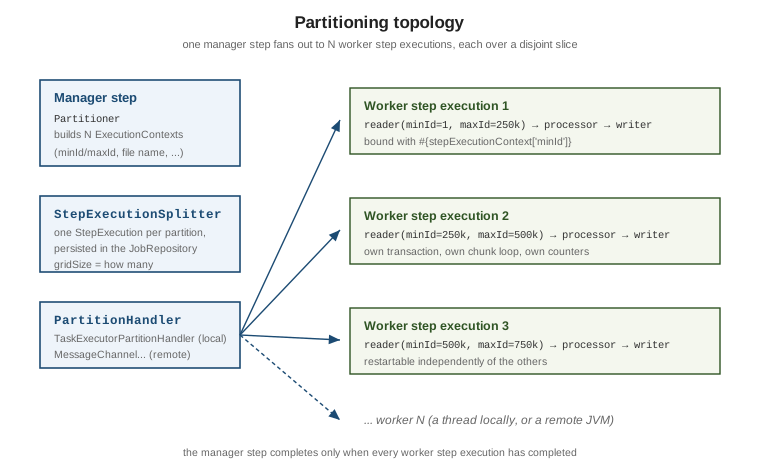
The pieces:
-
Partitioner— produces one namedExecutionContextper partition, holding whatever the worker needs (a key range, a file name). The six classic break-up approaches are compared in Architecture & processing strategies. -
StepExecutionSplitter— turns those contexts into persistedStepExecution`s, so each partition is visible and restartable in the `JobRepository. -
PartitionHandler— runs them.TaskExecutorPartitionHandlerruns them locally on a thread pool;MessageChannelPartitionHandlersends them to remote workers. -
gridSize— how many partitions to create. A hint to thePartitioner, not a thread count; the pool size governs how many run at once.
@Bean
public Partitioner tradeIdRangePartitioner(JdbcTemplate jdbcTemplate) {
    return gridSize -> {
        long min = jdbcTemplate.queryForObject("SELECT MIN(id) FROM trade", Long.class);
        long max = jdbcTemplate.queryForObject("SELECT MAX(id) FROM trade", Long.class);
        long targetSize = (max - min) / gridSize + 1;

        Map<String, ExecutionContext> partitions = new HashMap<>();
        long start = min;
        for (int i = 0; i < gridSize; i++) {
            ExecutionContext context = new ExecutionContext();
            context.putLong("minId", start);
            context.putLong("maxId", Math.min(start + targetSize - 1, max));
            partitions.put("partition" + i, context);
            start += targetSize;
        }
        return partitions;
    };
}

@Bean
public Step partitionedLoadStep(JobRepository jobRepository,
                                Partitioner tradeIdRangePartitioner,
                                Step workerStep,
                                TaskExecutor batchTaskExecutor) {

    TaskExecutorPartitionHandler handler = new TaskExecutorPartitionHandler();
    handler.setStep(workerStep);
    handler.setTaskExecutor(batchTaskExecutor);
    handler.setGridSize(8);

    return new StepBuilder("partitionedLoadStep", jobRepository)
            .partitioner("workerStep", tradeIdRangePartitioner)
            .partitionHandler(handler)
            .build();
}
The worker step binds its slice by late binding, which is why its reader must be @StepScope:
@Bean
@StepScope
public JdbcPagingItemReader<Trade> partitionedReader(
        DataSource dataSource,
        @Value("#{stepExecutionContext['minId']}") Long minId,
        @Value("#{stepExecutionContext['maxId']}") Long maxId) {
    return new JdbcPagingItemReaderBuilder<Trade>()
            .name("partitionedReader")
            .dataSource(dataSource)
            .selectClause("SELECT id, isin, quantity, price")
            .fromClause("FROM trade")
            .whereClause("WHERE id BETWEEN :minId AND :maxId")
            .parameterValues(Map.of("minId", minId, "maxId", maxId))
            .sortKeys(Map.of("id", Order.ASCENDING))
            .pageSize(1000)
            .rowMapper(new TradeRowMapper())
            .build();
}
Partitioning is usually the best of these options: each partition is an ordinary single-threaded step, so restart, skip and retry all behave normally, and only the failed partitions rerun.
Remote chunking
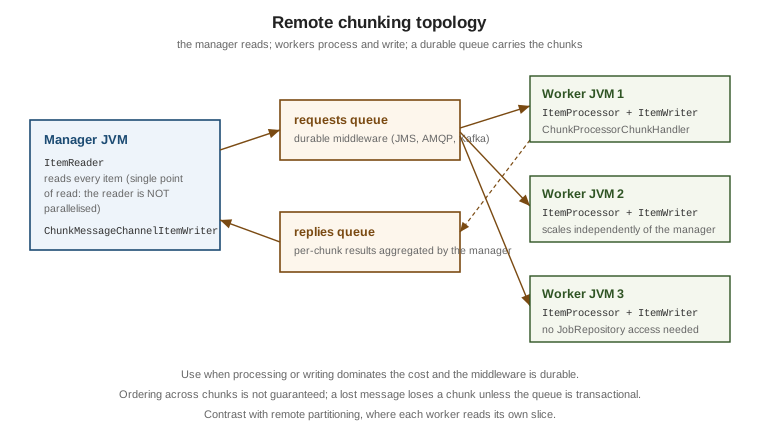
In remote chunking the manager reads every item and sends chunks over a MessageChannel; remote workers
process and write them and reply with the outcome. Reading is not parallelised, so this only pays when
processing or writing dominates.
The wiring, with ChunkMessageChannelItemWriter on the manager and ChunkProcessorChunkHandler on the
workers, is shown in
Spring Batch Integration. Two requirements are
non-negotiable: the middleware must be durable and transactional (an in-memory channel loses chunks), and
the items must be serialisable.
Remote partitioning and the remote step
Remote partitioning keeps the partitioning model but runs the workers in other JVMs:
MessageChannelPartitionHandler sends each partition’s StepExecution request over Spring Integration, and
workers execute the step against the shared JobRepository. Because each worker reads its own slice, the
manager is not a bottleneck — which is why remote partitioning usually scales further than remote chunking.
Spring Batch 6.0 adds a remote step abstraction that formalises "execute this step somewhere else", so the manager side no longer needs the hand-rolled aggregation that earlier versions required.
The DeployerPartitionHandler (from Spring Cloud Task) launches each partition as a new deployed
application — a Kubernetes pod, a Cloud Foundry task — instead of a long-running worker. It is linked, not
documented in depth here; see Cloud-native batch.
Trade-offs
| Option | Restartability | Ordering | Middleware |
|---|---|---|---|
Multi-threaded step |
Poor — position cannot be saved reliably; rerun the step |
Not preserved |
None |
Parallel steps (split) |
Good — each step restarts independently |
Per step |
None |
|
As the underlying step |
Preserved (the writer unwraps in order) |
None |
Local partitioning |
Excellent — only failed partitions rerun |
Per partition |
None |
Remote partitioning |
Excellent — per-partition `StepExecution`s persist |
Per partition |
Required, durable |
Remote chunking |
Moderate — depends on reply handling |
Not preserved across chunks |
Required, durable and transactional |