Django
|
This content was generated with the assistance of AI and should be verified against the official documentation before being relied on in production. The reference material consulted while preparing these pages is listed in the section bibliography. |
This section is written against Django 6.1.1 (released 2026-09-02), checked on 2026-10-03; Django 6.1.2, a security and bug-fix release, is scheduled for 2026-10-06. Django 6.1 supports Python 3.12, 3.13 and 3.14, and PostgreSQL 15 or later, MySQL 8.4 or later, MariaDB 10.11 or later and SQLite 3.37 or later. Where the long-term support release Django 5.2 LTS (supported until April 2028) behaves differently, the pages say so.
Django’s support policy gives each feature release mainstream support (bug and security fixes) until the next
feature release ships, roughly eight months later, followed by security fixes for roughly eight more months; every
third release is a long-term support (LTS) release that receives security fixes for about three years. Django 6.1 receives mainstream support until April 2027 and security fixes until
December 2027, and Django 6.0 is supported until April 2027. Django 6.2, due in April 2027, is the next LTS release
and the last one under this scheme. Starting with the release planned for January 2028, named Django 2028, Django
moves to calendar versioning (DEP 20) with one release per year, each supported for three years. Django 6.1 already
renames its deprecation warnings accordingly: what used to be RemovedInDjango70Warning is now
RemovedInDjango2028Warning. The What’s Changed & Upgrading page
covers the timeline and how to keep a project current.
What Django is
Django is a free, open-source, "batteries-included" Python web framework, maintained by the Django Software Foundation since 2008 and in public development since 2005. A single installation provides everything a database-backed web site needs:
-
an object-relational mapper (ORM) with schema migrations
-
URL routing, function-based and class-based views, middleware and the request/response objects
-
a template language with inheritance, partials and automatic HTML escaping
-
forms with validation and rendering, including forms generated from models
-
an automatic, customisable admin interface
-
authentication, permissions, sessions, and protection against CSRF, XSS, clickjacking and SQL injection, plus a built-in Content Security Policy since Django 6.0
-
caching, email, a background tasks framework (
django.tasks, Django 6.0), signals, logging, internationalisation, localisation and time zones, pagination and system checks -
contrib apps for content types, sites, sitemaps, syndication feeds, flat pages, redirects and GeoDjango
-
WSGI and ASGI deployment, with async views, async ORM methods and async authentication helpers
Django follows a model-template-view (MTV) split: models describe data, views decide what to return, and templates render it. Its design philosophies (loose coupling, less code, "don’t repeat yourself", explicit over implicit) are described on the Introduction & Architecture page.
This section is for developers who:
-
know Python (or come from Flask, FastAPI, Spring Boot, ASP.NET Core, Laravel or Rails) and want to build and run server-rendered sites, admin-heavy back offices, content sites or JSON APIs with Django
-
want one coherent path from a first project to testing, security, background work, real-time features, deployment and upgrades
-
learned Django from older books and tutorials (the 1.11 to 2.1 era) and need the current idioms:
path()instead ofurl(), theSTORAGESsetting,zoneinfo, psycopg 3, POST-only logout, async views,django.tasks, template partials and the built-in CSP
The Bookshelf scenario
Every example builds one small original site, Bookshelf, in the same domain as the Python FastAPI and NestJS sections, so that the three stacks can be compared page by page:
-
a public catalogue of
books,authorsandreviewswith server-rendered pages, PostgreSQL full-text search and pagination -
a custom user model with email login, sign-up, password reset and per-object permissions for editing reviews
-
staff curation in the admin
-
cover-image uploads
-
English and Spanish translations
-
a "new review" live feed over Server-Sent Events from an async view, with a Channels WebSocket variant
-
review-moderation emails sent through
django.tasks, with a Celery variant -
Redis caching
-
a versioned REST API built with Django REST framework, with a Django Ninja variant
-
a sitemap and an RSS feed
-
a Docker deployment with Gunicorn and Uvicorn
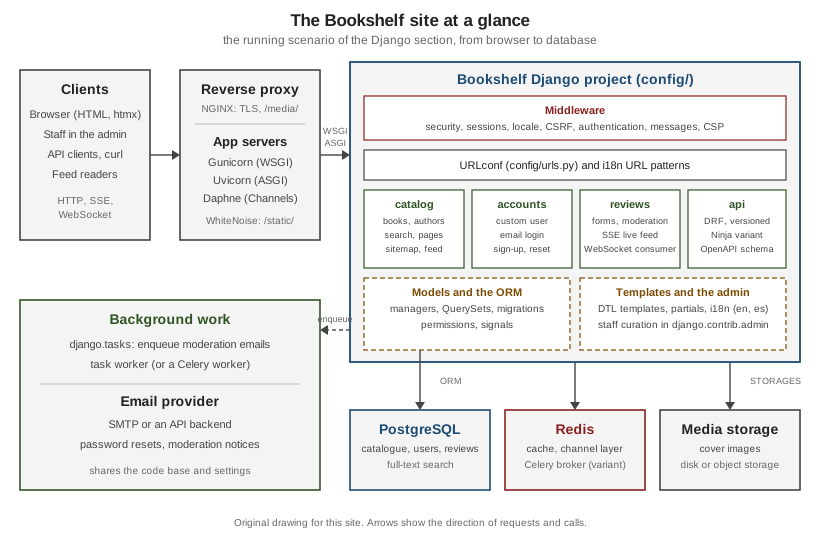
The final project layout (a config/ settings package, apps/catalog, apps/accounts, apps/reviews,
apps/api, templates/, static/ and pyproject.toml) is assembled on
Project Structure & Apps.
Reading path
The pages are ordered so that each one builds on the previous ones. Read them in this order the first time, then use them as a reference:
-
Foundations: what Django is made of, a first project, the project layout, settings, and
manage.py. -
Models and the ORM: fields, relationships, inheritance, migrations, queries, aggregation, managers, constraints, transactions, query optimisation, database backends and fixtures.
-
HTTP: the request/response cycle, URLs, function-based, class-based and generic views, middleware, sessions and cookies, file uploads and non-HTML responses.
-
Templates and the front end: the template language, partials with htmx, custom tags and filters, static files.
-
Forms: forms, validation, rendering and widgets, model forms and formsets.
-
The admin: registering models, then customising the admin for staff curation.
-
Authentication, authorisation and security: logins, the custom user model, permissions, passwords, the security middleware and settings, and Content Security Policy.
-
Application services: caching, email, the tasks framework and Celery, signals, logging, internationalisation, localisation and time zones, pagination and system checks.
-
Contrib apps: content types, sites, sitemaps and feeds, flat pages, redirects, humanize and GeoDjango.
-
Async and real-time: async views and the async ORM, then Channels and WebSockets.
-
Web APIs: Django REST framework, Django Ninja and GraphQL.
-
Testing: Django’s test framework, then pytest, factories and browser tests.
-
Production: deployment, containers, and performance.
-
Beyond the basics: what changed since older tutorials and how to upgrade, reusable apps and third-party packages, and best practices.
Readers who already know Django from older books can start with What’s Changed & Upgrading and then jump to the topics they use. The cheat sheet at Django Cheat Sheet condenses the whole section onto one page for quick lookup.
What’s covered
Each page builds on the Bookshelf scenario and ends with the official sources it derives from.
Where related material lives elsewhere on this site
The Django pages link to existing material instead of repeating it, and cover only what Django adds.
| Topic | Where it lives | How the Django section relates |
|---|---|---|
The Python language: classes, decorators and metaclasses, typing, asyncio, packaging, pytest |
Python Reference, including Classes & Objects, Decorators & Metaclasses, Type Hints, Concurrency & Async, Virtual Environments & Packaging and Testing |
Django pages link here instead of re-explaining classes, metaclasses, decorators, asyncio, packaging or pytest. |
API-first Python with FastAPI |
Python FastAPI, including Introduction & Architecture and Sub-applications, WSGI & GraphQL |
The introduction’s comparison table presents FastAPI as the API-first Python alternative, and the Django Ninja page links it for Pydantic-based APIs. |
CORS |
The security and Django REST framework pages link here for the theory and show only |
|
Front end: HTML and CSS, Bootstrap, JavaScript, React, Vue, Angular, accessibility, browser testing |
HTML & CSS, Bootstrap, JavaScript Development, React, Vue, Angular, Accessibility and End-to-End Testing in Real Browsers |
Linked from the templates, static-files, front-end and browser-testing pages, which cover only the Django side. |
The same ideas in other stacks |
The introduction’s framework comparison presents these as the same idea in other stacks. |
|
GraphQL theory and the N+1 problem |
GraphQL, including Python: Getting Started and Performance & the N+1 Problem |
The GraphQL with Django page links here for theory and covers only Strawberry-Django and Graphene-Django. |
OAuth 2.0, OpenID Connect, social login, MFA and JWT |
OAuth Reference, including OpenID Connect, Social Login & Federation, Authentication Methods, 2FA & Passwordless and JWT & JOSE |
The authentication, custom-user and Django REST framework pages link here for protocol theory. |
Architecture: layering, monolith or microservices, choosing a stack |
Architecture, including Layering Backend & Frontend, Choosing Monolith or Microservices and Starting a New Project: Which Path and Which Technologies |
The project-structure page links here; the "Backend framework" table of the last page has a Python / Django row. |
Messaging, Docker, Kubernetes and cloud platforms |
The Celery, Docker & Kubernetes and deployment pages show only the Django-specific parts. |
|
Databases: SQL, Redis, schema evolution, slow queries, pagination, pgvector |
SQL Reference, Redis Reference, Schema Evolution, Diagnosing Slow Queries, Pagination Strategies and PostgreSQL with pgvector |
The ORM, migrations, query-optimisation, pagination and caching pages cover only the Django side. |
Related topics that are planned but not yet part of this site are mentioned in prose only, where relevant: other Python web frameworks such as Flask, Tornado and Pyramid (issue #242), a programming languages comparison (#196), a cloud providers comparison (#201), and API managers, secret managers, gateways and scaling (#184). Thymeleaf templating is covered in the Thymeleaf section.
Bibliography
Every source used to prepare this section is listed here, each linked to its official site. Individual pages
list the subset they derive from under their own == References heading.
Books
All four books target Django 1.11 to 2.1 (2017 to 2018), releases that have long been out of support. They were consulted for concept coverage, narrative and structure only; no text, code listing, figure or sample project is taken from them, every example in this section is written against the current official documentation, and the pages point out where the books are outdated.
-
Melé, A. Django 2 by Example: Build powerful and reliable Python web applications from scratch. Packt Publishing, 2018. ISBN 978-1-78847-248-7. Packt publisher page; companion code: PacktPublishing/Django-2-by-Example on GitHub. Current edition: Melé, A. Django 5 By Example, 5th ed. Packt Publishing, 2024. Packt publisher page.
-
Greenfeld, D. R. and Greenfeld, A. R. Two Scoops of Django 1.11: Best Practices for Django, 4th ed. Two Scoops Press, 2017. Feldroy (publisher) page, which also presents the current edition, Two Scoops of Django 3.x; companion code: twoscoops/two-scoops-of-django-1.11 on GitHub.
-
Marani, F. Practical Django 2 and Channels 2: Building Projects and Applications with Real-Time Capabilities. Apress, 2019. ISBN 978-1-4842-4098-4 (print), 978-1-4842-4099-1 (eBook). Apress / Springer publisher page; companion code: Apress/practical-django2-and-channels2 on GitHub.
-
Vincent, W. S. Django for Beginners: Build websites with Python & Django. Self-published, 2018. LearnDjango (author) page, which presents the current edition; companion code: wsvincent/djangoforbeginners on GitHub.
Official Django documentation
Published at docs.djangoproject.com (the full contents), grouped as the documentation is:
-
Getting started: the overview, installation, the eight-part tutorial, reusable apps and what to read next
-
Using Django: the topic guides (models and databases, HTTP, forms, templates, class-based views, migrations, files, testing, authentication, caching, conditional view processing, signing, email, internationalisation and localisation, logging, pagination, security, performance, serialisation, settings, signals, system checks, async support and tasks)
-
How-to guides: authentication backends, custom model fields, custom lookups, custom management commands, custom template tags and filters, custom storage, CSP, CSV and PDF output, deployment (WSGI and ASGI servers, static files, the deployment checklist), error reporting, initial data, legacy databases, logging, overriding templates, upgrading and writing migrations
-
API reference: applications, checks, class-based views, clickjacking protection, CSP, CSRF, databases,
django-admin, exceptions, files, forms, logging, middleware, migration operations, models, paginator, request and response objects, schema editor, settings, signals, templates, tasks, unicode, URL dispatcher, utilities, validators and views -
contribpackages: the admin, auth, contenttypes, flatpages, humanize, messages, PostgreSQL, redirects, sitemaps, sites, staticfiles and syndication, and GeoDjango -
Release notes (from Django 1.11 to 6.1 and 6.1.2) and the deprecation timeline
-
Django 5.2 release notes in the 5.2 LTS documentation
The Django project
-
The Django weblog (release and security announcements)
-
Django’s ecosystem (the community’s list of third-party packages)
-
The Django source code, including the built-in task backends and
django/utils/deprecation.py -
Django Enhancement Proposals (DEPs), including DEP 20 on calendar versioning
Python, packaging and the gateway interfaces
-
Python documentation, in particular
unittest,unittest.mock,logging.config,logging.handlers, the logging HOWTO and cookbook,zoneinfo,datetime,contextvars,email.message,email.headerregistry, the profilers,urllib.requestandzipfile -
ASGI specification, including the HTTP and WebSocket protocol, and asgiref
-
Python Packaging User Guide, including writing
pyproject.toml, packaging projects, core metadata and thesetup.pydeprecation; build, setuptools data files, PyPI classifiers, the PyPI JSON API and trusted publishers
Databases, caches and servers
-
PostgreSQL, psycopg 3 and its connection pools, and PostGIS
-
Memcached and pymemcache
-
Gunicorn (design, settings, deployment, ASGI worker, signals, news) and uvicorn-worker
-
NGINX, in particular the proxy module and WebSocket proxying
Ecosystem projects used by the pages
-
APIs: Django REST framework (and its release notes), drf-spectacular, Simple JWT, adrf, Django Ninja (and its releases) and Pydantic
-
GraphQL: Strawberry-Django (with Strawberry’s Django integration and the Strawberry-Django releases) and Graphene-Django
-
Real time: Channels and channels_redis
-
Background work: Celery (including First steps with Django), django-celery-beat, django-celery-results, Flower, and django-tasks with its database and RQ backends
-
Developer tooling and profiling: django-debug-toolbar, django-extensions, django-upgrade, cookiecutter-django (and its repository), django-silk (repository), pyinstrument and django-cachalot
-
Configuration, storage and static files: django-environ, django-storages, WhiteNoise, django-vite, Vite backend integration and build, and django-statici18n
-
Authentication and permissions: django-allauth, django-guardian, django-rules, django-otp, django-two-factor-auth and argon2-cffi
-
Security headers: django-cors-headers and the django-csp migration guide
-
Forms, filtering and the front end: django-crispy-forms, crispy-bootstrap5, django-filter, htmx (and the essays on hypermedia-driven applications and when to use hypermedia), django-htmx, django-template-partials (and its migration guide) and Jinja
-
Internationalisation: django-modeltranslation, django-parler and Babel
-
Email, logging and monitoring: django-anymail, aiosmtpd, Sentry for Django (sentry-sdk), structlog and python-json-logger
-
Testing: pytest-django, pytest, pytest-cov, factory_boy, model_bakery, Faker, coverage.py with django_coverage_plugin, Playwright for Python, Selenium, responses, Moto and Locust
-
Documents and images: WeasyPrint, ReportLab and Pillow
-
Content management and data exchange: Wagtail, django CMS and django-import-export
-
Package directories: Django Packages
Containers, orchestration and CI
-
Docker documentation, in particular the Dockerfile reference, multi-stage builds, build context and the Compose file reference for services, fragments and startup order; the official PostgreSQL, PostGIS and Redis images; uv in Docker
-
Kubernetes documentation: Deployments, Jobs, Services, ConfigMaps, Secrets, probes, container lifecycle hooks, Kustomize and
kubectl -
GitHub Actions, including building and testing Python and PostgreSQL service containers
Specifications, standards and guidance
-
RFC 6455: The WebSocket Protocol and the MDN WebSocket API reference
-
OWASP Top 10, the OWASP Cheat Sheet Series (including email validation and verification), and the OWASP pages on session fixation and CSV injection
-
The Twelve-Factor App, in particular config and logs
-
The Well-Maintained Test (choosing third-party packages), by Adam Johnson
The books are consulted references for concept coverage, narrative and structure; they are not reproduced here. The official documentation linked above is authoritative, and where the two differ, the documentation of the version you run prevails.