Docker CI/CD with GitHub Actions
|
This content was generated with the assistance of AI and should be verified against the official documentation before being relied on in production; see the section bibliography for the reference material consulted while preparing these pages. |
Spring Boot Integration Tests with
Testcontainers covers the build.yml that verifies every change. This page covers the other half: building the
image in CI, testing it, and publishing it with the right tags and supply-chain metadata, using Docker’s official
actions at their current majors (docker/setup-qemu-action@v4, docker/setup-buildx-action@v4,
docker/login-action@v4, docker/metadata-action@v6, docker/build-push-action@v7, docker/bake-action@v7,
docker/scout-action@v1, docker/setup-docker-action@v5, docker/setup-compose-action@v2) with
actions/checkout@v7 and actions/setup-java@v6. The underlying Buildx features are explained on
BuildKit and Buildx. If branches, tags and pull requests that trigger
these workflows are new territory, see Git & GitHub first.
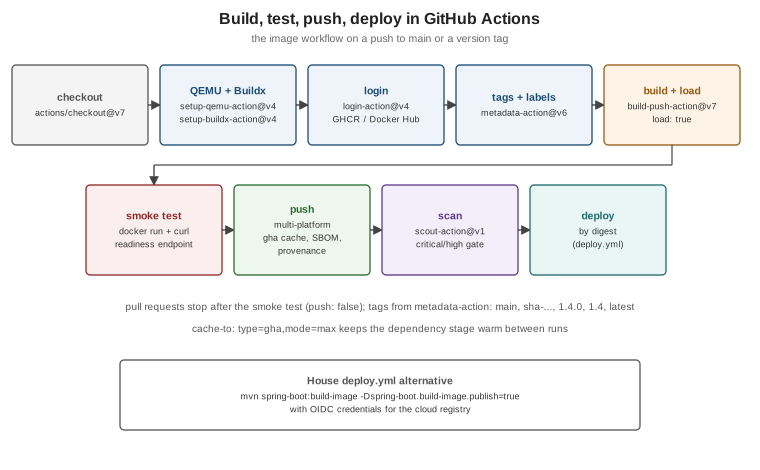
The building blocks
| Action | What it does |
|---|---|
|
Installs QEMU |
|
Creates a Buildx builder with the |
|
Logs in to a registry: GHCR with |
|
Computes tags and OCI labels/annotations from the Git ref, event and commit. |
|
Runs |
|
Runs |
|
Runs Docker Scout ( |
|
Install a specific Docker Engine or Compose version instead of the runner’s preinstalled one. |
Derived from each action’s README (linked under References) and Docker’s Docker Build GitHub Actions section.
Logging in
permissions:
  contents: read
  packages: write               # needed to push to ghcr.io with GITHUB_TOKEN

steps:
  - name: Log in to GHCR
    uses: docker/login-action@v4
    with:
      registry: ghcr.io
      username: ${{ github.actor }}
      password: ${{ secrets.GITHUB_TOKEN }}

  - name: Log in to Docker Hub
    uses: docker/login-action@v4
    with:
      username: ${{ vars.DOCKERHUB_USERNAME }}
      password: ${{ secrets.DOCKERHUB_TOKEN }}     # a Docker Hub access token, never the account password
For Amazon ECR, Google Artifact Registry or Azure Container Registry, obtain short-lived credentials with the
provider’s OIDC action first (aws-actions/configure-aws-credentials, google-github-actions/auth,
azure/login, with permissions: id-token: write), then log in; the login-action README has one example per
registry. Derived from docker/login-action and GitHub’s
Working
with the Container registry. For the ACR side of that azure/login OIDC push in depth, see
Azure Container Registry.
For the ECR side of the aws-actions/configure-aws-credentials OIDC push, see
Container Registry, and for the AWS CodeBuild/CodePipeline alternatives to GitHub Actions, see
Developer Tools and DevOps.
For the Artifact Registry side of a Google Cloud push, see
Container Registry and Builds, and for the Cloud Build and Cloud Deploy alternatives to
GitHub Actions, see Developer Tools and DevOps.
Tags and labels with metadata-action
  - name: Compute image metadata
    id: meta
    uses: docker/metadata-action@v6
    with:
      images: ghcr.io/${{ github.repository }}
      tags: |
        type=ref,event=branch
        type=ref,event=pr
        type=semver,pattern={{version}}
        type=semver,pattern={{major}}.{{minor}}
type=shasha-3f2a1bc"] t --> tt["1.4.0
1.4
latest
sha-9c0d4e2"] pr --> tpr["pr-42
sha-77ab5e1
(built, not pushed)"]
steps.meta.outputs.tags and steps.meta.outputs.labels feed straight into build-push-action; the labels include
the OCI source, revision, created and version keys. With the default flavor: latest=auto, latest is
added for every tag push matched by type=semver (except pre-releases such as v1.5.0-rc.1) or
type=ref,event=tag — the action does not compare versions, so a hotfix tag on an older line (v1.3.5 after
v1.4.0) moves latest back. To decide yourself, turn the automatic tag off and add it with an enable condition:
  - name: Compute image metadata
    id: meta
    uses: docker/metadata-action@v6
    with:
      images: ghcr.io/${{ github.repository }}
      flavor: |
        latest=false
      tags: |
        type=ref,event=branch
        type=ref,event=pr
        type=semver,pattern={{version}}
        type=semver,pattern={{major}}.{{minor}}
        type=sha
        # latest only for tags of the current release line; bump the prefix when a new line ships
        type=raw,value=latest,enable=${{ startsWith(github.ref, 'refs/tags/v1.4.') }}
Derived from docker/metadata-action — Latest tag (and its
flavor input and type=semver sections) and
Manage tags and labels.
Caching
The gha cache backend stores BuildKit’s cache in the GitHub Actions cache service, so the dependency stage of a
multi-stage build is reused across runs:
  - uses: docker/build-push-action@v7
    with:
      context: .
      cache-from: type=gha
      cache-to: type=gha,mode=max
Derived from Cache management with GitHub Actions. For
RUN --mount=type=cache directories (such as ~/.m2), which the layer cache does not export, the same page
documents persisting them with actions/cache.
Test before push
Build once, load the image into the runner’s Docker, test it, and push only if the tests pass:
  - name: Build and load for testing
    uses: docker/build-push-action@v7
    with:
      context: .
      load: true
      tags: orders-service:test
      cache-from: type=gha

  - name: Smoke-test the image
    run: |
      docker run -d --name smoke -p 8080:8080 orders-service:test
      timeout 90 bash -c 'until curl -fsS http://localhost:8080/actuator/health/readiness; do sleep 2; done'
      docker rm -f smoke

  - name: Build and push
    uses: docker/build-push-action@v7
    with:
      context: .
      push: true
      tags: ${{ steps.meta.outputs.tags }}
      labels: ${{ steps.meta.outputs.labels }}
      cache-from: type=gha
      cache-to: type=gha,mode=max
The second build is almost free: every step hits the cache. Derived from
Test before push with GitHub Actions. To hand an
image to a different job (for example a matrix of test jobs), export it as an artifact (outputs:
type=docker,dest=${{ runner.temp }}/image.tar), upload it with actions/upload-artifact, and docker load it in
the other job; see Share built image between
jobs.
Multi-platform images
  - uses: docker/setup-qemu-action@v4
  - uses: docker/setup-buildx-action@v4
  - uses: docker/build-push-action@v7
    with:
      context: .
      platforms: linux/amd64,linux/arm64
      push: true
      tags: ${{ steps.meta.outputs.tags }}
A JVM image cross-builds cheaply when the Maven stage uses FROM --platform=$BUILDPLATFORM, as the Dockerfile on
Java and Spring Boot Images does (see
BuildKit and Buildx). For native code, split the
platforms across native ubuntu-latest and ubuntu-24.04-arm runners and merge the digests; Docker documents that
pattern in Multi-platform image with GitHub
Actions.
Bake, Scout and pinned tool versions
  # Build every target of docker-bake.hcl, using the metadata-action bake file for tags and labels
  - uses: docker/bake-action@v7
    with:
      files: |
        ./docker-bake.hcl
        cwd://${{ steps.meta.outputs.bake-file }}
      push: true

  # Fail the job on fixable critical or high CVEs in the image just built
  - uses: docker/scout-action@v1
    with:
      command: cves
      image: ${{ steps.meta.outputs.tags }}
      only-severities: critical,high
      only-fixed: true
      exit-code: true

  # Pin the Docker Engine or Compose version instead of the runner's preinstalled one
  - uses: docker/setup-docker-action@v5
    with:
      version: v29.8.1
  - uses: docker/setup-compose-action@v2
    with:
      version: v5.5.1
Derived from docker/bake-action, docker/scout-action (Scout needs a Docker Hub login), docker/setup-docker-action, docker/setup-compose-action and Integrate Docker Scout with GitHub Actions.
The Docker GitHub Builder is an alternative to wiring these actions yourself: Docker-maintained reusable workflows
(docker/github-builder) that own runner selection, caching, provenance, signing and multi-platform manifests, so a
repository’s workflow only decides when to build. See
Docker GitHub Builder.
A complete image workflow
# .github/workflows/image.yml -- build, test and publish the service image to GHCR
name: image

on:
  push:
    branches: [main]
    tags: ["v*.*.*"]
  pull_request:

permissions:
  contents: read
  packages: write
  id-token: write          # keyless signing / attestation identity
  attestations: write

jobs:
  image:
    runs-on: ubuntu-latest
    timeout-minutes: 30
    steps:
      - uses: actions/checkout@v7

      - uses: docker/setup-qemu-action@v4

      - uses: docker/setup-buildx-action@v4

      - name: Log in to GHCR
        if: github.event_name != 'pull_request'
        uses: docker/login-action@v4
        with:
          registry: ghcr.io
          username: ${{ github.actor }}
          password: ${{ secrets.GITHUB_TOKEN }}

      - name: Image metadata
        id: meta
        uses: docker/metadata-action@v6
        with:
          images: ghcr.io/${{ github.repository }}
          tags: |
            type=ref,event=branch
            type=ref,event=pr
            type=semver,pattern={{version}}
            type=semver,pattern={{major}}.{{minor}}
            type=sha

      - name: Build for testing
        uses: docker/build-push-action@v7
        with:
          context: .
          load: true
          tags: orders-service:test
          cache-from: type=gha

      - name: Smoke test
        run: |
          docker run -d --name smoke -p 8080:8080 orders-service:test
          timeout 90 bash -c 'until curl -fsS http://localhost:8080/actuator/health/readiness; do sleep 2; done'
          docker rm -f smoke

      - name: Build and push (multi-platform, SBOM and provenance)
        id: push
        uses: docker/build-push-action@v7
        with:
          context: .
          platforms: linux/amd64,linux/arm64
          push: ${{ github.event_name != 'pull_request' }}
          tags: ${{ steps.meta.outputs.tags }}
          labels: ${{ steps.meta.outputs.labels }}
          annotations: ${{ steps.meta.outputs.annotations }}
          cache-from: type=gha
          cache-to: type=gha,mode=max
          sbom: true
          provenance: mode=max
Derived from the Docker Build GitHub Actions pages and GitHub’s Publishing Docker images. The Dockerfile it builds is the one on Java and Spring Boot Images; pull requests build and test but never push.
The house deploy.yml variant
The house deployment workflow (generated by .claude/skills/iru-setup-java-springboot-github-workflows) builds the
image without a Dockerfile, using Cloud Native Buildpacks through the Spring Boot Maven plugin, and pushes it with
credentials passed as docker.publishRegistry.* properties; the cloud credentials come from OIDC, so no long-lived
access key is stored:
# .github/workflows/deploy.yml (excerpt)
permissions:
  contents: read
  id-token: write          # OIDC to the cloud provider
  packages: write

jobs:
  deploy:
    runs-on: ubuntu-latest
    environment: ${{ inputs.environment }}          # approval gate and environment-scoped secrets
    steps:
      - uses: actions/checkout@v7

      - uses: actions/setup-java@v6
        with:
          distribution: temurin
          java-version: '25'
          cache: maven

      - name: Resolve image tag
        id: meta
        run: echo "tag=${{ inputs.image_tag || github.sha }}" >> "$GITHUB_OUTPUT"

      - name: Configure AWS credentials (OIDC)
        uses: aws-actions/configure-aws-credentials@v6
        with:
          role-to-assume: ${{ secrets.AWS_DEPLOY_ROLE_ARN }}
          aws-region: ${{ vars.AWS_REGION }}

      - name: Build and push the image with Cloud Native Buildpacks
        run: |
          mvn -B -ntp -pl boot -am spring-boot:build-image -DskipTests \
            -Dspring-boot.build-image.imageName=${{ vars.IMAGE_REPOSITORY }}:${{ steps.meta.outputs.tag }} \
            -Dspring-boot.build-image.publish=true \
            -Ddocker.publishRegistry.username=${{ secrets.REGISTRY_USERNAME }} \
            -Ddocker.publishRegistry.password=${{ secrets.REGISTRY_PASSWORD }}
This matches the skill’s workflow shape (the skill itself still pins actions/checkout@v5 and
actions/setup-java@v5; the current majors are shown here). The plugin configuration that makes the
docker.publishRegistry.* properties work is on
Java
and Spring Boot Images. Derived from the Spring Boot Maven plugin’s
Packaging OCI Images page.
Immutable tags and latest
-
Deploy by an immutable identifier: the commit SHA tag or, better, the digest that
build-push-actionoutputs (steps.push.outputs.digest). Environments then record exactly what runs. -
Treat version tags (
1.4.0) as immutable too — enable immutable tags on the registry where supported (see Registries and Docker Hub). -
Let
latestbe a convenience for humans (docker run ghcr.io/myorg/orders-service), never a deployment input.metadata-actionmoves it on every release tag push, hotfixes of older lines included, unless you control it withflavor: latest=falseas shown in Tags and labels withmetadata-action.
To add a load-test stage to such a pipeline, see CI/CD with Maven, Docker & GitHub Actions in the JMeter section.