Axum
|
This content was generated with the assistance of AI and should be verified against the official documentation before being relied on in production. The reference material consulted while preparing these pages is listed in the section bibliography. |
This section is written against axum 0.8.9 (released 2026-04-14), with axum-core 0.5.6, axum-extra 0.12.6, tokio 1.53,
tower 0.5, tower-http 0.7 and hyper 1, on Rust 1.99 (edition 2024), checked on 2026-10-06. axum itself needs Rust 1.80
or later. There is no axum 0.9 or 1.0 release yet; the breaking changes already queued for 0.9 on the main branch are
mentioned as upcoming where they matter, and examples follow the axum-v0.8.9 tag of the repository.
What axum is
axum is a web framework from the Tokio project. It routes HTTP requests to plain async functions, turns request parts
into typed arguments through extractors, and turns return values into responses through IntoResponse — without
macros. It has no middleware system of its own: every router, handler and layer is a tower Service, so the whole
tower and tower-http ecosystem (timeouts, compression, tracing, CORS, rate limits) applies, and the same middleware
works with tonic, hyper and AWS Lambda. Underneath, hyper speaks HTTP/1.1 and HTTP/2 and Tokio runs the tasks.
The section is for developers who know some Rust — ownership, traits, async/await — and want to build production
services. Rust itself is covered in the Rust Reference; these pages link
there instead of repeating it.
The Bookshelf application
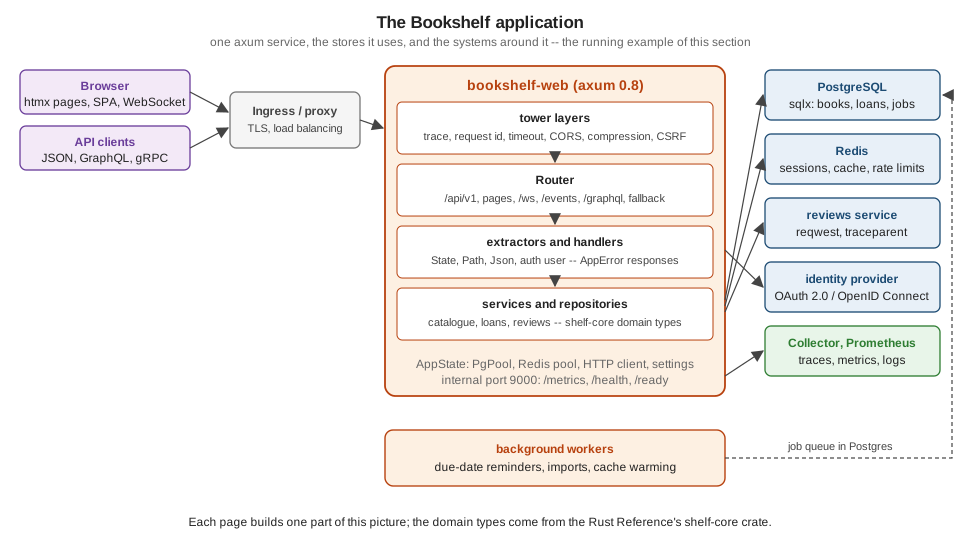
Every page builds part of Bookshelf, an original library application: a catalogue of books and authors, loans with
due dates, reviews, user accounts, an HTML front end with htmx, live updates over WebSockets and SSE, and the operational
pieces of a real service. Its domain types (Book, Isbn, Loan) come from the shelf-core crate of the Rust
Reference, so the same code sits behind a command-line tool there and behind an HTTP API here.
New here? Read in this order
-
Introduction & Architecture and Getting Started — the stack and a first service
-
Routing, Handlers and Extractors — the request side
-
Responses and Error Handling — the response side
-
State & Dependency Injection and Tower Service Model — how the pieces fit
-
JSON REST APIs and Databases with sqlx — a first real API
-
Then the security, web UI and operations groups below in any order; finish with Testing and Deployment.
Coming from axum 0.6 or 0.7, or from another framework? Start with Migration & Framework Comparison.
What’s covered
Foundations — Introduction & Architecture, Tower Service Model, Getting Started and Project Structure.
Routing, handlers, extractors and responses — Routing, Routing Composition, Handlers, Extractors, Custom Extractors, axum-extra, Responses, Error Handling and State & Dependency Injection.
Middleware and HTTP concerns — Writing Middleware, Applying Middleware & Ordering, tower-http Catalog, Request Limits & Timeouts, CORS & Compression and Rate Limiting & Load Shedding.
Building APIs — JSON REST APIs, Validation, OpenAPI with utoipa, Forms & Content Negotiation and GraphQL & gRPC.
Security — Sessions & Cookies, Password Authentication, JWT & Bearer Tokens, OAuth2 & OpenID Connect, Authorization, CSRF & Security Hardening and TLS & HTTPS.
Web UI and real-time — Server-side Templates, htmx, Static Files & SPAs, WebSockets, Server-Sent Events & Streaming, File Uploads and Full-stack with Leptos & Dioxus.
Operations — Background Jobs & Tasks, HTTP Clients & Proxies, Graceful Shutdown, Configuration, Logging & Tracing, OpenTelemetry & Distributed Tracing, Metrics & SLOs, Testing, Performance Tuning and Deployment.
Reference — Migration & Framework Comparison.
Quick reference — Cheat Sheet, with a one-page downloadable PDF.
Related material on this site
| Topic | Where |
|---|---|
Rust language, async/await, tokio, serde, error handling |
|
OAuth 2.0, OpenID Connect and JWT in depth |
|
CORS in the browser |
|
Container images and Compose |
|
Running services in a cluster |
|
SQL and PostgreSQL |
|
Redis data structures and operations |
|
GraphQL schemas, resolvers and clients |
|
Prometheus, PromQL and alerting |
|
MCP servers and AI agents in Rust (the rmcp SDK, Rig) |
Model Context Protocol (MCP) and The 2026 Agent Frameworks Landscape |
Other backend frameworks (FastAPI, NestJS, Spring Boot, ASP.NET Core, Laravel) |
A comparison of backend and web frameworks across languages is planned (issue #263).
Bibliography
Books
-
Indo Yoon (technical reviewer Joshua Mo), Beginning Axum: Learning Modern Web Development With Rust, 1st edition. Apress, 2026. ISBN 979-8-8688-2630-6 (print), 979-8-8688-2631-3 (eBook), DOI 10.1007/979-8-8688-2631-3. Publisher page; companion code and chat application.
-
Manjunath Gangappa and Rajkumar Rangaraj (foreword by Trask Stalnaker), Mastering Distributed Observability in Rust: Implement OpenTelemetry in a real-world, multi-container e-commerce architecture, 1st edition. Packt, 2026 (June). ISBN 978-1-80667-179-3 (print); eBook ISBN 978-1-80667-178-6 as given by retailer listings. Publisher page; companion code.
-
Nouman Azam, Advanced Rust: Exploring Power Features of Rust for Intermediate and Advanced Developers, 1st edition (technical reviewer Yogendra Sharma). Apress, 2026. ISBN 979-8-8688-2991-8 (print), 979-8-8688-2992-5 (eBook), DOI 10.1007/979-8-8688-2992-5. Publisher page. Chapter 2 (debugging and tracing) was used for this section.
-
Ethan Crossley, Hayden Van Der Post and Alice Schwartz (credited inconsistently), Rust for Scientific Computing: Numerical Methods, Simulations, and Linear Algebra. Reactive Publishing, 2026. No ISBN is printed; retailers list the paperback as 979-8-19849-392-6. Publisher site. Consulted for topic coverage only: no facts or code were taken from it. Its chapter 15 web-service example is cited only where it shows outdated axum code (
axum::Server,AddExtensionLayer,/:idroutes).
The books are consulted references, not the primary source. On any discrepancy, and wherever a book is silent on a later feature, the official documentation wins; where a book shows an outdated form, the pages say so in prose (collected on Migration & Framework Comparison).
axum, Tokio, tower and hyper
-
axum 0.8.9 API documentation, axum-core, axum-extra and axum-macros
-
axum examples (axum-v0.8.9), CHANGELOG and ECOSYSTEM.md (at the tag)
-
Tokio tutorial, Graceful Shutdown, Getting started with Tracing, tokio, tokio-util, futures 0.3.34 and tokio-console
-
tower, tower-http 0.7.1 (CHANGELOG), hyper, hyper-util and http-body-util, hyper 1.12.0 API, matchit 0.8.4 and headers 0.4.2
-
Tokio blog: Inventing the Service trait and console-subscriber 0.5.0
-
The Rust Programming Language and the Async Book, through the Rust Reference
-
The Cargo Book, The Rust Reference, the standard library documentation, the Rust compiler error index and The Rust Performance Book
Crates and services used on the pages
-
Serialization, validation and errors: serde (attributes), validator, garde, thiserror, anyhow, serde_json 1.0.151
-
OpenAPI: utoipa, utoipa-axum, utoipa-swagger-ui, aide, utoipa CHANGELOG, and client generators OpenAPI Generator and progenitor
-
Data: sqlx (API), SeaORM, Diesel and diesel-async, redis-rs, deadpool-redis, moka
-
ORMs: sea-orm 2.0.4, sea-orm-migration 2.0.4, sea-query 1.0.2, SeaORM CHANGELOG and diesel 2.3.13; databases: PostgreSQL 16 documentation and Redis documentation
-
Authentication: tower-sessions, axum-login, argon2 and password-hash, jsonwebtoken, oauth2, openidconnect, tower-sessions repository, tower-sessions-redis-store 0.16.0, jsonwebtoken CHANGELOG, argon2 CHANGELOG, oauth2 upgrade guide, GitHub: Authorizing OAuth apps and secrecy 0.10.3
-
Templates and front end: askama and askama_web, minijinja, maud, htmx, Leptos, Dioxus, askama 0.16.1 API, maud 0.27.0 API, htmx reference, htmx examples: Active Search and Inline Validation, the htmx SSE and WebSocket extensions, leptos 0.8.22, leptos_axum 0.8.10, cargo-leptos, dioxus 0.7.10, Vite: Building for production and Project Fluent
-
Traffic and serving: tower_governor, governor 0.10.4, axum-server, rustls 0.23.45, tokio-rustls 0.26.6, Let’s Encrypt documentation, reqwest, reqwest-middleware, reqwest-retry 0.9.1 and reqwest-tracing 0.7.1
-
Observability: tracing, tracing-subscriber, OpenTelemetry Rust, tracing-opentelemetry, opentelemetry-otlp, metrics, metrics-exporter-prometheus, opentelemetry_sdk 0.33.0, opentelemetry-http 0.33.0, opentelemetry-rust repository, OpenTelemetry: Sampling, OpenTelemetry semantic conventions and Prometheus: Metric and label naming
-
Performance: mimalloc 0.1.52, tikv-jemallocator 0.7.0, cargo-flamegraph, samply, oha and k6
-
Testing and jobs: axum-test, insta (docs), cargo-nextest, mockall 0.15.0, Pact, testcontainers-modules, tokio-cron-scheduler, apalis
-
GraphQL and gRPC: async-graphql (API 7.2.1, async-graphql-axum 7.2.1), tonic (repository, tonic-prost-build 0.14.6) and gRPC: Core concepts
-
Configuration: config, figment, dotenvy, envy 0.4.2
-
Development loop: bacon and listenfd 1.0.2
-
Supply chain: cargo-deny, cargo-audit and the RustSec advisory database
-
Deployment: cargo-chef, AWS Lambda Rust runtime, cargo-lambda, Fly.io (fly.toml), Shuttle, lambda_http 1.3.1, distroless, Docker Hub: rust
-
Containers and orchestration: Docker Dockerfile reference, build secrets, cache optimisation and docker container stop; Kubernetes Pod Lifecycle, Container Lifecycle Hooks, probes and Secrets; systemd systemd.kill and systemd.service
-
Services: Jaeger, Prometheus, Grafana (Tempo), OpenTelemetry Collector
Specifications and standards
-
RFC 9110: HTTP Semantics, RFC 9111: HTTP Caching, RFC 9113: HTTP/2, RFC 3986: URI, RFC 6265: Cookies
-
RFC 6455: The WebSocket Protocol, RFC 8441: WebSockets with HTTP/2 and WHATWG: Server-sent events
-
RFC 9457: Problem Details, RFC 7519: JWT, RFC 6749: OAuth 2.0, RFC 7636: PKCE, OpenID Connect Core 1.0 and WHATWG Fetch: CORS
-
RFC 6266: Content-Disposition, RFC 6585: Additional HTTP Status Codes, RFC 6750: Bearer Token Usage, RFC 7239: Forwarded HTTP Extension, RFC 7301: ALPN, RFC 7517: JSON Web Key, RFC 7578: multipart/form-data, RFC 8446: TLS 1.3, RFC 8594: Sunset Header, RFC 8725: JWT Best Current Practices, RFC 9106: Argon2, RFC 9700: OAuth 2.0 Security Best Current Practice and RFC 9745: Deprecation Header
-
WHATWG HTML: URL-encoded form data, W3C Server Timing, JSON Lines and the NDJSON specification
-
GraphQL specification and the Protocol Buffers proto3 language guide
-
OWASP Top 10:2025 (project page), OWASP API Security Top 10 (2023) and the OWASP Cheat Sheet Series: Password Storage, Session Management, CSRF Prevention, REST Security, Input Validation and Logging, Authentication, Authorization, XSS Prevention, File Upload, HTTP Headers, JSON Web Token, Secrets Management, SSRF Prevention and WebSocket Security
-
MDN: HTTP (including Content Security Policy)
Articles and guides
-
Google SRE Book: Service Level Objectives and The Site Reliability Workbook: Alerting on SLOs
-
Filippo Valsorda, Cross-Site Request Forgery (the design behind Go’s CrossOriginProtection and tower-http’s
CsrfLayer) -
Alice Ryhl, Async: What is blocking?
-
Luca Palmieri, 5x Faster Rust Docker Builds with cargo-chef