Request/Response Cycle
|
This content was generated with the assistance of AI and should be verified against the official documentation before being relied on in production. The reference material consulted while preparing these pages is listed in the section bibliography. |
This page is written against Django 6.1 (6.1.1 on PyPI; 6.1.2 is scheduled for 2026-10-06), Python 3.12-3.14 and PostgreSQL 15+,
checked on 2026-10-03; where Django 5.2 LTS behaves differently the text says so. The listings were run in a scratch project on
Python 3.13.16 and Django 6.1.1 with SQLite: manage.py check, 32 tests (manage.py test), curl sessions against runserver,
Uvicorn and Gunicorn, and the stand-alone scripts below all passed, and the output shown is the real output. Nothing on this page
needs PostgreSQL or Redis.
Every Django site, however large, is a function from an HTTP request to an HTTP response. Understanding the path a request takes
through the framework explains most of the questions people ask in practice: why a middleware sees a response it did not
create, why request.user is missing in one place, why a 404 page looks different with DEBUG = True, why a view that
forgets return fails with a ValueError, or why an async view is slower under one server than another. This page follows one
request from the socket to the view and back, in order, and describes every object it meets on the way: the handler, the
middleware chain, the URL resolver, the view, the deferred template renderer, the error views, and the HttpRequest,
QueryDict and HttpResponse classes. The Bookshelf scenario (the catalog app) supplies the examples.
Each layer has a page of its own for the details this page only summarises: Middleware for
writing and ordering middleware, Function-Based Views & Shortcuts for
the views themselves, and Introduction & Architecture for the MTV
architecture this cycle implements. URL patterns (path(), converters, namespaces, reverse()), class-based and generic
views, file uploads, and streaming, CSV and PDF responses each have their own pages in this section; here they appear only
at the point where the cycle reaches them. Readers coming from FastAPI will find the same ideas under different names on
FastAPI: Request Object & Content Type and
FastAPI: Status Codes & Error Handling.
The cycle at a glance
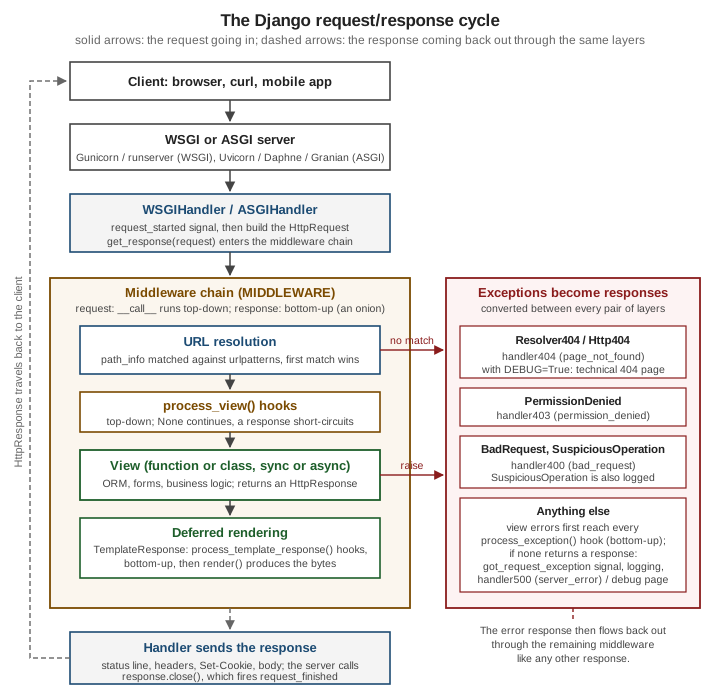
In words, for one ordinary GET under WSGI:
-
The server (Gunicorn,
runserver, uWSGI, mod_wsgi; or Uvicorn, Daphne, Granian, Hypercorn under ASGI) accepts the connection, parses the HTTP request and calls the application object thatconfig/wsgi.pyorconfig/asgi.pyexposes. -
The handler (
WSGIHandlerorASGIHandler) sends therequest_startedsignal, builds anHttpRequestfrom the server’senviron(WSGI) orscopeand body (ASGI), and passes it toget_response(). -
get_response()calls the outermost middleware. Each middleware’s__call__()runs its "before" code, then callsget_responseto hand the request to the next layer. -
The innermost layer (Django’s own, not yours) resolves the URL: it matches
request.path_infoagainst theurlpatternsofROOT_URLCONF(or ofrequest.urlconfif a middleware set one) and stores the result inrequest.resolver_match. -
Every middleware’s
process_view()hook runs, top-down. Any of them may answer on its own. -
The view runs with the request plus the URL’s captured arguments, and returns a response object.
-
If the response has a
render()method (aTemplateResponse), everyprocess_template_response()hook runs, bottom-up, and then the template is rendered. -
The response travels back out through each middleware’s "after" code, bottom-up.
-
The handler turns the response into a status line, headers (including
Set-Cookie) and a body for the server, which sends them and callsresponse.close(); closing sendsrequest_finished.
Whenever something raises along the way, Django turns the exception into a response and the cycle continues from step 8, as the red panel in the figure shows. The sections below take the steps in order.
The Bookshelf project used on this page
The examples need only a project (config) with one app (catalog) containing two models, a few views and a test module.
The settings are the startproject defaults plus catalog in INSTALLED_APPS, with SECRET_KEY and DEBUG read from the
environment so that the same file serves both the development session and the DEBUG = False checks below:
import os

from django.core.management.utils import get_random_secret_key

SECRET_KEY = os.environ.get("DJANGO_SECRET_KEY") or get_random_secret_key()
DEBUG = os.environ.get("DJANGO_DEBUG", "1") == "1"
ALLOWED_HOSTS = ["localhost", "127.0.0.1", "testserver"]

INSTALLED_APPS = [
    # ... the default django.contrib apps ...
    "catalog",
]from django.db import models
class Author(models.Model):
name = models.CharField(max_length=200)
def __str__(self):
return self.name
class Book(models.Model):
title = models.CharField(max_length=200)
author = models.ForeignKey(Author, on_delete=models.PROTECT, related_name="books")
price = models.DecimalField(max_digits=6, decimal_places=2)
class Meta:
ordering = ["title"]
def __str__(self):
return self.titleThe root URLconf below wires every view used in this page. Each path() line is explained where its view appears;
the two handler variables at the bottom are covered under error views:
from django.contrib import admin
from django.urls import path

from catalog import views

urlpatterns = [
    path("admin/", admin.site.urls),
    path("hello/", views.hello, name="hello"),
    path("books/", views.book_list, name="book-list"),
    path("books/<int:pk>/inspect/", views.inspect_request, name="inspect"),
    path("negotiate/", views.negotiate, name="negotiate"),
    path("attributes/", views.attributes, name="attributes"),
    path("csrf/", views.csrf_cookie, name="csrf"),
    path("cookies/", views.cookies, name="cookies"),
    path("moved/", views.moved, name="moved"),
    path("empty/", views.gone_forever, name="empty"),
    path("errors/missing/", views.missing),
    path("errors/forbidden/", views.forbidden),
    path("errors/bad-request/", views.bad_request),
    path("errors/suspicious/", views.suspicious),
    path("errors/boom/", views.boom),
    path("errors/lookup/", views.lookup_failure),
    path("mistakes/none/", views.returns_none),
    path("mistakes/await/", views.forgot_await),
    path("async/", views.async_hello, name="async"),
]

handler404 = "catalog.views.not_found"
handler500 = "catalog.views.server_error"
The first view is as small as a view can be, and it is the one used to exercise the handlers directly in the next section:
from django.http import HttpResponse


def hello(request):
    return HttpResponse("Hello from Bookshelf", content_type="text/plain")
Source: Django: Writing views and Django: URL dispatcher
The server and the handler
Django does not listen on a socket. A server does, and it speaks to Django through one of two Python standards:
WSGI (a synchronous callable application(environ, start_response)) or
ASGI (an asynchronous callable application(scope, receive, send)).
startproject generates config/wsgi.py and config/asgi.py, each of which exposes a module-level application;
Introduction & Architecture compares the two interfaces and lists
the servers. What matters here is what the callable behind application does, because it is the first piece of
Django code that touches the request. get_wsgi_application() and get_asgi_application() call django.setup() and
return an instance of django.core.handlers.wsgi.WSGIHandler or django.core.handlers.asgi.ASGIHandler. Django documents the
two functions, not the classes, as the public interface, so build on them in production code. The classes are used
directly below only to make the cycle visible.
WSGIHandler
WSGIHandler.__call__(environ, start_response) does five things, in this order (read in Django 6.1.1’s
django/core/handlers/wsgi.py):
-
It records the script prefix (
SCRIPT_NAME, orFORCE_SCRIPT_NAME) so thatreverse()and{% url %}produce paths that work when Django is mounted below/. -
It sends the
request_startedsignal with the handler class assenderand theenvirondictionary. -
It builds a
WSGIRequest(anHttpRequestsubclass) from theenviron. -
It calls
get_response(request), which runs the middleware chain, the view and everything in between, and always returns a response object. -
It calls
start_response()with the status line and the headers (the response’s headers plus oneSet-Cookieper cookie) and returns the response, which is an iterable of byte strings. When the server provideswsgi.file_wrapper, aFileResponseis handed to it so the server can usesendfile-style transfers.
The handler can be called without a server, which is the clearest way to see that a WSGI application is "just a function":
from wsgiref.util import setup_testing_defaults

from django.core.handlers.wsgi import WSGIHandler
from django.test import SimpleTestCase


class HandlerTests(SimpleTestCase):
    def test_wsgi_handler_speaks_wsgi(self):
        environ = {}
        setup_testing_defaults(environ)
        environ.update(PATH_INFO="/hello/", REQUEST_METHOD="GET", HTTP_HOST="localhost")
        seen = {}

        def start_response(status, headers):
            seen["status"], seen["headers"] = status, dict(headers)

        body = b"".join(WSGIHandler()(environ, start_response))
        self.assertEqual(seen["status"], "200 OK")
        self.assertEqual(seen["headers"]["Content-Type"], "text/plain")
        self.assertEqual(body, b"Hello from Bookshelf")
setup_testing_defaults() from the standard library’s wsgiref fills in the environ keys a real server would provide.
WSGIHandler() loads the middleware chain once, in its constructor; a production server creates it once per worker process
(the module-level application), never per request.
Source: Django: How to deploy with WSGI
ASGIHandler
ASGIHandler.__call__(scope, receive, send) has the same job with different mechanics:
-
It serves only
httpscopes. Awebsocketscope raisesValueError; WebSockets belong to Channels, which routes thewebsocketscope to consumers and handshttpto Django (see the Channels page of this section). -
It reads the whole request body before the view runs:
read_body()collectshttp.requestmessages into aSpooledTemporaryFile(in memory up toFILE_UPLOAD_MAX_MEMORY_SIZE, which is 2.5 MiB by default, then on disk) and wraps it as the request’s body stream. A slow upload therefore never occupies the view, but it also means the view cannot start processing a body while it is still arriving. -
It sends
request_startedwithawait signals.request_started.asend(…)(asynchronous signal dispatch exists since Django 5.0) and builds anASGIRequest. -
ASGIRequestfillsMETAfrom the scope: header names containing an underscore are dropped (the same anti-spoofing rule asrunserver), repeated headers are joined with commas and repeatedCookieheaders with"; ". If the request cannot even be built (an undecodable query string gives a plain400, an oversized body a plain-text413), the handler answers directly and no middleware runs. -
While the view runs it listens for the
http.disconnectmessage. If the client goes away first, the view’s task is cancelled and anasyncio.CancelledErroris raised inside it, so anasyncview can clean up (supported since Django 5.0). -
It sends the response in chunks of up to 64 KiB (
ASGIHandler.chunk_size) ashttp.response.startandhttp.response.bodymessages; for aStreamingHttpResponseit sends each chunk of the iterator as it is produced.
A hand-written ASGI "server" shows the message flow. The receive callable must behave like a real server’s: deliver the body,
and then block until the client disconnects (a version that returns a second http.request message makes Django raise an
AssertionError, because the protocol forbids it):
import asyncio

from django.core.handlers.asgi import ASGIHandler


class HandlerTests(SimpleTestCase):  # the same class as above
    async def test_asgi_handler_speaks_asgi(self):
        scope = {
            "type": "http",
            "asgi": {"version": "3.0"},
            "http_version": "1.1",
            "method": "GET",
            "path": "/hello/",
            "raw_path": b"/hello/",
            "query_string": b"",
            "headers": [(b"host", b"localhost")],
            "server": ("localhost", 8000),
            "client": ("127.0.0.1", 50000),
            "scheme": "http",
        }
        sent = []
        messages = [{"type": "http.request", "body": b"", "more_body": False}]

        async def receive():
            if messages:
                return messages.pop(0)
            await asyncio.Event().wait()  # like a real server: block until disconnect

        async def send(message):
            sent.append(message)

        await ASGIHandler()(scope, receive, send)
        self.assertEqual(sent[0]["type"], "http.response.start")
        self.assertEqual(sent[0]["status"], 200)
self.assertEqual(sent[1]["body"], b"Hello from Bookshelf")What differs inside the cycle
Everything after the handler is shared code in django.core.handlers.base.BaseHandler, but the handler’s mode decides
whether each step runs natively or through an adapter (see Sync and async through the cycle):
| WSGI | ASGI | |
|---|---|---|
Request class |
|
|
Body handling |
The server streams the body; Django reads it lazily when |
Django buffers the body before calling the middleware (a 2.5 MiB threshold decides memory versus disk). |
Client disconnects |
Not visible to the view; the server simply fails to write. |
Cancels the view’s task with |
|
Sent with |
Sent with |
|
Must be a synchronous iterator. |
Should be an asynchronous iterator (4.2+); a sync iterator is consumed fully, with a warning. |
Multiple |
Handled by the server. |
Supported since 6.0. |
Middleware chain |
Built with |
Built with |
Signals around a request
Three signals in django.core.signals frame the cycle:
| Signal | When it is sent |
|---|---|
|
By the handler, before the |
|
When the response has been delivered and |
|
Whenever an exception reaches Django’s exception-to-response conversion and will become a |
Django itself listens: the database layer connects reset_queries and close_old_connections to request_started and
close_old_connections to request_finished, which is how CONN_MAX_AGE is enforced, and the URL machinery resets the
thread’s URLconf (set_urlconf(None)) on request_finished. The test below connects two receivers and records the order
around a hand-driven WSGI call:
from django.core import signals


class HandlerTests(SimpleTestCase):  # the same class again
    def test_signals_around_one_request(self):
        events = []

        def started(sender, **kwargs):
            events.append(("request_started", sender.__name__))

        def finished(sender, **kwargs):
            events.append(("request_finished", sender.__name__))

        environ = {}
        setup_testing_defaults(environ)
        environ.update(PATH_INFO="/hello/", HTTP_HOST="localhost")
        signals.request_started.connect(started)
        signals.request_finished.connect(finished)
        try:
            result = WSGIHandler()(environ, lambda status, headers: None)
            events.append(("response returned to the server", ""))
            result.close()  # the WSGI server calls close() when it has sent the body
        finally:
            signals.request_started.disconnect(started)
            signals.request_finished.disconnect(finished)
        self.assertEqual(
            events,
            [
                ("request_started", "WSGIHandler"),
                ("response returned to the server", ""),
                ("request_finished", "WSGIHandler"),
            ],
        )
Two practical consequences follow. First, request_finished fires when the server closes the response, which for a
streaming response is after the last chunk, not when the view returns. Second, the official signals reference names the
sender class WsgiHandler; the real class is WSGIHandler, which is what the receiver above printed.
Source: Django: request_started, request_finished and got_request_exception
The middleware chain
Middleware is the first and the last code your project runs for a request. Django builds the chain once, when the handler is
created: BaseHandler.load_middleware() walks settings.MIDDLEWARE in reverse, calls each middleware factory with a
get_response callable (the layer that was just built, starting from the handler’s own _get_response), and wraps every
layer in an exception-to-response converter. The outermost layer ends up in the handler’s _middleware_chain, and
get_response(request) simply calls it. A factory is any callable that takes get_response and returns a callable that takes a
request and returns a response, either a function or a class with __init__(get_response) and __call__(request). Because the
chain is built once, __init__() (or the body of a function factory) runs once per process, not per request.
| Phase | Order and rule |
|---|---|
Request ("before" code) |
|
|
|
View |
Called with the request and the URL’s arguments. |
|
Reverse order (innermost first), only if the response has a |
|
Reverse order (innermost first), only for exceptions raised by the view or by |
Response ("after" code) |
Reverse order, bottom-up: the same layers that saw the request see the response. |
The three process_* hooks are optional extras on a class-based middleware; they are what the figure at the top of this page draws
inside the chain. Writing each kind of middleware, the full list of built-in classes and their ordering rules are on the
Middleware page; this page uses just enough middleware to show the cycle.
The default stack
startproject generates this MIDDLEWARE; each entry has a role in the cycle:
| Middleware | What it does in the cycle |
|---|---|
|
Optional HTTPS redirect (before the view), security headers such as HSTS and |
|
Attaches |
|
Rejects |
|
In |
|
Attaches |
|
Attaches |
|
Adds |
The order is not decoration: AuthenticationMiddleware reads the session, so moving it above SessionMiddleware breaks it, and
a middleware that wants to wrap everything (timing, request IDs, logging) goes first, while one that needs request.user goes
after AuthenticationMiddleware.
Watching the chain work
A middleware that records every hook it receives makes the order visible. Because two instances of one class cannot be given
different arguments (Django instantiates with only get_response), the example uses two subclasses that differ in their name:
from django.http import HttpResponse

TRACE: list[str] = []


class TraceMiddleware:
    """Records every hook Django calls, in order."""

    name = "trace"

    def __init__(self, get_response):
        self.get_response = get_response  # called once, at server start-up

    def __call__(self, request):
        TRACE.append(f"{self.name}: before get_response")
        response = self.get_response(request)
        TRACE.append(f"{self.name}: after get_response -> {response.status_code}")
        return response

    def process_view(self, request, view_func, view_args, view_kwargs):
        TRACE.append(f"{self.name}: process_view({view_func.__name__})")
        return None  # None means "carry on"

    def process_template_response(self, request, response):
        TRACE.append(f"{self.name}: process_template_response")
        return response

    def process_exception(self, request, exception):
        TRACE.append(f"{self.name}: process_exception({type(exception).__name__})")
        return None


class OuterTrace(TraceMiddleware):
    name = "outer"


class InnerTrace(TraceMiddleware):
    name = "inner"
TRACE is a module-level list only because the example is a demonstration; real middleware must not keep per-request state
in module or instance attributes, because one instance serves every request of the process, concurrently. A small script drives the
test client through a chain of just those two classes and prints the trace (the test client builds the same handler chain, with
DEBUG = False so the error views are the production ones):
import os

import django

os.environ.setdefault("DJANGO_SETTINGS_MODULE", "config.settings")
django.setup()

from django.test import Client
from django.test.utils import setup_test_environment, override_settings

from catalog.middleware import TRACE

setup_test_environment()  # lets the test Client work outside the test runner

CHAIN = ["catalog.middleware.OuterTrace", "catalog.middleware.InnerTrace"]


def show(title, path, **extra):
    TRACE.clear()
    client = Client(raise_request_exception=False)
    response = client.get(path, **extra)
    print(f"--- {title}: GET {path} -> {response.status_code}")
    for line in TRACE:
        print("   ", line)


with override_settings(MIDDLEWARE=CHAIN, ALLOWED_HOSTS=["testserver"], DEBUG=False):
    show("plain view", "/hello/")
    show("exception", "/errors/boom/")
    show("404 raised by URL resolution", "/nowhere/")
--- plain view: GET /hello/ -> 200
outer: before get_response
inner: before get_response
outer: process_view(hello)
inner: process_view(hello)
inner: after get_response -> 200
outer: after get_response -> 200
--- exception: GET /errors/boom/ -> 500
outer: before get_response
inner: before get_response
outer: process_view(boom)
inner: process_view(boom)
inner: process_exception(RuntimeError)
outer: process_exception(RuntimeError)
inner: after get_response -> 500
outer: after get_response -> 500
--- 404 raised by URL resolution: GET /nowhere/ -> 404
outer: before get_response
inner: before get_response
inner: after get_response -> 404
outer: after get_response -> 404Four facts the trace proves, each of which surprises someone:
-
Both layers' "before" code runs before any
process_view(): the view hooks belong to the innermost step, after URL resolution, not to each layer’s own turn. -
process_view()runs top-down, butprocess_exception()(andprocess_template_response()) run bottom-up. -
The response of a failing view, a
500here, is an ordinary response when it passes the "after" code of each layer. Neither layer needed atry/except. -
A URL that matches no pattern never reaches
process_view()orprocess_exception(): resolution raisesResolver404before either step, and the converter turns it into a404response (see URL resolution). AHttp404raised inside a view is different: it passes throughprocess_exception()like any other exception, as the next test shows.
The tests that assert these traces (and the next two behaviours) use override_settings(MIDDLEWARE=…), which replaces the chain for
one test:
TRACED = [
    "catalog.middleware.OuterTrace",
    "catalog.middleware.InnerTrace",
]


class TraceTests(TestCase):
    def setUp(self):
        TRACE.clear()

    @override_settings(MIDDLEWARE=TRACED)
    def test_template_response(self):
        response = self.client.get("/books/")
        self.assertContains(response, "Dune by Frank Herbert")
        self.assertEqual(
            [line for line in TRACE if "template" in line],
            ["inner: process_template_response", "outer: process_template_response"],
        )

    @override_settings(MIDDLEWARE=TRACED)
    def test_exception_hooks(self):
        self.client.raise_request_exception = False
        response = self.client.get("/errors/boom/")
        self.assertEqual(response.status_code, 500)
        self.assertEqual(
            [line for line in TRACE if "exception" in line],
            [
                "inner: process_exception(RuntimeError)",
                "outer: process_exception(RuntimeError)",
            ],
        )
        # the 500 is an ordinary response by the time it leaves the inner layer
self.assertIn("inner: after get_response -> 500", TRACE)Short-circuiting and rescuing
A layer may answer without calling get_response. Nothing inside it, the view included, ever sees the request, but the response
still travels back out through the layers above it. The next middleware returns 503 for requests carrying a maintenance
header, and the RescueMiddleware shows a process_exception() that returns a response for one exception type; both live in
catalog/middleware.py beside the tracing classes:
class MaintenanceGate:
    """Short-circuits: answers 503 without ever calling get_response."""

    def __init__(self, get_response):
        self.get_response = get_response

    def __call__(self, request):
        if request.headers.get("X-Maintenance") == "on":
            TRACE.append("gate: short-circuit 503")
            return HttpResponse("Back soon", status=503, headers={"Retry-After": "120"})
        return self.get_response(request)


class RescueMiddleware(TraceMiddleware):
    """process_exception that turns one exception type into a response."""

    name = "rescue"

    def process_exception(self, request, exception):
        super().process_exception(request, exception)
        if isinstance(exception, LookupError):
            return HttpResponse("rescued: " + str(exception), status=422)
return None @override_settings(
MIDDLEWARE=TRACED[:1] + ["catalog.middleware.MaintenanceGate"] + TRACED[1:]
)
def test_short_circuit(self):
response = self.client.get("/hello/", headers={"X-Maintenance": "on"})
self.assertEqual(response.status_code, 503)
self.assertEqual(response["Retry-After"], "120")
self.assertEqual(
TRACE,
[
"outer: before get_response",
"gate: short-circuit 503",
"outer: after get_response -> 503",
],
)
@override_settings(
MIDDLEWARE=TRACED[:1] + ["catalog.middleware.RescueMiddleware"] + TRACED[1:]
)
def test_exception_middleware_can_rescue(self):
response = self.client.get("/errors/lookup/")
self.assertEqual(response.status_code, 422)
self.assertEqual(response.content, b"rescued: no such shelf")
# outer sits above rescue, so its process_exception is never called
self.assertNotIn("outer: process_exception(LookupError)", TRACE)
# but the response still travels back out through every layer
self.assertIn("outer: after get_response -> 422", TRACE)The built-in middleware short-circuits constantly, and it is the usual source of "my view is never called" reports.
CsrfViewMiddleware.process_view() rejects an unsafe-method request without a valid token with a 403 before the view
runs. Against runserver with DEBUG = False, a bare POST to the attributes view of the next section fails, and a POST
that first fetches the CSRF cookie and echoes it in the X-CSRFToken header succeeds (the csrf view is
@ensure_csrf_cookie and returns plain text):
$ curl -s -o /dev/null -w "%{http_code}\n" -X POST http://localhost:8764/attributes/ \
    -H "Content-Type: application/json" -d '{"title":"Dune"}'
403
$ curl -s -c jar.txt http://localhost:8764/csrf/
csrftoken cookie set
$ TOKEN=$(awk '$6=="csrftoken"{print $7}' jar.txt)
$ curl -s -b jar.txt -X POST http://localhost:8764/attributes/ \
    -H "X-CSRFToken: $TOKEN" -H "Content-Type: application/json" -d '{"title":"Dune"}'
{"received": {"title": "Dune"}}
The Django test client skips CSRF checks by default (Client(enforce_csrf_checks=True) turns them on), which is why such
failures only appear in a browser or with curl:
    def test_csrf_middleware_answers_before_the_view_runs(self):
        strict = Client(enforce_csrf_checks=True)
        response = strict.post("/attributes/", {"a": "1"})
        self.assertEqual(response.status_code, 403)  # the view never ran
        strict.get("/csrf/")  # sets the csrftoken cookie
        token = strict.cookies["csrftoken"].value
        ok = strict.post("/attributes/", {"a": "1"}, headers={"X-CSRFToken": token})
self.assertEqual(ok.status_code, 200)Exceptions are converted between layers
Each layer is wrapped by convert_exception_to_response(). When a view or a middleware raises, the wrapper turns the
exception into a response before the next layer up sees anything. Every middleware therefore always gets a response back from
get_response, and never needs its own try/except around it. The official documentation puts it this way: even if the very
next middleware raises Http404, your middleware will receive a response with status_code 404. Two corollaries:
-
process_exception()is not a general error hook. It sees only exceptions raised by the view or by aTemplateResponse’s `render(); an exception raised by another middleware is converted straight to a response. -
Setting
DEBUG_PROPAGATE_EXCEPTIONStoTruestops the conversion of exceptions that would become a500: they propagate out of the handler to the server (the testtest_debug_propagate_exceptions_skips_the_500_pagebelow shows it). It is a debugging aid for servers that have their own error pages, not a production switch. The official text says it skips "this conversion", but in Django 6.1.1 the4xxconversions (Http404,PermissionDenied,BadRequest,SuspiciousOperation) still happen.
The full set of conversions is the subject of Exceptions and error views.
Middleware in sync and async mode
A middleware declares which modes it supports with the class or function attributes sync_capable (default True) and
async_capable (default False). When the handler builds the chain it compares each layer’s mode with the mode of the layer
below it and, if they differ, wraps the callable with asgiref’s `sync_to_async() or async_to_sync(). The adaptation costs a
thread hop, which is why a single synchronous third-party middleware makes an ASGI deployment slower than it should be.
A function middleware that supports both modes uses the sync_and_async_middleware decorator and checks the mode of
get_response once, at start-up:
from inspect import iscoroutinefunction

from django.utils.decorators import sync_and_async_middleware


@sync_and_async_middleware
def timing_middleware(get_response):
    """Function middleware that adapts to whichever mode it is given."""
    import time

    if iscoroutinefunction(get_response):

        async def middleware(request):
            start = time.perf_counter()
            response = await get_response(request)
            response.headers["X-Elapsed-ms"] = f"{(time.perf_counter() - start) * 1000:.1f}"
            return response

    else:

        def middleware(request):
            start = time.perf_counter()
            response = get_response(request)
            response.headers["X-Elapsed-ms"] = f"{(time.perf_counter() - start) * 1000:.1f}"
            return response

return middlewareclass HybridMiddlewareTests(SimpleTestCase):
@override_settings(MIDDLEWARE=["catalog.middleware.timing_middleware"])
def test_timing_middleware_under_wsgi(self):
self.assertIn("X-Elapsed-ms", self.client.get("/hello/"))
@override_settings(MIDDLEWARE=["catalog.middleware.timing_middleware"])
async def test_timing_middleware_under_asgi(self):
response = await AsyncClient().get("/hello/")
self.assertIn("X-Elapsed-ms", response)Django logs every adaptation at DEBUG level on the django.request logger when DEBUG = True, which is the quickest audit of
a middleware stack. The script builds both handlers with timing_middleware first and the sync-only OuterTrace last:
import logging, os, sys

import django

os.environ["DJANGO_SETTINGS_MODULE"] = "config.settings"
logging.basicConfig(level=logging.DEBUG, format="%(name)s %(levelname)s %(message)s", stream=sys.stdout)
django.setup()

from django.conf import settings
from django.core.handlers.asgi import ASGIHandler
from django.core.handlers.wsgi import WSGIHandler

logging.getLogger("django.request").setLevel(logging.DEBUG)
settings.DEBUG = True
settings.MIDDLEWARE = ["catalog.middleware.timing_middleware", "catalog.middleware.OuterTrace"]
print("== building ASGIHandler (OuterTrace is sync-only, timing_middleware is both)")
ASGIHandler()
print("== building WSGIHandler")
WSGIHandler()
== building ASGIHandler (OuterTrace is sync-only, timing_middleware is both)
django.request DEBUG Asynchronous handler adapted for middleware catalog.middleware.OuterTrace.
== building WSGIHandlerUnder ASGI the chain is built asynchronous, so the sync-only OuterTrace is the one adaptation (the message, worded from the
adapter’s side, says the asynchronous handler below it is adapted for a synchronous middleware); the hybrid function adds
none. Under WSGI nothing is adapted. The process_view, process_template_response and process_exception hooks are adapted
individually: process_exception hooks are always run synchronously, even under ASGI.
URL resolution
At the centre of the chain, BaseHandler.resolve_request() decides which view will run:
-
If the request has a
urlconfattribute (set by a middleware), that module is the root URLconf; otherwiseROOT_URLCONFis used.set_urlconf()records the choice for the current thread (soreverse()and{% url %}agree with it), andrequest_finishedresets it. -
The resolver matches
request.path_info(the path without the script prefix, and without the query string) against each entry ofurlpatterns, in order, and stops at the first match.include()hands the rest of the path to a nested list. -
The result is a
ResolverMatch, stored inrequest.resolver_matchand unpacked into the view, its positional arguments and its keyword arguments. -
If nothing matches,
Resolver404(a subclass ofHttp404) is raised.
The ResolverMatch object is what a view or a template gets when it asks "which route am I?":
| Attribute | Meaning |
|---|---|
|
The view callable; for a class-based view, the function returned by |
|
The arguments that will be passed to the view: positional groups, or named parts. |
|
The two halves of |
|
The pattern’s |
|
The application and instance namespaces, joined with |
|
The namespaced name used with |
|
The patterns tried before a match was found or the list was exhausted (useful in debugging). |
resolve("/path/") returns the same object without a request, and reverse() goes the other way. The test below resolves a
path, checks every attribute that matters, and goes through the whole stack with the test client:
class ResolutionTests(SimpleTestCase):
    def test_resolve_returns_resolver_match(self):
        match = resolve("/books/7/inspect/")
        self.assertIs(match.func, views.inspect_request)
        self.assertEqual(match.args, ())
        self.assertEqual(match.kwargs, {"pk": 7})
        self.assertEqual(match.url_name, "inspect")
        self.assertEqual(match.route, "books/<int:pk>/inspect/")
        self.assertEqual(reverse("inspect", kwargs={"pk": 7}), "/books/7/inspect/")

    def test_request_factory_skips_middleware_and_urls(self):
        request = RequestFactory().get("/anything/")
        # URL resolution never happened, so there is no resolver_match
        self.assertIsNone(request.resolver_match)
        self.assertEqual(views.hello(request).status_code, 200)
The second test marks a boundary that matters for testing: RequestFactory builds a request and calls a view directly, so
neither middleware nor URL resolution runs; request.resolver_match is None and request.user does not exist unless the
test sets it. The test client, by contrast, goes through every layer on this page.
Two details come from the official reference: request.resolver_match exists in views and in process_view(), but not in
middleware code that runs before URL resolution (the "before" half of __call__()); and reverse() accepts query= and
fragment= since Django 5.2, a feature that belongs to the URLs & Routing page of this section.
Switching the URLconf per request
Because the handler looks for request.urlconf before resolving, a middleware can route different hosts to different URL
trees; setting it to None returns to ROOT_URLCONF. This is how multi-tenant or api. subdomain setups are built without
a second project:
class HostUrlconfMiddleware:
    """Serve a different URLconf for api.* hosts (sets request.urlconf)."""

    def __init__(self, get_response):
        self.get_response = get_response

    def __call__(self, request):
        if request.get_host().split(":")[0].startswith("api."):
            request.urlconf = "catalog.api_urls"
return self.get_response(request)from django.http import JsonResponse
from django.urls import path
def index(request):
return JsonResponse({"urlconf": request.urlconf, "host": request.get_host()})
urlpatterns = [path("", index)] @override_settings(
ALLOWED_HOSTS=[".testserver"],
MIDDLEWARE=["catalog.middleware.HostUrlconfMiddleware"],
)
def test_request_urlconf_replaces_root_urlconf(self):
api = self.client.get("/", headers={"Host": "api.testserver"})
self.assertEqual(api.json(), {"urlconf": "catalog.api_urls", "host": "api.testserver"})
# the same path under the normal host is not routed at all
self.assertEqual(self.client.get("/").status_code, 404)The middleware must come before anything that resolves URLs, and reverse() inside the request then uses the replaced
URLconf as well.
Source: Django: HttpRequest.urlconf
Trailing slashes and APPEND_SLASH
A request for /hello (no slash) matches no pattern, so resolution raises Resolver404. CommonMiddleware sees the 404
on the way out and, because APPEND_SLASH is True by default and /hello/ would resolve, replaces the response with a
permanent redirect. It is a good illustration of the middleware doing work after the cycle’s middle:
    @override_settings(MIDDLEWARE=["django.middleware.common.CommonMiddleware"])
    def test_append_slash_redirects_a_404(self):
        response = self.client.get("/hello")
        self.assertEqual((response.status_code, response["Location"]), (301, "/hello/"))
        self.assertEqual(self.client.get("/hello/")["Content-Length"], "20")
$ curl -si http://localhost:28773/hello | grep -i "^HTTP\|^location"
HTTP/1.1 301 Moved Permanently
Location: /hello/
$ curl -si http://localhost:28773/hello/ | grep -i "^HTTP\|^content-length"
HTTP/1.1 200 OK
Content-Length: 20The same middleware set Content-Length: 20 on the 200 response. Two pitfalls: a POST to a URL without the slash cannot be
redirected without losing its body, so with DEBUG = True Django raises a RuntimeError telling you to fix the form’s action;
and a view can opt out with should_append_slash = False (the no_append_slash decorator).
Source: Django: APPEND_SLASH
Calling the view
With a ResolverMatch in hand, _get_response() runs the process_view() hooks and then calls the view:
response = view(request, *args, **kwargs)args are the unnamed groups of a re_path() pattern (used only when the pattern has no named groups); kwargs are the named
parts, such as pk, overridden by the optional kwargs dictionary given to path(). A view may be a function, the callable
returned by View.as_view(), or any callable that takes a request; the sections of this page after this one use plain
functions, and Function-Based Views & Shortcuts covers the
conveniences around them. Before the call the handler does two more things.
Transactions. If ATOMIC_REQUESTS is True for a database alias in DATABASES, the view is wrapped in
transaction.atomic(using=alias), unless the view is decorated with @transaction.non_atomic_requests. That wrapping is
only possible for synchronous views: with an async def view the handler raises RuntimeError: You cannot use ATOMIC_REQUESTS
with async views. The wrapping covers the view only, not the middleware around it and not template rendering (the transaction commits when
the view returns, before a TemplateResponse renders).
Async views. A view that is a coroutine function is run through async_to_sync() in WSGI mode and awaited natively in ASGI mode;
a synchronous view in ASGI mode runs in a thread (sync_to_async(thread_sensitive=True)). Both are described in
Sync and async through the cycle.
The contract. A view must return an HttpResponse (or a subclass, or an object with the same interface such as
StreamingHttpResponse or TemplateResponse). Two mistakes are caught by the handler with a clear message:
def returns_none(request):
    pass  # forgot the return statement


def forgot_await(request):
return async_hello(request) # a coroutine object, never awaitedclass ViewContractTests(TestCase):
def test_view_must_return_a_response(self):
with self.assertRaisesMessage(
ValueError, "didn't return an HttpResponse object. It returned None"
):
self.client.get("/mistakes/none/")
with self.assertRaisesMessage(ValueError, "It returned an unawaited coroutine"):
self.client.get("/mistakes/await/")
def test_atomic_requests_rejects_async_views(self):
# ATOMIC_REQUESTS is a per-database setting; turn it on for this test only
with mock.patch.dict(connection.settings_dict, {"ATOMIC_REQUESTS": True}):
with self.assertRaisesMessage(
RuntimeError, "You cannot use ATOMIC_REQUESTS with async views."
):
self.client.get("/async/")
# the same setting is harmless for a sync view
self.assertEqual(self.client.get("/hello/").status_code, 200)The ValueError for returns_none reads "The view catalog.views.returns_none didn’t return an HttpResponse object. It returned
None instead." In production this becomes a 500. The forgot_await case (a synchronous view that returns the result
of calling an async def function without await) gives the same check a different message; Python also prints a "coroutine was
never awaited" RuntimeWarning.
Deferred rendering with TemplateResponse
A plain HttpResponse holds finished bytes. A TemplateResponse holds the template name and the context instead, so that
decorators and middleware can still change them after the view has returned; Django renders it only when the response
leaves the chain’s inner step. The shortcut render() is the opposite: it renders immediately and returns an ordinary
HttpResponse (the usual choice, and slightly cheaper). The book_list view uses TemplateResponse:
from django.template.response import TemplateResponse

from .models import Book


def book_list(request):
    books = Book.objects.select_related("author")
    return TemplateResponse(
        request, "catalog/book_list.html", {"heading": "Books", "books": books}
)<!doctype html>
<html lang="en">
<body>
<h1>{{ heading }}</h1>
<ul>
{% for book in books %}
<li>{{ book.title }} by {{ book.author.name }} ({{ book.price }})</li>
{% endfor %}
</ul>
</body>
</html>The constructor is TemplateResponse(request, template, context=None, content_type=None, status=None, charset=None, using=None,
headers=None); its base class SimpleTemplateResponse has the same signature without request. Rendering follows rules
the test below demonstrates, all taken from the reference:
-
After the view returns, the handler runs the
process_template_response()hooks (bottom-up) and then callsrender(); the response middleware then sees the rendered response. -
render()takes effect once; later calls return the first result. Assigningresponse.contentrenders immediately. -
Reading
contentbefore rendering raisesContentNotRenderedError.is_renderedtells you which state you are in. -
add_post_render_callback()registers a function that runs right after rendering (useful for caching the output). -
An exception during
render()is passed toprocess_exception()like a view exception, and an error view that returns aTemplateResponseis rendered by the handler automatically.
    def test_template_response_is_lazy_until_rendered(self):
        request = RequestFactory().get("/books/")
        response = views.book_list(request)
        self.assertFalse(response.is_rendered)
        with self.assertRaises(ContentNotRenderedError):
            response.content
        response.context_data["heading"] = "Changed after the view returned"
        response.render()
        self.assertTrue(response.is_rendered)
        self.assertIn(b"Changed after the view returned", response.content)
With the seeded book (Dune by Frank Herbert), curl shows the rendered page; the queryset is evaluated during rendering,
after the view has returned, which is a subtle reason to keep select_related() or prefetch_related() in the view, and
a reason a process_template_response() hook can still add context:
$ curl -s http://localhost:8764/books/
<!doctype html>
<html lang="en">
<body>
  <h1>Books</h1>
  <ul>

    <li>Dune by Frank Herbert (9.99)</li>

  </ul>
</body>
</html>
The template language and the rest of the template engine have their own pages in this section.
The HttpRequest object
The handler builds one HttpRequest per request (a WSGIRequest or an ASGIRequest) and every layer after it receives the same object.
Treat its attributes as read-only unless the reference says otherwise; middleware may add attributes. The attributes fall in three groups.
Attributes Django sets
| Attribute | Meaning |
|---|---|
|
The HTTP method, always uppercase. Test it with |
|
|
|
The path including or excluding the script prefix ( |
|
|
|
Uploaded files, only for a |
|
A dictionary of cookie names to string values. |
|
A dictionary of server and header values: |
|
A case-insensitive, dict-like view of the request headers ( |
|
The raw body as bytes. Reading it also consumes the stream; after |
|
The parsed |
|
The |
|
New in 6.1: the class used to parse |
When no Content-Type header is sent, request.content_type is "text/plain", as the curl output below shows.
Attributes your code or middleware sets
Django does not set these but honours them if present: request.urlconf (root URLconf for this request, covered above),
request.current_app (a hint for {% url %} and reverse() namespace resolution), and request.exception_reporter_filter and
request.exception_reporter_class (replace DEFAULT_EXCEPTION_REPORTER_FILTER and DEFAULT_EXCEPTION_REPORTER for this request).
The bundled middleware adds request.session (SessionMiddleware), request.user and request.auser()
(AuthenticationMiddleware; auser() is the coroutine for async code and has existed since 5.0), and request.site
(CurrentSiteMiddleware). If an attribute you expect is missing, the middleware that sets it is not in MIDDLEWARE or comes too late.
Methods
| Method | What it returns |
|---|---|
|
The originating host and port, from |
|
The path plus the query string (the second one from |
|
An absolute URL with the request’s own scheme; Django will not turn |
|
|
|
A cookie set with |
|
Content negotiation from the |
|
A file-like interface for streaming a big body, for example straight into |
|
The authenticated user in async code. |
One reference-page sentence is out of date in Django 6.1: the get_signed_cookie() entry says cookies signed by older Django
versions are accepted by default. The 6.1 release notes deprecate the transitional setting SIGNED_COOKIE_LEGACY_SALT_FALLBACK, and its
default is False in 6.1 (read in global_settings.py of Django 6.1.1): signed cookies that carry the legacy salt derivation (produced by older releases) are rejected
unless the setting is set to True during a migration.
A view that reports what Django knows about the request makes all of this concrete:
from django.http import JsonResponse


def inspect_request(request, pk):
    match = request.resolver_match
    data = {
        "method": request.method,
        "scheme": request.scheme,
        "is_secure": request.is_secure(),
        "host": request.get_host(),
        "path": request.path,
        "path_info": request.path_info,
        "full_path": request.get_full_path(),
        "absolute_uri": request.build_absolute_uri(),
        "query": request.GET.dict(),
        "tags": request.GET.getlist("tag"),
        "content_type": request.content_type,
        "user_agent": request.headers.get("user-agent"),
        "meta_has_http_accept": "HTTP_ACCEPT" in request.META,
        "cookies": request.COOKIES,
        "view_name": match.view_name,
        "url_name": match.url_name,
        "route": match.route,
        "kwargs": match.kwargs,
        "pk": pk,
    }
    return JsonResponse(data)
Requested against runserver (with DJANGO_DEBUG=0 and the repeated parameter tag), the answer is:
$ curl -s "http://localhost:28774/books/7/inspect/?tag=a&tag=b&page=2" \
    -H "Accept: application/json" -b "theme=dark" | python -m json.tool
{
"method": "GET",
"scheme": "http",
"is_secure": false,
"host": "localhost:28774",
"path": "/books/7/inspect/",
"path_info": "/books/7/inspect/",
"full_path": "/books/7/inspect/?tag=a&tag=b&page=2",
"absolute_uri": "http://localhost:28774/books/7/inspect/?tag=a&tag=b&page=2",
"query": {
"tag": "b",
"page": "2"
},
"tags": [
"a",
"b"
],
"content_type": "text/plain",
"user_agent": "curl/8.7.1",
"meta_has_http_accept": true,
"cookies": {
"theme": "dark"
},
"view_name": "inspect",
"url_name": "inspect",
"route": "books/<int:pk>/inspect/",
"kwargs": {
"pk": 7
},
"pk": 7
}Note "query": {"tag": "b"} against "tags": ["a", "b"]: QueryDict.get() and dict() return the last value for a repeated key, and
getlist() returns all of them.
Source: Django: HttpRequest objects
Reading the body
request.POST is filled only for application/x-www-form-urlencoded and multipart/form-data bodies. JSON, XML and any other format
arrive in request.body and must be parsed by the view. The attributes view handles both and turns a malformed JSON body into
BadRequest, a 400 (see Exceptions and error views):
import json

from django.core.exceptions import BadRequest
from django.http import HttpResponseNotAllowed, JsonResponse


def attributes(request):
    """Show request.body, request.POST and the file-like interface."""
    if request.method != "POST":
        return HttpResponseNotAllowed(["POST"])
    if request.content_type == "application/json":
        try:
            payload = json.loads(request.body)
        except json.JSONDecodeError:
            raise BadRequest("Malformed JSON")
        return JsonResponse({"received": payload})
return JsonResponse({"form": request.POST.dict()}) def test_body_post_and_json(self):
form = self.client.post("/attributes/", {"a": "1", "b": ["x", "y"]})
self.assertEqual(form.json(), {"form": {"a": "1", "b": "y"}})
js = self.client.post("/attributes/", {"x": 1}, content_type="application/json")
self.assertEqual(js.json(), {"received": {"x": 1}})
refused = self.client.get("/attributes/")
self.assertEqual(refused.status_code, 405)
self.assertEqual(refused["Allow"], "POST")The file-like interface, the header mapping and the immutability rules are easiest to see on a RequestFactory request, whose output
is shown after the script (run in manage.py shell):
import json

from django.http import RawPostDataException
from django.test import RequestFactory

rf = RequestFactory()

# a JSON POST: request.POST stays empty, request.body holds the bytes
request = rf.post("/api/books/", data=json.dumps({"title": "Dune"}), content_type="application/json")
print(request.method, request.content_type, dict(request.POST), request.body)

# the file-like interface consumes the stream; body can no longer be read afterwards
request = rf.post("/api/books/", data='{"title": "Dune"}', content_type="application/json")
print(request.read(8))
try:
    request.body
except RawPostDataException as exc:
    print("RawPostDataException:", exc)

# header handling: META keys versus request.headers
request = rf.get(
    "/books/?page=2",
    headers={"X-Bender": "bite my shiny metal", "Accept": "text/html,application/json;q=0.8"},
)
print(request.META["HTTP_X_BENDER"], "|", request.headers["x-bender"], "|", request.headers["X-BENDER"])
print(request.accepts("text/html"), request.accepts("image/png"))
print(request.get_preferred_type(["application/json", "text/html"]))
print(request.get_preferred_type(["image/png"]))

# immutability of GET/POST
try:
    request.GET["page"] = "3"
except AttributeError as exc:
    print("AttributeError:", exc)

print(type(request).__name__, request.path, request.path_info, request.get_full_path())
POST application/json {} b'{"title": "Dune"}'
b'{"title"'
RawPostDataException: You cannot access body after reading from request's data stream
bite my shiny metal | bite my shiny metal | bite my shiny metal
True False
text/html
None
AttributeError: This QueryDict instance is immutable
WSGIRequest /books/ /books/ /books/?page=2Request size is bounded by settings: DATA_UPLOAD_MAX_MEMORY_SIZE (2.5 MiB by default; counts everything except file uploads),
DATA_UPLOAD_MAX_NUMBER_FIELDS (1000) and DATA_UPLOAD_MAX_NUMBER_FILES (100). Exceeding them raises RequestDataTooBig,
TooManyFieldsSent or TooManyFilesSent, all SuspiciousOperation subclasses, when the body or POST is first read, which is why
the error appears inside the view (or in a middleware that touches request.POST early), not at connection time:
    @override_settings(DATA_UPLOAD_MAX_MEMORY_SIZE=10)
    def test_oversized_body_is_a_400_raised_lazily(self):
        # RequestDataTooBig (a SuspiciousOperation) fires when the body is read
        with self.assertLogs("django.security.RequestDataTooBig", level="ERROR"):
            response = self.client.post("/attributes/", {"title": "x" * 100})
        self.assertEqual(response.status_code, 400)
A related rule from the middleware reference: do not read request.POST in middleware before the view runs, because that
freezes the upload handlers a view might still want to change; CsrfViewMiddleware is the one exception (it offers
csrf_exempt and csrf_protect so a view can decide when validation happens).
QueryDict
request.GET and request.POST are django.http.QueryDict instances: dictionaries that keep a list of values per key, because HTML
forms (<select multiple>, repeated checkboxes) and URLs (?tag=a&tag=b) allow repeated keys. They are immutable inside a request; call .copy() for a
mutable deep copy, for example to rebuild a query string with one parameter changed.
| Call | Behaviour |
|---|---|
|
The last value; |
|
All values as a list ( |
|
A plain |
|
|
|
Mutators (on a mutable copy only); |
|
The query-string form; |
|
A standalone instance; |
from django.http import QueryDict

q = QueryDict("tag=a&tag=b&page=2")
print(q["tag"], q.getlist("tag"), q.dict(), q.urlencode())
print(q.copy().__class__.__name__, q._mutable, q.copy()._mutable)
b ['a', 'b'] {'tag': 'b', 'page': '2'} tag=a&tag=b&page=2
QueryDict False True def test_querydict(self):
q = QueryDict("a=1&a=2&c=3")
self.assertEqual(q["a"], "2")
self.assertEqual(q.getlist("a"), ["1", "2"])
with self.assertRaises(AttributeError):
q["z"] = "boom"
m = q.copy()
m["z"] = "ok"
self.assertEqual(m.urlencode(), "a=1&a=2&c=3&z=ok")Source: Django: QueryDict objects
Content negotiation: accepts() and get_preferred_type()
Browsers, curl and API clients tell the server which representations they can handle in the Accept header. Two request methods read it:
-
request.accepts("application/json")returnsTrueif the header matches that type (since 3.1). Most browsers sendAccept: /by default, in which caseaccepts()isTruefor every type, so it answers "may I send this?", not "which is best?". -
request.get_preferred_type(["text/html", "application/json"])returns the best of the candidates according to the header’sqweights and parameters, orNoneif none is acceptable (since 5.2). With/it returns the first candidate, so list your default first.
The negotiate view answers HTML, JSON or 406 Not Acceptable. Because the response now depends on a request header, it declares that
with Vary: Accept (the vary_on_headers decorator adds it) so that caches keep one entry per representation:
from http import HTTPStatus

from django.http import HttpResponse, JsonResponse
from django.views.decorators.vary import vary_on_headers


@vary_on_headers("Accept")
def negotiate(request):
    best = request.get_preferred_type(["text/html", "application/json"])
    if best is None:
        return HttpResponse(status=HTTPStatus.NOT_ACCEPTABLE)
    if best == "application/json":
        return JsonResponse({"books": ["Dune", "Emma"]})
return HttpResponse("<ul><li>Dune</li><li>Emma</li></ul>") def test_content_negotiation(self):
html = self.client.get("/negotiate/", headers={"Accept": "text/html"})
self.assertEqual(html["Content-Type"], "text/html; charset=utf-8")
data = self.client.get(
"/negotiate/", headers={"Accept": "application/json;q=1, text/html;q=0.5"}
)
self.assertEqual(data.json(), {"books": ["Dune", "Emma"]})
self.assertEqual(data["Vary"], "Accept")
nope = self.client.get("/negotiate/", headers={"Accept": "image/png"})
self.assertEqual(nope.status_code, 406)$ for h in "text/html" "application/json" "application/json;q=1, text/html;q=0.5" "image/png" "*/*"; do
> echo "## Accept: $h"; curl -si localhost:8764/negotiate/ -H "Accept: $h" | grep -i "^HTTP\|^content-type\|^vary\|^{\|^<"; done
## Accept: text/html
HTTP/1.1 200 OK
Content-Type: text/html; charset=utf-8
Vary: Accept
<ul><li>Dune</li><li>Emma</li></ul>
## Accept: application/json
HTTP/1.1 200 OK
Content-Type: application/json
Vary: Accept
{"books": ["Dune", "Emma"]}
## Accept: application/json;q=1, text/html;q=0.5
HTTP/1.1 200 OK
Content-Type: application/json
Vary: Accept
{"books": ["Dune", "Emma"]}
## Accept: image/png
HTTP/1.1 406 Not Acceptable
Content-Type: text/html; charset=utf-8
Vary: Accept
## Accept: */*
HTTP/1.1 200 OK
Content-Type: text/html; charset=utf-8
Vary: Accept
<ul><li>Dune</li><li>Emma</li></ul>request.accepts() and get_preferred_type() replace the old habit of deciding "is this an AJAX call?" with
request.is_ajax(), which looked at the non-standard X-Requested-With header: it was deprecated in 3.1 and removed in 4.0.
Negotiate on what the client accepts (or on the URL, for example a .json suffix) instead of how the request was made.
If you must still detect the header, read request.headers.get("x-requested-with") == "XMLHttpRequest" yourself.
The HttpResponse object
Unlike the request, the response is your responsibility: a view builds it and returns it. django.http.HttpResponse is the
workhorse; it holds the body and the headers in memory, which also lets middleware read and change them.
HttpResponse(content=b"", content_type=None, status=200, reason=None, charset=None, headers=None)content may be a str, bytes, memoryview or an iterator of strings or bytes (consumed immediately, which is not
streaming); content_type defaults to text/html; charset=utf-8 (from DEFAULT_CHARSET); status accepts an integer or an
http.HTTPStatus member; headers is a dictionary of headers. The most useful attributes and methods:
| Member | Meaning |
|---|---|
|
The body as bytes, and as a decoded string ( |
|
The status; the reason phrase follows |
|
A case-insensitive, dict-like object (added in 3.2; the older |
|
A |
|
The encoding, whether the response streams (always |
|
A file-like interface for building the body incrementally; |
|
Cookie helpers, described below. |
|
Called by the server at the end of the request; closes files and sends |
A stand-alone script exercises the constructor, reason_phrase, write(), BadHeaderError, the redirect classes, JsonResponse and
the streaming flag; every line of the output below was produced by it:
from http import HTTPStatus

from django.http import (
    BadHeaderError,
    HttpResponse,
    HttpResponsePermanentRedirect,
    HttpResponseRedirect,
    JsonResponse,
    StreamingHttpResponse,
)

r = HttpResponse("Hello", status=HTTPStatus.CREATED, headers={"X-Shelf": "A1"})
print(r.status_code, r.reason_phrase, r.charset, r["content-type"])
r.write(", world")
print(r.content, r.text, r.streaming, r.closed)
r.status_code = 202
print(r.reason_phrase)                      # follows status_code until set explicitly
r.headers["Cache-Control"] = "no-store"
print(sorted(k for k, _ in r.items()))
try:
    r["X-Bad"] = "a\nb"
except BadHeaderError as exc:
    print("BadHeaderError:", exc)

print(HttpResponseRedirect("/a/").status_code,
      HttpResponseRedirect("/a/", preserve_request=True).status_code,
      HttpResponsePermanentRedirect("/a/").status_code,
      HttpResponsePermanentRedirect("/a/", preserve_request=True).status_code)

j = JsonResponse([1, 2, 3], safe=False)
print(j["Content-Type"], j.content)
try:
    JsonResponse([1, 2, 3])
except TypeError as exc:
    print("TypeError:", exc)

s = StreamingHttpResponse(iter([b"a", b"b"]))
print(s.streaming, s.is_async, hasattr(s, "content"), list(s.streaming_content))
201 Created utf-8 text/html; charset=utf-8
b'Hello, world' Hello, world False False
Accepted
['Cache-Control', 'Content-Type', 'X-Shelf']
BadHeaderError: Header values can't contain newlines (got 'a\nb')
302 307 301 308
application/json b'[1, 2, 3]'
TypeError: In order to allow non-dict objects to be serialized set the safe parameter to False.
True False False [b'a', b'b']For Cache-Control and Vary, which can hold several comma-separated values that other layers also set, use
django.utils.cache.patch_cache_control() and patch_vary_headers() rather than assigning, so values added by middleware
are not lost.
Source: Django: HttpResponse objects
Subclasses and status codes
Django ships a subclass for each common status. They differ from HttpResponse only in status_code (and in the constructor
arguments noted):
| Class | Status | Notes |
|---|---|---|
|
302 |
Required first argument: the target; |
|
301 |
|
|
304 |
No arguments and no content; used for conditional requests. |
|
400 |
|
|
403 |
|
|
404 |
|
|
405 |
Required argument: the list of permitted methods, which the class puts in the |
|
410 |
|
|
500 |
|
|
200 |
|
|
200 |
Not an |
|
200 |
A |
Any other status uses HttpResponse(status=…), or a one-line subclass:
from http import HTTPStatus

from django.http import HttpResponse, HttpResponseRedirect


class HttpResponseNoContent(HttpResponse):
    status_code = HTTPStatus.NO_CONTENT


def moved(request):
    return HttpResponseRedirect("/hello/", preserve_request=True)


def gone_forever(request):
return HttpResponseNoContent() def test_redirect_and_custom_response(self):
moved = self.client.get("/moved/")
self.assertEqual((moved.status_code, moved["Location"]), (307, "/hello/"))
self.assertEqual(self.client.get("/empty/").status_code, 204)$ curl -si http://localhost:8764/moved/ | grep -i "^HTTP\|^location"
HTTP/1.1 307 Temporary Redirect
Location: /hello/
$ curl -si http://localhost:8764/empty/ | head -1
HTTP/1.1 204 No Content
$ curl -si http://localhost:8764/attributes/ | grep -i "^HTTP\|^allow"
HTTP/1.1 405 Method Not Allowed
Allow: POSTA 302 lets the browser switch a POST to a GET when it follows the redirect, which is what the post/redirect/get pattern
wants; 307 and 308 (preserve_request=True, Django 5.2+) ask the client to repeat the same method and body, which is what
you want for an API that moved. The redirect() shortcut gained the same argument.
Cookies
Cookies are response state, not request state: the server sets them in Set-Cookie headers and the browser returns them in
Cookie. set_cookie(key, value="", max_age=None, expires=None, path="/", domain=None, secure=False, httponly=False, samesite=None)
takes max_age as seconds or a timedelta (a timedelta is accepted since 4.1) and computes expires for you.
Use secure=True so the cookie is sent only over HTTPS, httponly=True so JavaScript cannot read it, and samesite="Lax" or
"Strict" as defence in depth against cross-site requests (not a replacement for CSRF protection; samesite="None" is the explicit
"send always" form). delete_cookie(key, path="/", domain=None, samesite=None) must repeat the path and domain used to set the
cookie. Browsers guarantee about 4096 bytes per cookie; Django does not warn if you exceed it.
set_signed_cookie(key, value, salt="", …) adds a signature, and request.get_signed_cookie(key, salt=…) verifies it: the signature
protects against tampering, but the value is still readable by the client, so never put secrets in it.
def cookies(request):
    response = HttpResponse("cookies set")
    response.set_cookie("theme", "dark", max_age=3600, httponly=True, samesite="Lax")
    response.set_signed_cookie("cart", "42", salt="cart", httponly=True)
return response def test_cookies_and_signed_cookie(self):
response = self.client.get("/cookies/")
self.assertEqual(response.cookies["theme"]["samesite"], "Lax")
self.assertTrue(response.cookies["theme"]["httponly"])
self.assertTrue(response.cookies["cart"].value.startswith("42:"))$ curl -si http://localhost:8764/cookies/ | grep -i "^HTTP\|set-cookie"
HTTP/1.1 200 OK
Set-Cookie: theme=dark; expires=Sat, 03 Oct 2026 00:38:57 GMT; HttpOnly; Max-Age=3600; Path=/; SameSite=Lax
Set-Cookie: cart=42:1xCmq9:_JNWCn_MaziEVcOm2qbo8qm0s4kohvPvuXdqVC5KNUs; HttpOnly; Path=/The signed value is value:timestamp:signature. Its signing key comes from SECRET_KEY (and SECRET_KEY_FALLBACKS for rotation),
which is why SECRET_KEY must come from the environment. Sessions, the messages framework and the signing module have their own
page in this section; here it is enough to know that signed cookies are an HttpResponse feature. Note that 6.1 changed the salt
derivation of signed cookies; see What changed recently.
Streaming and file responses in the cycle
StreamingHttpResponse and its subclass FileResponse send their body in pieces instead of building it in memory. They change the cycle
in four ways: they have no content (middleware must test response.streaming and wrap streaming_content instead of reading it; wrappers must match
the iterator type, which response.is_async reveals); middleware that needs the whole body, such as CommonMiddleware’s
`Content-Length or ConditionalGetMiddleware’s `ETag, skips them; request_finished fires only when the server has sent the last
chunk; and under WSGI a streaming response ties up a worker for its whole duration. Under ASGI the iterator should be asynchronous
(supported since 4.2); a synchronous one is consumed completely, with a warning, which defeats streaming. If a client disconnects
mid-stream under ASGI, Django cancels the coroutine, and you may catch asyncio.CancelledError to release resources (re-raise it afterwards).
Building such responses in practice (CSV exports, PDFs, server-sent events) belongs to the Responses, Streaming, CSV & PDF page
of this section.
Exceptions and error views
Exceptions do not escape the cycle. The converter described in the middleware section catches every exception raised in a view or
a middleware and turns it into a response, using django.core.handlers.exception.response_for_exception(). The mapping in Django 6.1.1:
| Raised | Status | Error view | Logging and notes |
|---|---|---|---|
|
404 |
|
Logged at |
|
403 |
|
Logged at |
|
400 |
|
Logged at |
|
400 |
|
Logged at |
|
400 |
|
Logged at |
Anything else |
500 |
|
The |
Before any of this, process_exception() hooks see an exception raised by the view (and only that), and a hook that returns a
response ends the conversion. If an error view itself fails, Django falls back: it sends got_request_exception and
answers through the 500 handler. Under ASGI there is a last line of defence too: a plain-text 500 if even that
fails, with the traceback only when DEBUG is on.
Custom error views
handler400, handler403, handler404 and handler500 are plain module-level variables in the root URLconf (setting them in an
included URLconf has no effect). Each holds a callable or its dotted path. handler404, handler403 and handler400 receive
(request, exception), and handler500 receives only (request). The default 404.html, 500.html, 403.html and
400.html templates (top level of the template tree) are what the built-in views render; a custom view replaces them when you need
to vary the output, here by the Accept header so API clients get JSON and browsers get HTML:
from django.http import HttpResponse, JsonResponse


def not_found(request, exception=None):
    if request.accepts("application/json") and not request.accepts("text/html"):
        return JsonResponse({"error": "not_found", "path": request.path}, status=404)
    return HttpResponse("<h1>Sorry, nothing here</h1>", status=404)


def server_error(request):
    return HttpResponse("<h1>Something broke on our side</h1>", status=500)
The URLconf already ends with handler404 = "catalog.views.not_found" and handler500 = "catalog.views.server_error" (see the
project listing above). Keep error views simple and independent of the database and of context processors: they run when something
else is already wrong. Tests drive them by raising the exception from a view; the test client re-raises unhandled exceptions by
default (raise_request_exception), so set it to False when you want to see the 500 page:
class ErrorTests(SimpleTestCase):
    def test_exceptions_become_status_codes(self):
        self.client.raise_request_exception = False
        cases = {
            "/errors/missing/": 404,
            "/errors/forbidden/": 403,
            "/errors/bad-request/": 400,
            "/errors/suspicious/": 400,
            "/errors/boom/": 500,
            "/nowhere/": 404,
        }
        with self.assertLogs("django.request", level="WARNING"):
            for path, status in cases.items():
                with self.subTest(path=path):
                    self.assertEqual(self.client.get(path).status_code, status)

    def test_custom_handlers(self):
        self.client.raise_request_exception = False
        html = self.client.get("/nowhere/", headers={"Accept": "text/html"})
        self.assertContains(html, "Sorry, nothing here", status_code=404)
        api = self.client.get("/nowhere/", headers={"Accept": "application/json"})
        self.assertEqual(api.json(), {"error": "not_found", "path": "/nowhere/"})
        boom = self.client.get("/errors/boom/")
        self.assertContains(boom, "Something broke", status_code=500)

    def test_client_reraises_unhandled_exceptions_by_default(self):
        with self.assertRaisesMessage(RuntimeError, "database exploded"):
            self.client.get("/errors/boom/")

    @override_settings(DEBUG_PROPAGATE_EXCEPTIONS=True)
    def test_debug_propagate_exceptions_skips_the_500_page(self):
        self.client.raise_request_exception = False
        # a would-be 500 now escapes the handler and reaches the server...
        with self.assertRaises(RuntimeError):
            self.client.get("/errors/boom/")
        # ...while 4xx conversions are unaffected
        self.assertEqual(self.client.get("/errors/missing/").status_code, 404)

    @override_settings(DEBUG=True)
    def test_debug_true_shows_technical_pages_instead_of_handlers(self):
        response = self.client.get("/nowhere/", headers={"Accept": "text/html"})
        self.assertContains(response, "Page not found", status_code=404)
        self.assertNotContains(response, "Sorry, nothing here", status_code=404)
The views these tests call are one-liners that raise (missing raises Http404("No such book"), forbidden raises
PermissionDenied("Staff only"), bad_request raises BadRequest("Malformed filter"), suspicious raises
SuspiciousOperation("Tampered cookie"), boom raises RuntimeError("database exploded")). Against runserver with DJANGO_DEBUG=0:
$ curl -si localhost:8764/nowhere/ -H "Accept: text/html" | grep -i "^HTTP\|^<"
HTTP/1.1 404 Not Found
<h1>Sorry, nothing here</h1>
$ curl -si localhost:8764/nowhere/ -H "Accept: application/json" | grep -i "^HTTP\|^{"
HTTP/1.1 404 Not Found
{"error": "not_found", "path": "/nowhere/"}
$ curl -si localhost:8764/errors/boom/ | grep -i "^HTTP\|^<"
HTTP/1.1 500 Internal Server Error
<h1>Something broke on our side</h1>
With the default DEBUG = True, the console shows the logging described in the table (tracebacks trimmed here), and the browser
gets the technical pages (about 63 KB each for the 400 and 500 cases) instead of the handlers:
Not Found: /nowhere/
[02/Oct/2026 23:39:36] "GET /nowhere/ HTTP/1.1" 404 5055
Forbidden (Permission denied): /errors/forbidden/
django.core.exceptions.PermissionDenied: Staff only
[02/Oct/2026 23:39:36] "GET /errors/forbidden/ HTTP/1.1" 403 135
Tampered cookie
django.core.exceptions.SuspiciousOperation: Tampered cookie
[02/Oct/2026 23:39:36] "GET /errors/suspicious/ HTTP/1.1" 400 63800
Malformed filter: /errors/bad-request/
django.core.exceptions.BadRequest: Malformed filter
[02/Oct/2026 23:39:36] "GET /errors/bad-request/ HTTP/1.1" 400 63744
Internal Server Error: /errors/boom/
RuntimeError: database exploded
[02/Oct/2026 23:39:36] "GET /errors/boom/ HTTP/1.1" 500 63656
The CSRF failure view is separate: set CSRF_FAILURE_VIEW (default django.views.csrf.csrf_failure) to customise it. Error handling
for URL patterns (handler404 with a namespaced URLconf, Resolver404) and for forms and models has its own treatment on the URLs & Routing
and Forms pages; for a comparison with FastAPI’s exception handlers see
FastAPI: Status Codes & Error Handling.
Sync and async through the cycle
One chain serves both modes, and Django adapts whatever does not match. Reading django/core/handlers/base.py (6.1.1) gives the
rules:
| Piece | Under WSGI (sync chain) | Under ASGI (async chain) |
|---|---|---|
Middleware |
Sync middleware runs directly; async-only middleware is wrapped with |
Async middleware runs directly; sync-only middleware is wrapped with |
|
Adapted to the mode of the chain, individually. |
Adapted to the mode of the chain, individually. |
|
Sync. |
Always run in sync mode, in a thread. |
Sync view |
Called directly. |
Run with |
Async view |
Run with |
Awaited on the server’s event loop. |
|
Called directly. |
Run in a thread unless |
|
Supported for sync views. |
Raises |
Request body |
Read lazily. |
Buffered before the chain starts. |
Practical consequences:
-
A single synchronous middleware in the stack makes every request pay a thread hop under ASGI, hence the advice to check the
django.requestDEBUGlog as shown earlier. The bundled middleware supports both modes. -
Do not call blocking code in an
async defview. The ORM’s synchronous methods are async-unsafe: Django raisesSynchronousOnlyOperationinstead of risking corruption, so use thea-prefixed ORM methods orsync_to_async(). -
request.useris a lazy object that touches the database; in an async view useawait request.auser()(5.0+). -
With a purely synchronous codebase there is no need to switch to ASGI; async pays off when requests spend their time waiting (external APIs, streaming, long polling, WebSockets) and many must be open at once.
The async_hello view uses await request.auser() and runs on both server types:
import asyncio

from django.http import JsonResponse


async def async_hello(request):
    await asyncio.sleep(0.01)
    user = await request.auser()
return JsonResponse({"async": True, "anonymous": not user.is_authenticated})class AsyncTests(SimpleTestCase):
async def test_async_view_and_auser(self):
response = await AsyncClient().get("/async/")
self.assertEqual(response.json(), {"async": True, "anonymous": True})
def test_async_view_under_the_sync_client(self):
self.assertTrue(self.client.get("/async/").json()["async"])The same code was then served by Uvicorn (ASGI) and by Gunicorn (WSGI):
$ DJANGO_DEBUG=0 uvicorn config.asgi:application --port 28771 &
$ DJANGO_DEBUG=0 gunicorn config.wsgi:application -b 127.0.0.1:28772 &
$ for P in 28771 28772; do echo "## port $P"; curl -si localhost:$P/async/ | grep -i "^HTTP\|^server\|^{"; done
## port 28771
HTTP/1.1 200 OK
server: uvicorn
{"async": true, "anonymous": true}
## port 28772
HTTP/1.1 200 OK
Server: gunicorn
{"async": true, "anonymous": true}
The ASGI deployment needs uvicorn installed (python -m pip install uvicorn), and a production setup needs process management,
covered on the Deployment page of this section. The introduction page of this section runs a longer experiment about when async
helps; this page only needs to show that one codebase serves both.
Putting it together
Everything above runs in one project. The commands used for verification:
$ python manage.py check
System check identified no issues (0 silenced).
$ python manage.py test
Found 32 test(s).
System check identified no issues (0 silenced).
Creating test database for alias 'default'...
................................
----------------------------------------------------------------------
Ran 32 tests in 0.049s

OK
Destroying test database for alias 'default'...
A compact reference of who may do what, by position in the cycle:
| Hook or object | Before the view | After the view | Can short-circuit | Sees exceptions |
|---|---|---|---|---|
|
yes |
no |
yes (return a response) |
no |
|
yes |
no |
yes (return a response) |
no |
The view |
runs |
no |
not applicable |
raises them |
|
no |
yes |
no (must return a response with |
no |
|
no |
yes |
yes (return a response) |
yes (from the view and |
|
no |
yes |
can replace the response |
never (they are already responses) |
Common pitfalls, collected from the sections above:
-
Using
request.POSTto detect a form submission instead ofrequest.method == "POST". -
Reading
request.bodyafter the form parser, orrequest.POSTin a middleware, and then wondering why uploads or later reads fail. -
Forgetting that
process_exception()does not seeHttp404raised by URL resolution or errors raised by other middleware. -
Keeping per-request state on
selfin a middleware; one instance serves all requests concurrently. -
Expecting
RequestFactoryto run middleware or URL resolution (it runs neither), or the test client to enforce CSRF (it does not unless asked). -
Testing error pages with
DEBUG = True: the technical pages replace your handlers. The test runner setsDEBUG = Falsefor you;runserverdoes not. -
Trusting
X-Forwarded-*headers withoutUSE_X_FORWARDED_HOST,SECURE_PROXY_SSL_HEADERand a proxy that overwrites them, sorequest.scheme,get_host()andbuild_absolute_uri()are wrong behind TLS termination. -
A view that returns nothing, or returns an un-awaited coroutine: both fail with a
ValueErrornaming the view. -
Using
ATOMIC_REQUESTS = Truetogether with async views. -
Forgetting that a
POSTto a URL without the trailing slash cannot be redirected byAPPEND_SLASHwithout losing the body.
Source: Django: Middleware and Django: Testing tools
Where the books are outdated
The books listed in the section bibliography were written for Django 1.11 to 3.x and describe the same cycle, but several APIs on the way have changed. When following a book, translate these:
-
Old-style middleware.
MIDDLEWARE_CLASSESwithprocess_request()andprocess_response()methods was replaced byMIDDLEWAREandget_responsecallables in Django 1.10; support for the old setting was removed in 2.0. Old middleware classes can be adapted withdjango.utils.deprecation.MiddlewareMixin, whose__init__()requires theget_responseargument since 4.0, but new code should use the factory pattern shown above. The old semantics also differ: underMIDDLEWAREevery layer that saw the request sees the response and a failing layer cannot skip the others. -
request.is_ajax(). Deprecated in 3.1 and removed in 4.0, because it relied on a non-standard header. Userequest.headers,request.accepts()(3.1) orget_preferred_type()(5.2). -
request.REQUEST. Gone since 1.9; userequest.GETorrequest.POSTexplicitly. -
url()anddjango.core.urlresolvers.django.conf.urls.url()was removed in 4.0 (usepath()orre_path());django.core.urlresolverswas removed in 2.0 (usedjango.urls). -
render_to_response(). Removed in 3.0; userender()orTemplateResponse. -
HttpResponse(mimetype=…). Themimetypeargument is long gone (1.7); the argument iscontent_type. -
Headers. Books set
response["Header"]or readrequest.META["HTTP_X"]. Both still work, butresponse.headers(3.2) andrequest.headers(2.2) are the supported, case-insensitive interfaces. -
WSGI only. Books describe a synchronous, WSGI-only framework. ASGI arrived in 3.0, async views and middleware in 3.1, the async ORM in 4.1, async streaming responses in 4.2, and client-disconnect handling in 5.0; the
Channels-only advice for anything long-lived is dated, though Channels remains right for WebSockets. -
Error handlers. The current signatures are
handler404(request, exception),handler403(request, exception),handler400(request, exception)andhandler500(request); older code that defineshandler404(request)must accept the extraexceptionargument. -
Signed cookies. Examples that use the
signingmodule orset_signed_cookie()are correct in outline, but the salt derivation changed in 6.1 and the compatibility switch is deprecated.
What changed recently
| Version | Change relevant to this page |
|---|---|
3.0 |
ASGI support; |
3.1 |
Async views and async middleware ( |
3.2 |
|
4.0 |
|
4.2 |
|
5.0 |
|
5.2 LTS |
|
6.0 |
Several |
6.1 |
|
On 5.2 LTS the 6.1 items (multipart_parser_class, max_length on redirects, RedirectView.preserve_request, the new signed-cookie salt) are absent, and everything older than 6.1 in the table is available. Between 5.2 LTS and 6.1 the cycle itself (handler, middleware chain, resolution, error conversion) did not change shape. The visible differences are the
additions above.
Source: Django 6.1 release notes, 6.0, 5.2, 5.0, 4.2, 4.0, 3.2, 3.1 and Django Deprecation Timeline
Where to go next
-
Middleware: writing, ordering and configuring middleware, with a reference of every built-in class.
-
Function-Based Views & Shortcuts:
render(),redirect(),get_object_or_404(), decorators and conditional processing. -
Introduction & Architecture: the MTV component map that this cycle fits into.
-
Settings & Configuration:
MIDDLEWARE,ROOT_URLCONF,ALLOWED_HOSTSand the other settings named above. -
The URLs & Routing, Class-Based Views, Generic Views, Sessions/Cookies/Messages/Signing, File Uploads & Storage and Responses/Streaming/CSV/PDF pages of this section continue each thread this page started.