Thymeleaf
|
This content was generated with the assistance of AI and should be verified against the official documentation before being relied on in production. The reference material consulted while preparing these pages is listed in the section bibliography. |
This section is written against Thymeleaf 3.1.5 (released 2026-04-21), the version managed by Spring Boot 4.1.1 together
with Spring Framework 7.0.9, Thymeleaf Layout Dialect 4.0.1 and htmx-spring-boot 5.2.0 (versions verified on
2026-10-07). Thymeleaf 3.1.5 is the minimum version this section teaches, because 3.1.4 and 3.1.5 together fixed the three 2026
expression-sandbox advisories. Thymeleaf has no formal end-of-life policy: in practice only the
3.1 line receives fixes, the 3.0 and 2.x lines are unsupported, and the project’s open milestones are 3.1.6, 3.2.0 and
4.0, none of them with a date. The Spring integration module is still called thymeleaf-spring6 (there is no
thymeleaf-spring7), and it works with Spring Framework 7. Where the books or older tutorials describe different
behaviour, the pages say so, and
What’s Changed & Migration collects every difference in one place.
What Thymeleaf is
Thymeleaf is a server-side Java template engine for web and standalone environments. Its defining idea is the
natural template: a template is a valid HTML file that a browser can open directly as a static prototype, and that
Thymeleaf turns into a dynamic page by evaluating attributes such as th:text and th:each on the server. Because the
dynamic logic lives in attributes the browser ignores, designers and developers can work on the same files.
A single engine provides:
-
six template modes (HTML, XML, TEXT, JAVASCRIPT, CSS and RAW), template resolvers, a context, and parsed-template and expression caches
-
the Standard Dialect and its Spring flavour, the SpringStandard Dialect, built from attribute, element and model processors, with the Standard Expression language (
${...},*{...},#{...},@{...},~{...}) and a family of utility objects -
fragments and, through the community Layout Dialect, layout inheritance
-
inlining for text, JavaScript and CSS, and the textual template modes for emails and generated files
-
integration with Spring MVC and Spring WebFlux, Spring Security (
sec:*attributes), Spring’s conversion, validation and message infrastructure -
an extension model for your own dialects and processors
This section is for developers who:
-
know Java and want to build server-rendered web applications on Spring Boot, with forms, validation, security, internationalization and a maintainable layout system
-
want interactive pages without a single-page application, using fragment rendering, htmx and Alpine.js
-
learned Thymeleaf from older books and tutorials (Spring Boot 2, Thymeleaf 3.0, htmx 1) and need the current idioms
-
are choosing between Thymeleaf and Vaadin, JSF or the template engines of other stacks, and want the trade-offs
The Bookshelf scenario
Every example builds one small original application, Bookshelf, in the same domain as the Django, PHP and Laravel and Next.js sections, so that the stacks can be compared page by page. Here it is a Spring Boot 4.1 and Thymeleaf application, the first Java implementation of the scenario:
-
a public catalogue of books, authors and reviews with pagination, sorting and search
-
a shared layout with header, navigation, flash messages and footer, and reusable fragment components
-
create, edit and delete forms with Bean Validation, conversion, cover-image upload and dynamic rows
-
English and Spanish internationalization with a locale switcher
-
sign-in with Spring Security (form login, the roles
READERandLIBRARIAN),sec:*attributes and CSRF -
an htmx-enhanced version: active search, click to load, inline editing, delete with confirmation, out-of-band counters, inline validation and Server-Sent Events notifications
-
loan-reminder emails rendered from HTML and text templates
-
an optional WebFlux variant of the catalogue
-
tests with
@WebMvcTest, HtmlUnit and end-to-end tools, Tailwind CSS v4 styling and a container deployment
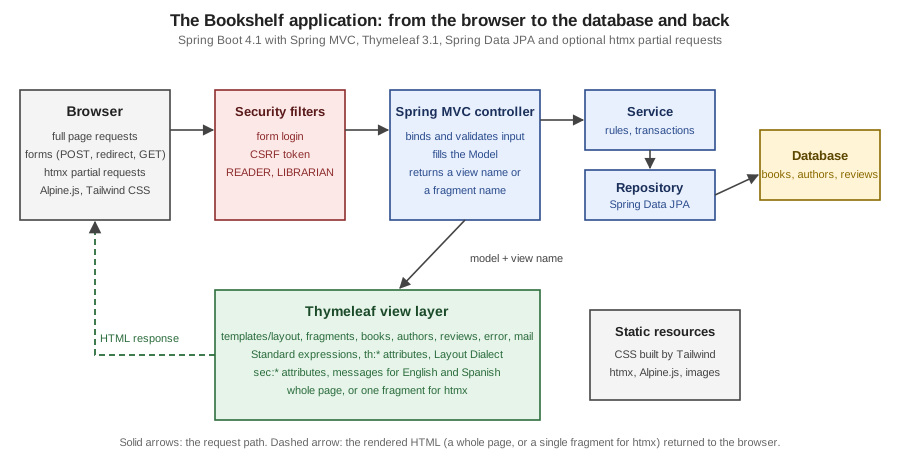
The final project layout (src/main/java packages for book, author, review, security and web, and
src/main/resources/templates folders for layout, fragments, books, authors, reviews, error and mail) is
assembled on Getting Started.
Reading path
The pages are ordered so that each one builds on the previous ones. Read them in this order the first time, then use
them as a reference. Before starting, be comfortable with the language and the framework underneath:
the Java Reference for records, streams and java.time, and the
SpringBoot Reference for dependency injection, auto-configuration, Spring Data and
Spring Security.
-
Foundations: what Thymeleaf is, a first Spring Boot project, standalone use and the auto-configuration.
-
Core template language: expressions, operators, utility objects, text and attributes, iteration, variables, links, inlining, textual modes and natural templates.
-
Fragments and layouts: reuse of markup, the Layout Dialect and a component library.
-
Spring MVC: controllers and views, forms, validation, conversion, internationalization, pagination and errors.
-
Security: Spring Security integration, then escaping, restricted mode and the security advisories.
-
Dynamic and interactive pages: fragment rendering, htmx, Alpine.js, push updates and reactive rendering.
-
Assets and other outputs: styling, front-end assets and emails.
-
Quality, extension and operations: testing, custom dialects, performance, tooling and migration.
What’s covered
Each page builds on the Bookshelf scenario, links every example to the official page it derives from, and ends with the sources it uses.
Foundations
-
Introduction & Architecture: what Thymeleaf is, natural templates, template modes, dialects and processors, and how it compares with other engines
-
Getting Started: a Spring Boot 4.1 project, a first controller and the full Bookshelf project
-
Standalone Engine & Configuration: using Thymeleaf without Spring
-
Spring Boot Auto-configuration & Properties: what Boot registers and every
spring.thymeleaf.*property
Core template language
-
Standard Expression Syntax: the five expression types and the basic objects
-
Literals, Operators & Preprocessing: literals, operators, the Elvis operator and preprocessing
-
Expression Utility Objects: every
#...utility object -
Text & Attribute Setting:
th:text,th:attrand the attribute processors -
Iteration & Conditionals:
th:each, the status variable,th:ifandth:switch -
Local Variables, Attribute Precedence, Comments & Blocks:
th:with, the precedence order, comment blocks andth:block -
Link URLs: every
@{...}link form -
Inlining: text, JavaScript and CSS inlining
-
Textual Template Modes: the TEXT, JAVASCRIPT and CSS modes
-
Natural Templates & Decoupled Logic: prototype-friendly templates and
.th.xmlfiles
Fragments and layouts
-
Fragments:
th:fragment,th:insert,th:replaceand fragment expressions -
Layouts & the Layout Dialect: page skeletons with
layout:decorate -
Reusable UI Components: a Bookshelf component library
Building web applications with Spring MVC
-
Spring MVC Integration: views, view resolvers, controllers and the model
-
Forms & Data Binding:
th:object,th:fieldand every input type -
Validation & Error Messages: Bean Validation,
#fieldsandth:errors -
Conversion & Formatting:
${{...}}, formatters and converters -
Internationalization: messages, locale resolution and a language switcher
-
Displaying Data, Pagination & Sorting: tables,
Pageableand sortable headers -
Error Handling & Flash Messages: error pages and flash attributes
Security
-
Spring Security Integration: the
sec:*attributes, CSRF and method security -
Template Security & XSS: escaping, restricted mode, template injection and the CVEs
Dynamic and interactive pages
-
Fragment Rendering & AJAX: returning part of a page
-
htmx Fundamentals: the
hx-*attributes, headers and events -
htmx with Spring Boot: the
htmx-spring-bootlibrary -
htmx Patterns: fifteen worked patterns
-
Alpine.js & Web Components: client-side state and custom elements
-
Server-Sent Events & WebSockets: pushing rendered HTML
-
Reactive Rendering with WebFlux: the reactive engine and its response modes
Assets and other outputs
-
Styling & Front-end Assets: static resources, WebJars and Tailwind CSS v4
-
Emails & Text Templates: HTML and plain-text email
Quality, extension and operations
-
Testing: slices, HtmlUnit,
thymeleaf-testingand end-to-end tests -
Extending Thymeleaf: custom dialects and processors
-
Performance & Production: caches, the SpringEL compiler and packaging
-
Tooling & IDE Support: IDE plugins and the official examples
-
What’s Changed & Migration: version-to-version migration map
-
Cheat Sheet: a one-page summary with a downloadable PDF
Where related material lives elsewhere on this site
The Thymeleaf pages link to existing material instead of repeating it, and cover only what Thymeleaf adds.
| Topic | Where it lives | How the Thymeleaf section relates |
|---|---|---|
Spring Boot, Spring Security, Spring Data, profiles, testing and reactive fundamentals |
SpringBoot Reference, including Getting Started with Spring Boot, Spring Security, Spring Data JPA, Configuration and Profiles, Unit and Integration Testing, REST APIs with Spring MVC and WebFlux and Reactive Programming with Project Reactor |
Thymeleaf pages link here instead of re-explaining Spring Boot, security, persistence, profiles, test slices or Reactor. |
The choice between Thymeleaf, Vaadin and JSF |
Server-Side Web UI Frameworks and Vaadin Reference, including Spring Boot Integration |
The introduction compares Thymeleaf with Vaadin and links these pages for the decision table. |
The Java language and persistence |
The getting-started page uses records, streams and |
|
The same idea in other stacks |
Django Templates, Template Partials & htmx, Blade Templates, Razor Syntax and Tag Helpers, Static Files, Templates & Frontend (FastAPI), Qute Templating, Server-side Templates (Axum) and htmx with Axum |
The comparison table of the introduction and the htmx pages point to these pages. |
Front end: HTML and CSS, Tailwind CSS, Bootstrap, accessibility |
HTML & CSS Reference, Tailwind Reference, Bootstrap Reference and Web Accessibility |
The styling, forms and validation pages link here for the CSS and accessibility theory. |
Browser testing and cross-origin requests |
The testing page links the end-to-end page, and the htmx pages link the CORS theory. |
|
OAuth 2.0 and OpenID Connect login |
OAuth Reference, including Choosing an OAuth Flow and Spring Boot Integration: Overview |
The Spring Security page links here for OAuth 2.0 login. |
Architecture decisions |
Starting a New Project, Layering: Isolating Backend and Frontend, Migration Path: From Single-Tenant to Multi-Tenant SaaS and Migration Path: From a Monolith to Microservices |
The introduction links these pages for when a server-rendered front end is the right choice. |
Containers, orchestration and cloud |
Docker, Kubernetes and Cloud |
The performance-and-production page shows only the Thymeleaf-specific parts. |
Images and media |
Linked where image fragments and cover uploads are discussed. |
Some related topics are tracked as separate issues and are only mentioned here: a comparison of backend and web frameworks (#263), chat, videoconference and WebSockets (#264), Playwright, Cypress and Selenium (#258) and IDE links (#116). PDF generation with JasperReports and iText is covered in the PDF Generation section, JSF in the JSF (JavaServer Faces) section, client-side Java with GWT in the GWT (Google Web Toolkit) section, and the JSP and Struts counterpart of this section in JSP & Struts.
Bibliography
Every source used to prepare this section is listed here, each linked to its official site. Individual pages list the
subset they derive from under their own == References heading.
Books
The two books by Wim Deblauwe were consulted for concept coverage, narrative and structure only. They target older versions (Spring Boot 2.3 and Thymeleaf 3.0 for the first, Spring Boot 3.1 and htmx 1.9 for the second). No text, code listing, figure or sample project is taken from them: every example in this section is written against the current official documentation, and the pages point out where the books are outdated.
-
Deblauwe, W. Taming Thymeleaf: Practical Guide to building a web application with Spring Boot and Thymeleaf. Self-published on Leanpub. Version consulted: 1.1.1 (2021-04-13); Leanpub now sells an edition updated for Spring Boot 3. Leanpub page and the author’s book page; companion code: wimdeblauwe/taming-thymeleaf-sources on GitHub.
-
Deblauwe, W. Modern frontends with htmx: Use htmx with Spring Boot and Thymeleaf to build dynamic and interactive web applications. Self-published on Leanpub. Version consulted: 1.0.0 (2023-12-03). Leanpub page and the paperback on Lulu; companion code: wimdeblauwe/modern-frontends-with-htmx-sources on GitHub.
Official Thymeleaf documentation and resources
Published at thymeleaf.org/documentation.
-
The three 3.1 tutorials: Using Thymeleaf, Thymeleaf + Spring and Extending Thymeleaf
-
The articles: Standard Dialect in 5 minutes, Standard URL syntax, Layouts, Thymeleaf vs JSP, From HTML to HTML (via HTML), Spring Security integration basics, Spring MVC: how to access data, Sending email in Spring with Thymeleaf, Say Hello! Extending Thymeleaf in 5 minutes and Say Hello Again! Extending Thymeleaf even more in 5 minutes
-
The articles no longer served by thymeleaf.org, cited from the Wayback Machine: Thymeleaf 3.1: what’s new (archived) and Thymeleaf 3.0 migration (archived)
-
The home page, download, ecosystem, FAQ and release notes pages
-
The 3.1.5 javadocs: thymeleaf, thymeleaf-spring6 and thymeleaf-extras-springsecurity6
-
The thymeleaf/thymeleaf repository on GitHub: releases, milestones, the examples (GTVG, STSM and extraThyme), the thymeleaf-extras-springsecurity6 and testing READMEs, and the security advisories
Official documentation of related projects
-
Thymeleaf Layout Dialect, including its migration guide to 4.0
-
Spring Boot reference: the servlet and reactive template engines, the templating application properties, DevTools, hot swapping, error pages, internationalization, test slices, system requirements and the ThymeleafAutoConfiguration API
-
Spring Framework reference: the Thymeleaf view technology, HTML fragments and the WebFlux view technology
-
Spring Data JPA reference, for pagination and sorting
-
htmx documentation (with its extensions and reference) and htmx-spring-boot
-
Alpine.js, Tailwind CSS, WebJars, Web Awesome and SortableJS
-
Testing: HtmlUnit, Playwright for Java, Testcontainers and AssertJ
Specifications, standards and security sources
-
HTML Living Standard (WHATWG), Content Security Policy Level 3 (W3C), RFC 9110: HTTP Semantics and RFC 6265: HTTP State Management (cookies)
-
OWASP Cross Site Scripting Prevention Cheat Sheet, PortSwigger: server-side template injection, OWASP Web Security Testing Guide: testing for server-side template injection and the OWASP Top 10
-
Security advisories for Thymeleaf: CVE-2026-41901 (GHSA-c9ph-gxww-7744), CVE-2026-40478, CVE-2026-40477, CVE-2021-43466 and CVE-2023-38286
The books are consulted references for concept coverage, narrative and structure; they are not reproduced here. The official documentation linked above is authoritative, and where the two differ, the documentation of the version you run prevails.