Getting Started
|
This section documents modern Objective-C as implemented by Apple Clang in the current Xcode release — Objective-C 2.0 plus ARC, literals and subscripting, This content was generated with the assistance of AI and should be verified against developer.apple.com before being relied on in production. This section’s bibliography lists the reference material consulted while preparing these pages. |
Objective-C is C with Smalltalk-style object messaging bolted on. Every valid C program is a valid
Objective-C program: the language adds a small set of @-prefixed directives, a square-bracket message-send
syntax, and a dynamic run-time library that decides at execution time which method a message actually invokes.
That "thin layer over C, dynamic dispatch at the top" design is the single fact that explains most of the rest
of this reference.
What Objective-C Is
The language has exactly two halves, and keeping them apart makes it far easier to learn:
-
The C half. Types, operators, control flow, functions, pointers,
struct, the preprocessor — all unchanged from C. Objective-C is a strict superset of C, so C libraries are called directly with no bridge, no marshalling and no overhead. -
The Objective-C half.
@interface/@implementationclass declarations, message sends written[receiver message], protocols, categories, and a run-time library (libobjc) that resolves each message by selector at the moment it is sent.
// The C half: an ordinary function, ordinary types.
int doubled(int x) { return x * 2; }

// The Objective-C half: a message send. "length" is looked up at run time.
NSString *greeting = @"Hello";
NSUInteger n = [greeting length];
The second line is not a function call that the compiler resolves to an address. It compiles to a call to
objc_msgSend(greeting, @selector(length)), and the run time finds the implementation. This is why
Objective-C supports categories, method swizzling, key-value observing and message forwarding — features
that a statically dispatched language cannot offer — and also why the compiler cannot catch an
"unrecognized selector" mistake for you.
A Short History
| Period | What happened |
|---|---|
Early 1980s |
Brad Cox and Tom Love design Objective-C at Stepstone, adding Smalltalk-80’s messaging model to C so that reusable "software ICs" could be built without leaving the C toolchain. |
1988 |
NeXT licenses the language and builds NeXTSTEP on it. The |
1996-2001 |
Apple acquires NeXT; NeXTSTEP becomes the basis of Mac OS X, and Objective-C becomes the language of Cocoa. |
2006-2007 |
Objective-C 2.0 ships with Mac OS X 10.5: declared properties ( |
2011 |
ARC — Automatic Reference Counting — moves retain/release bookkeeping into the compiler, and remains
the default memory model today. Literals and subscripting ( |
2014-present |
Swift is announced and gradually becomes Apple’s default language. Objective-C keeps evolving where it must
interoperate — nullability annotations, lightweight generics, |
Two features are removed and appear in this reference only as history: garbage collection (deprecated in
OS X 10.8, removed in 10.11) and class posing (poseAsClass:, see
Categories and Extensions). Neither is
available in any current toolchain.
Objective-C Compared
Versus C++
Both add objects to C, but from opposite directions:
| Objective-C | C++ | |
|---|---|---|
Dispatch |
Dynamic by default — selector looked up at run time |
Static by default; |
Unknown method |
Run-time error ( |
Compile-time error |
Object model |
Single inheritance + protocols; all objects are heap-allocated pointers |
Multiple inheritance, templates, stack or heap allocation, value semantics |
Introspection |
Rich and built in — classes, methods, ivars and properties are all enumerable at run time |
Minimal ( |
Memory |
ARC (compiler-inserted reference counting) |
RAII, smart pointers, manual |
The two can be mixed in one translation unit — see Objective-C++ and C Interoperability.
Versus Swift
Swift is safer and terser; Objective-C is more dynamic and has decades of shipped code behind it. Swift
enforces optionality, value types and exhaustive switch at compile time, where Objective-C leans on run-time
conventions (nil absorbing messages, NSError ** out-parameters). The two interoperate closely within one
target — see Swift Interoperability.
Objective-C remains worth knowing for maintaining and extending existing codebases, for reading Apple’s own framework headers, for run-time-driven techniques (KVO, swizzling, proxies) that Swift cannot express natively, and for C and C++ interoperability without a bridging layer.
Toolchains
| Toolchain | Notes |
|---|---|
Apple Clang (Xcode) |
The reference implementation and the subject of this section. Ships with Xcode or the Command Line Tools
( |
Clang (upstream LLVM) |
Available on Linux and Windows. Supports the language, but Apple’s frameworks are not present — pair it with GNUstep for a Foundation implementation. |
GCC |
Retains an Objective-C front end and the GNU run time. It lags Apple Clang: no ARC on the GNU run time in practice, and no Clang modules. Suitable for legacy GNUstep code. |
GNUstep |
An open-source reimplementation of the OpenStep/Cocoa APIs ( |
File Extensions
| Extension | Contents |
|---|---|
|
Header — the public interface: |
|
Implementation — Objective-C and C source ( |
|
Implementation compiled as **Objective-C**, so C syntax is also accepted. |
|
Prefix header, precompiled and implicitly included (rare in modern projects; prefer |
The Compilation Pipeline
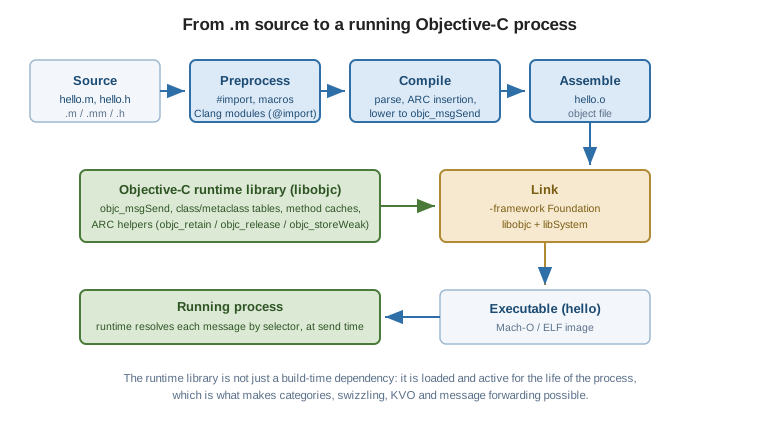
An Objective-C translation unit travels the same route as a C one; what is distinctive is that the
Objective-C constructs are lowered into ordinary C calls into libobjc, and that the run-time library must
be linked in and is present at execution time.
Hello, World
#import <Foundation/Foundation.h>

int main(int argc, const char *argv[]) {
    @autoreleasepool {
        NSString *name = @"World";
        NSLog(@"Hello, %@!", name);
    }
    return 0;
}
Four things in nine lines are worth naming:
-
#importis Objective-C’s include directive — like#include, but it never includes the same file twice, so header guards are unnecessary. -
Foundation/Foundation.his the umbrella header of the Foundation framework, which suppliesNSString,NSArray,NSLogand the rest of the value and collection types. -
@autoreleasepoolbounds the lifetime of autoreleased temporaries. Under ARC it is still required at the top ofmainand in tight loops; see Automatic Reference Counting. -
%@is the format specifier for an Objective-C object:NSLogsends itdescriptionand prints the result. See Classes and Objects.
Building and Running
With Apple Clang on macOS:
clang -fobjc-arc -fmodules -Wall -Wextra \
      -framework Foundation \
      hello.m -o hello
./hello
# 2026-01-01 12:00:00.000 hello[12345:678901] Hello, World!
With GNUstep on Linux:
clang `gnustep-config --objc-flags` \
      hello.m -o hello \
      `gnustep-config --base-libs`
./hello
gnustep-config --objc-flags emits the include paths and run-time selection flags; --base-libs emits the
linker flags for libgnustep-base. Substitute gcc for clang if you must use the GNU compiler, and drop
-fobjc-arc and -fmodules, which the GNU run-time configuration generally does not support.
The flag set used throughout this reference is clang -fobjc-arc -fmodules -Wall -Wextra -framework
Foundation: ARC on, Clang modules on, warnings turned up. Examples note explicitly where GNUstep differs.
See Also
-
Basic Syntax and Types — the type vocabulary (
id,BOOL,NSInteger,SEL) the rest of the section assumes. -
Classes and Objects — writing your first
@interface/@implementationpair. -
Build and Tooling — the full flag reference,
xcodebuild, analyzers, sanitizers and debugging.