Model Context Protocol (MCP)
|
This content was generated with the assistance of AI and should be verified against the official documentation of each tool and framework before being relied on in production. This section’s bibliography lists the reference material consulted while preparing these pages. |
This sub-section was written against the 2026-07-28 revision of the Model Context Protocol specification and the SDK, framework and host versions listed in Version baseline, all read from PyPI, npm, Maven Central and the official documentation on 2026-09-29. Where an individual page and that baseline ever disagree after a later update, the baseline is the one to trust.
Why MCP exists: the N x M problem
Before a standard existed, connecting an AI application to a tool or a data source meant writing an integration for that one pair: a Claude Code plugin for the issue tracker, a different VS Code extension for the same tracker, a hand-rolled function for a home-grown agent. With N hosts (AI applications) and M tools that is up to N x M integrations, each with its own authentication, schema mapping and failure modes. The Model Context Protocol (MCP) replaces that grid with one protocol: a host embeds an MCP client once, a tool or data source exposes an MCP server once, and any client can talk to any server — N + M implementations instead of N x M.
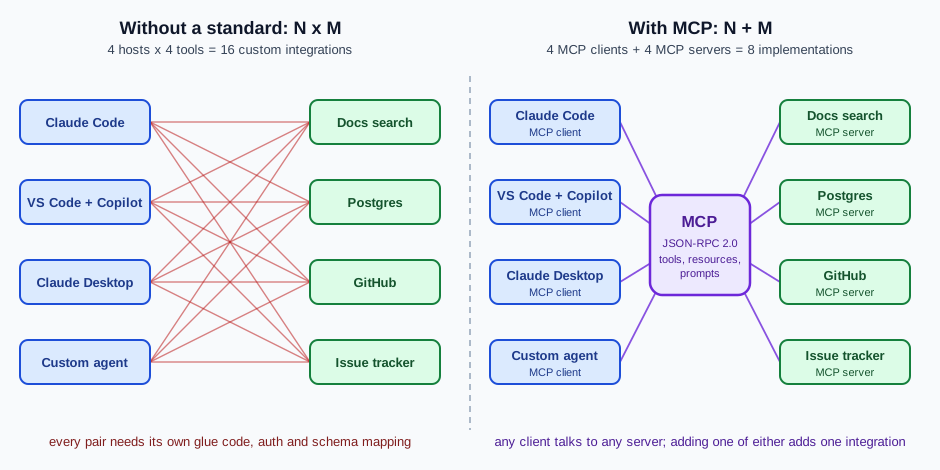
An MCP server exposes three kinds of capability to the model: tools (functions the model can call), resources (data the application can read, addressed by URI) and prompts (reusable message templates the user can pick), and can ask the user for missing information through elicitation. Messages are JSON-RPC 2.0 and travel over stdio for local servers or Streamable HTTP for remote ones. The details are on MCP Architecture, Tools, Resources, Prompts & Elicitation and Transports; this page only orients you and lists the sources.
Governance
MCP was introduced by Anthropic and is now an open standard governed under the Linux Foundation, which formed the Agentic AI Foundation (AAIF) as a neutral home for open agent standards, starting with MCP; its sibling protocol, Agent2Agent (A2A), is a separate Linux Foundation project, and Agent-to-Agent Protocol (A2A) explains how the two fit together. The specification is versioned by date, changes are proposed and decided in the open as Specification Enhancement Proposals (SEPs, the numbers quoted in the release blog), and SDKs are ranked in tiers by how completely and promptly they follow it (see the SDK table under Other SDK languages). Sources are in the Bibliography: the Linux Foundation announcement and the versioning page.
Three revisions in thirteen months
Protocol revisions are named by date. The three most recent ones changed different layers of the protocol, and the last one changed the shape of it:
| Revision | What changed |
|---|---|
JSON-RPC batching removed; structured tool output ( |
|
OpenID Connect Discovery accepted for authorization-server discovery; icons for tools, resources and prompts;
incremental scope consent through |
|
A stateless core: the |
Two consequences follow for anyone reading older material, including the books in the bibliography, which all
predate the 2026-07-28 revision: the initialize handshake, sessions and Mcp-Session-Id, the old FastMCP
class name in the official Python SDK (now MCPServer), and the v1 TypeScript package @modelcontextprotocol/sdk
describe the previous protocol era. Each page flags that behaviour where it matters and shows the current API, and
the architecture page covers the history in
one place.
Version baseline
Every version below was read from the package registries, the official documentation and the running servers built for this sub-section on 2026-09-29. Each page repeats the subset it uses in its own lead paragraph.
| Area | Versions |
|---|---|
Protocol |
Specification revision 2026-07-28, with the previous revisions 2025-11-25 and 2025-06-18 described on this page. |
Python |
Python 3.12 (the |
Java |
Java 21; Spring Boot 4.1.1 with Spring AI 2.0.1 (GA; 2.1.0-M1 exists but is a milestone and is not used); the MCP
Java SDK 2.0.1 (Spring AI 2.0.1 resolves 2.0.0); LangChain4j MCP |
TypeScript |
Node.js 24 LTS ( |
Tooling |
MCP Inspector 2.8.0 ( |
Models and stores |
Ollama with |
The Java protocol-version skew
The Java stack lags the specification, and this sub-section says so rather than hiding it. The MCP Java SDK 2.0.x
defines protocol versions only up to 2025-11-25, and Spring AI 2.0.1 builds on it, so a Spring AI MCP server
has no server/discover and no multi-round-trip elicitation: it answers a 2026-07-28 client’s initialize with
2025-11-25, and calling server/discover fails (a "method not found" error on the Streamable mode, an internal
error on the stateless mode). The Spring AI reference still describes its Streamable-HTTP servers as introduced
with spec version 2025-03-26 and does not mention 2026-07-28. Consequently the Java build of docs-assistant is
tested with the Inspector in its legacy protocol era and has no elicitation step, and its component argument is
required. The Java SDK is a Tier 2 SDK on the official SDK list, not one of the SDKs updated in the release blog.
The details and the practical consequences are on Spring Boot MCP Servers.
What’s covered
The sub-section builds one running example, the docs-assistant MCP server — the MCP-facing side of the DocsAssistant scenario used in LLM Foundations & Prompting, AI Agents and Vector Databases & RAG. It exposes this site’s documentation through the same four things on every stack:
-
a tool
search_docs(query, component?, top_k)that returnsstructuredContent(hits with title, URL, snippet and score) together with anoutputSchema; -
a resource template
docs://{component}/{page}that returns a page’s AsciiDoc; -
a prompt
answer_with_citations; -
an elicitation through a Multi Round-Trip Request that asks which component to search when the query is ambiguous.
It is built three times — Python, Java and TypeScript — and each build passes the same Inspector CLI contract script, shown once on Testing & Debugging. The pages are grouped the same way as the navigation:
Concepts
-
MCP Architecture — hosts, clients and servers, JSON-RPC 2.0, the stateless core and
_metanegotiation,server/discover, extensions, trace context, and one full discover, list and call exchange in three languages. -
Tools, Resources, Prompts & Elicitation — tools with
inputSchema,outputSchemaandstructuredContent, resources and URI templates, prompts, elicitation throughinput_required, cacheable lists, and the deprecated roots, sampling and logging. -
Transports — stdio, Streamable HTTP with the
Mcp-MethodandMcp-Nameheaders,subscriptions/listen, why HTTP+SSE is deprecated, load balancing without sticky sessions, and acurlwalkthrough. -
Authorization — OAuth 2.1 for remote servers, Protected Resource Metadata, resource indicators, CIMD versus DCR, RFC 9207, audience binding and no token passthrough.
Building servers
-
Python MCP Servers — the official
mcpv2MCPServer, stdio and Streamable HTTP, theFastMCPtoMCPServerrename and the standalone FastMCP 4. -
MCP inside FastAPI — mounting MCP in a FastAPI process, the lifespan pitfall, FastMCP’s
combine_lifespans, generated versus curated tools, and sharing authentication. -
Spring Boot MCP Servers — the Spring AI 2.0 starters, the
STREAMABLE,STATELESSandSSEmodes,@McpTooland its siblings, Spring Security, the plain Java SDK and the protocol-version caveat. -
Node.js MCP Servers —
@modelcontextprotocol/serverv2,registerToolwith Zod,serveStdio(), the Express adapter and migrating from the v1 SDK.
Clients and hosts
-
Building MCP Clients — Python, Java and TypeScript clients, handling
input_required, LangChain adapters and a local Ollama model driving MCP tools. -
Connecting Hosts — Claude Code, Claude Desktop, VS Code and GitHub Copilot, and the Copilot cloud agent, with pointers to other hosts.
Testing and deployment
-
Testing & Debugging — the MCP Inspector, the shared contract test, a CI recipe, logging to stderr and OpenTelemetry, and common errors and their fixes.
-
Deploying Remote Servers — a Dockerfile per stack, stateless scaling, capacity math, gateways that route on
Mcp-Method, TLS, rate limits and the MCP Registry.
Design and integration
-
Designing Good MCP Servers — tool design rules for LLM callers, curated versus generated tools, the token cost of tool definitions and code execution with MCP.
-
Exposing RAG through MCP — search and retrieve tools, handles instead of sessions, access control from the caller’s identity, and wiring to pgvector and to a Spring AI
VectorStore. -
MCP Security — confused deputy, token passthrough, SSRF, state handle hijacking, local server compromise, tool poisoning and prompt injection, least privilege and human confirmation.
Cheat sheet
-
Cheat Sheet (PDF) — a single-page, printable summary of every concept in this sub-section.
Related material elsewhere on this site is linked rather than repeated: the OAuth fundamentals in the OAuth Reference, REST APIs in Spring Boot REST APIs, containers in the Docker Reference, the retrieval side of RAG in Agentic RAG, and how coding tools use MCP servers (rather than build them) in MCP Configuration. The CLI alternative to an MCP server, and how to wrap a CLI as one, is covered in Building CLIs for AI Agents (see CLI vs. MCP). Chat-channel hosts are covered in Conversational Channels. LangChain, Spring AI, Hugging Face, Voice Agents, LLMOps & Evaluation and AI Security & Responsible AI are separate sub-sections of this AI section; the production RAG service behind the RAG server of these pages is covered in RAG Systems in Production, in particular RAG Behind MCP.
Other SDK languages
This sub-section builds servers in Python, Java and TypeScript. The other official SDKs follow the same protocol; the table lists them with the tier the official SDK list gave them on 2026-09-29. Their documentation is the place to look; this sub-section does not cover them.
| Language | Tier | Documentation and repository |
|---|---|---|
C# |
Tier 1 |
|
Go |
Tier 1 |
|
Rust |
Tier 1 |
Rust SDK documentation and rust-sdk repository; the language in the Rust Reference |
Kotlin |
Tier 3 |
|
Swift |
Tier 3 |
(TypeScript and Python are Tier 1 and Java is Tier 2; those three are the subject of this sub-section. Ruby is Tier 1 and PHP Tier 3 on the same list.)
MCP Apps
MCP servers can also return interactive user interfaces to hosts through the MCP Apps extension. Building those UIs is out of scope here; the extensions framework that carries them is introduced on MCP Architecture, and the MCP Apps overview is the starting point.
Bibliography
The following sources were consulted while preparing this sub-section’s pages. Every class, decorator, method, field, header, flag and protocol name was checked against the installed packages, the official source repositories or the specification pages listed here on 2026-09-29 — never copied from a book. Every URL cited on any page of this sub-section is listed here, once.
Requester-provided books, consulted for concepts only and never the source of an example. All five predate the 2026-07-28 revision (they describe the initialize handshake, sessions and the v1 SDKs), so where they differ from the specification or an SDK’s own documentation, those are authoritative:
-
Lee, Wei-Meng. Hugging Face in Action. Manning Publications, 2026. ISBN 978-1-63343-671-8. Publisher page: https://www.manning.com/books/hugging-face-in-action. Official code repository: https://github.com/weimenglee/HuggingFaceInAction. Consulted for its MCP chapter: the concepts of resources, tools and prompts, building a server with
uvand FastMCP, the Inspector, Claude Desktop configuration and third-party servers. -
Albada, Michael. Building Applications with AI Agents: Designing and Implementing Multiagent Systems. O’Reilly Media, 1st ed., Sep 2025. ISBN 978-1-098-17650-1. Publisher page: https://www.oreilly.com/library/view/building-applications-with/9781098176495/. Official code repository: https://github.com/michaelalbada/BuildingApplicationsWithAIAgents. Consulted for MCP as a reusable tool catalogue,
MultiServerMCPClientin LangGraph, and the security concerns of connecting third-party servers. -
Mendelevitch, Ofer, and Forrest Sheng Bao. Hands-On RAG for Production. O’Reilly Media, May 2026. ISBN 979-8-341-62171-8. Publisher page: https://www.oreilly.com/library/view/hands-on-rag-for/9798341621701/. Official code repository: https://github.com/ofermend/hands-on-rag. Consulted for MCP (tools, resources, prompts; host, client and server) in the move from RAG to agents.
-
Polzer, Dominik. RAG with Python Cookbook. O’Reilly Media, Apr 2026. ISBN 979-8-341-60056-0. Publisher page: https://www.oreilly.com/library/view/rag-with-python/9798341600553/. Official code repository: https://github.com/polzerdo55862/RAG-with-Python-Cookbook. Consulted for an MCP client driving a server started with
npxoruvx. -
Walls, Craig. Spring AI in Action. Manning Publications, 2026. ISBN 978-1-63343-611-4. Publisher page: https://www.manning.com/books/spring-ai-in-action. Official code repository: https://github.com/habuma/spring-ai-in-action-samples. Consulted for its MCP client and server chapters.
oreilly.com answers automated fetches with an HTTP 403 response, but every publisher page above is a live,
reachable page when opened in a browser.
The specification, revision 2026-07-28:
Earlier revisions, for the revision timeline:
Other protocol pages:
Python:
Java:
TypeScript and Node.js:
Other SDKs:
Hosts and clients:
LangChain and MCP:
Identity providers:
RFCs, standards and drafts:
Reference servers and other MCP servers:
Security references:
Governance:
Papers and engineering articles:
These books are consulted references, not the primary source of any example on this sub-section’s pages. On any discrepancy between a book and an SDK’s or framework’s own official documentation or a protocol’s specification, that documentation is authoritative.