Virtual Threads
|
This section documents the current Java release line, with Java 25 LTS as the reference point (no specific patch version is pinned), as published at the Java developer portal, the Java Tutorials, and the Java SE API specification — which are the references these pages are written and verified against. This content was generated with the assistance of AI and should be verified against the official documentation before being relied on in production. This section’s bibliography lists the reference material consulted while preparing these pages. |
A virtual thread is a java.lang.Thread that is scheduled by the JVM rather than the operating
system, so it costs a few hundred bytes instead of a megabyte-scale OS stack. Millions can exist at
once, and blocking one is cheap. This lets straightforward blocking code — one thread per request — scale like hand-written asynchronous code. This page is grounded in the official
dev.java "Virtual Threads" tutorial and the
JDK core-libraries virtual-threads
guide; the introductory books in this section’s bibliography predate the feature entirely.
Platform Threads vs. Virtual Threads
A platform thread is a thin wrapper over an OS thread: creating one is expensive, and a server can support only a few thousand. The old workaround was a bounded pool plus asynchronous, callback-style APIs that never block a pooled thread — fast, but hard to read and debug.
A virtual thread removes the trade-off. It runs Java code on an OS thread only while it is doing work;
the moment it blocks (I/O, a lock, sleep), it steps aside and the OS thread is reused. You write
plain sequential code — var response = client.send(request) — and still get high concurrency.
// three ways to start one
Thread t = Thread.ofVirtual().name("worker-1").start(() -> System.out.println("hi"));
t.join();

Thread.startVirtualThread(() -> System.out.println("also virtual"));   // shorthand

Runnable task = () -> System.out.println("later");
Thread u = Thread.ofVirtual().unstarted(task);   // build now, start when ready
u.start();
Thread.ofVirtual()
returns a
Thread.Builder;
Thread.ofPlatform() is its counterpart for the classic kind. For the thread-per-request model, hand
every task to
Executors.newVirtualThreadPerTaskExecutor(),
which creates one fresh virtual thread per submitted task — never pool virtual threads.
import java.util.concurrent.*;

try (ExecutorService exec = Executors.newVirtualThreadPerTaskExecutor()) {
    for (int i = 0; i < 10_000; i++) {
        int id = i;
        exec.submit(() -> {
            String body = fetch("https://example.com/item/" + id);   // blocking call is fine
            return parse(body);
        });
    }
}   // returns once all 10,000 tasks have finished
Every Thread reports which kind it is, and virtual threads are unnamed unless you set a name:
jshell> Thread.currentThread().isVirtual()
$1 ==> false

jshell> Thread.ofVirtual().start(() -> System.out.println(Thread.currentThread()))
VirtualThread[#26]/runnable@ForkJoinPool-1-worker-1
$2 ==> VirtualThread[#26]/runnable

jshell> var t = Thread.ofVirtual().name("job-", 0).start(() -> {})
t ==> VirtualThread[#28,job-0]/terminated
Starting a million virtual threads is routine; starting a million platform threads exhausts memory. Because each task gets its own thread, thread-local context, stack traces, and step-through debugging all work the way they do in single-threaded code.
Carrier Threads, Mounting, and Pinning
Virtual threads run on a small pool of platform threads called carrier threads (by default sized to the number of available processors). Running a virtual thread on a carrier is mounting; parking it and freeing the carrier when it blocks is unmounting. Because a blocked virtual thread holds no carrier, a handful of carriers serve a very large number of virtual threads.
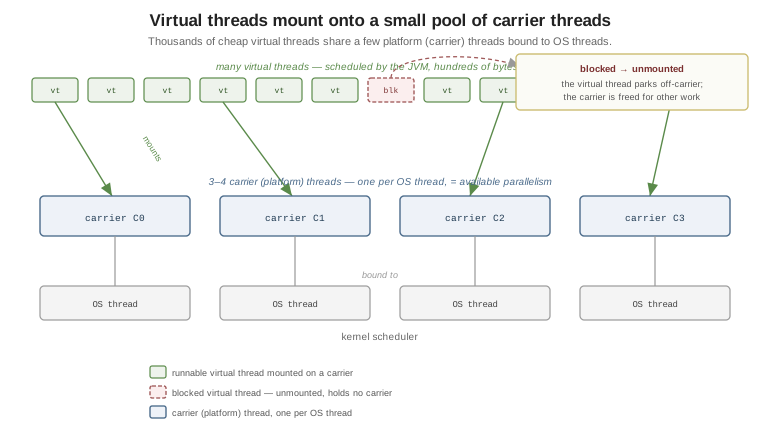
A virtual thread is pinned when it cannot unmount from its carrier while blocked, which reduces
throughput. As of the current release line a synchronized block or method no longer pins in the
common case; the remaining causes are native stack frames (a JNI call) and a few internal blocking
operations. Where pinning still matters, replace the monitor with an explicit
ReentrantLock,
which releases the carrier cleanly.
import java.util.concurrent.locks.ReentrantLock;

private final ReentrantLock lock = new ReentrantLock();

void updateShared() {
    lock.lock();
    try {
        blockingIo();          // virtual thread unmounts here; carrier runs other work
    } finally {
        lock.unlock();
    }
}
Diagnose pinning with the JDK Flight Recorder event jdk.VirtualThreadPinned or the system property
-Djdk.tracePinnedThreads=full. Keep synchronized regions that wrap blocking calls short, and prefer
java.util.concurrent locks in hot paths. The carrier pool defaults to the number of available
processors and can be resized with -Djdk.virtualThreadScheduler.parallelism, though the default is
right for almost all workloads.
When to use them
Virtual threads target code that spends most of its time waiting — network calls, database queries,
file I/O, sleep. For those, replace a bounded platform-thread pool with
newVirtualThreadPerTaskExecutor() and keep the blocking style.
They do not speed up CPU-bound work: computation still needs a real core, so a fixed pool sized to
the processor count remains the right tool there. And because virtual threads are unlimited, they no
longer serve as a concurrency limit — to cap how many requests hit a downstream service at once, use
a Semaphore (see High-Level Concurrency) around the
call rather than a small thread pool.
Structured Concurrency and Scoped Values
Two related APIs shape how virtual threads are used. Structured concurrency treats a group of
subtasks as a single unit of work: they are forked together, joined together, and a failure or
cancellation in one cancels its siblings, so no subtask outlives the method that started it. The entry
point is StructuredTaskScope in java.util.concurrent; it is still moving through the preview process,
so the exact factory and method names change between releases — consult the current guide and compile
with preview features enabled.
import java.util.concurrent.StructuredTaskScope;   // preview API -- shape may change

// run two lookups as one unit; if either fails, the other is cancelled
try (var scope = StructuredTaskScope.open()) {
    StructuredTaskScope.Subtask<User>  user  = scope.fork(() -> loadUser(id));
    StructuredTaskScope.Subtask<Order> order = scope.fork(() -> loadOrder(id));

    scope.join();                                  // wait for both; propagate any failure

    return new Page(user.get(), order.get());
}   // every subtask has completed or been cancelled here
Scoped values are an immutable, inheritable alternative to ThreadLocal: a value is bound for the
dynamic extent of a call and is automatically visible to any virtual thread forked inside that extent,
with no cleanup. ScopedValue lives in java.lang and is available in the current release line.
import java.lang.ScopedValue;

private static final ScopedValue<String> REQUEST_ID = ScopedValue.newInstance();

void handle(Request req) {
    ScopedValue.where(REQUEST_ID, req.id())
               .run(() -> process(req));           // REQUEST_ID is bound inside this call
}

void process(Request req) {
    log("handling " + REQUEST_ID.get());           // reads the binding from the enclosing scope
}
See Also
-
Concurrency Basics — the
ThreadAPI and memory model that virtual threads extend rather than replace. -
High-Level Concurrency —
ExecutorService,ReentrantLock, and the concurrent collections used with virtual threads. -
I/O and Files — the blocking I/O calls that virtual threads make inexpensive.
-
Exceptions — how structured concurrency surfaces a failed subtask’s exception to the enclosing scope.