Documentation Tools
|
This content was generated with the assistance of AI and should be verified against the official documentation of each tool before being relied on in production. This section’s bibliography lists the reference material consulted while preparing these pages. |
Docs as code
Docs as code means treating documentation like source code: the pages are plain text files kept in a Git repository next to the code they describe, changed through branches and pull requests, reviewed by the same people, and built into a site by a CI job on every push. A static site generator reads those files, resolves links between them, applies a theme and writes a folder of HTML, CSS and JavaScript that any static host can serve. The benefits are the ones code already enjoys: history and blame, review before publishing, the documentation of version 2 living on the branch of version 2, and a build that fails when a link is broken.
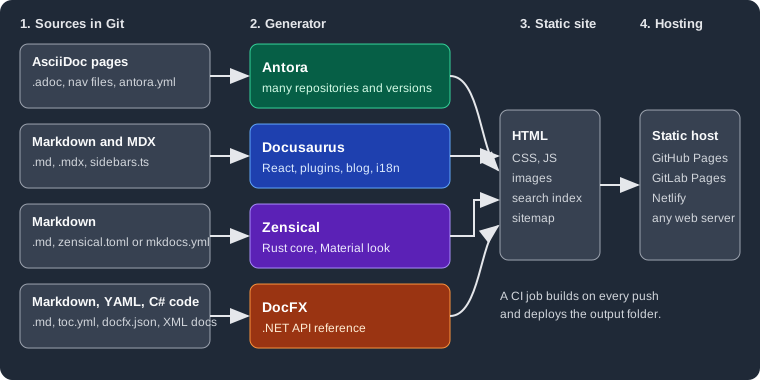
This section covers four generators that fill that role in different ways. All version numbers below are the baselines the pages were written against; they were checked on 2026-10-26.
-
Antora 3.2.1 builds a site from AsciiDoc kept in one or many Git repositories and branches, and models the result as versioned components and modules. It is the tool behind this site. Its look comes from a UI bundle, a ZIP of Handlebars templates, CSS, JavaScript and fonts that has its own subsection here.
-
Docusaurus 3.10.2 is a React-based generator for Markdown and MDX with docs, blog and custom pages, versioning, internationalisation, a plugin system and component swizzling. Version 3.10 is the last 3.x minor release; version 4 exists only as canary builds.
-
Zensical 0.0.72 is a Python-installed generator with a Rust core, made by the authors of Material for MkDocs. It reads Markdown and can read an existing
mkdocs.yml. It is in alpha, and version 0.1.0 was announced for 2026-11-05. -
DocFX 2.81.0 is a community-maintained .NET tool that builds Markdown plus API reference pages generated from .NET assemblies and their XML documentation comments (and REST API pages from Swagger 2.0 files).
Which subsection should I read?
| If you need … | Read |
|---|---|
Documentation spread over many repositories and versions, written in AsciiDoc |
Antora, then its UI Bundle pages to change the look of the site |
A product site with docs, a blog, translations and React components |
|
A fast Markdown site, a Python project, or a way off Material for MkDocs |
Zensical and its migration page |
An API reference generated from C# or other .NET code |
|
A side-by-side view with dated numbers |
|
A one-page printable summary |
All pages use one running example, Pocket Units, a small units-conversion library with a C# and a Python implementation, so the same content can be compared as it is built four ways.
What’s covered
Antora
-
Antora — overview of the tool and a map of its pages.
Docusaurus
-
Docusaurus — overview of the tool and a map of its pages.
Zensical
-
Zensical — overview of the tool and a map of its pages.
DocFX
-
DocFX — overview of the tool and a map of its pages.
Comparison
-
Comparison — overview of the tool and a map of its pages.
Cheat Sheet (PDF)
-
Cheat Sheet (PDF) — overview of the tool and a map of its pages.
Comparison and reference
-
Comparison — feature matrix, strengths and weaknesses, dated metrics, charts, scores, a decision flowchart and recommendations by purpose.
-
Cheat Sheet (PDF) — a one-page printable summary of the four tools with a downloadable PDF.
Related material on this site
| Page | Why it relates |
|---|---|
Writing the XML documentation comments that DocFX turns into API pages. |
|
The |
|
XML documentation comments in Visual Basic and the DocFX step. |
|
Docstring styles read by mkdocstrings in a Zensical site. |
|
Man pages and reference docs, with AsciiDoc and Antora as one possible home. |
|
A React framework; a Docusaurus site shares its React and MDX foundations. |
|
The branches, pull requests and GitHub Pages deployment that docs as code builds on. |
Bibliography
Every source below is the official site, repository or documentation page of the tool, library or service it supports,
and each entry links to it. The links were opened on 2026-10-26. Entries marked (unverified) could not be opened from the
authoring environment (the site refused automated requests), so open them and confirm the content, version and status
before you rely on them; the versions they would show were confirmed through the package registry instead. Every page of
the section also lists, under its own == References heading, the exact official pages its examples derive from.
Antora and its UI
-
Antora documentation — what’s new, how Antora works, install and quickstart, playbook, content sources, component version descriptor, versioning, modules and families, resource IDs, xrefs, navigation, extensions and generator events, CLI, container image, cache, private repository authentication, publishing to GitHub Pages and GitLab Pages,
ui-bundle-url,ui-output-dirandui-supplemental-files. -
Antora Default UI documentation and its repository — prerequisites, build and preview, templates, helpers, stylesheets and static files.
-
antora.org, the Antora repository and the antora npm package (unverified).
-
Lunr extension, Collector extension, Atlas extension and Assembler.
-
Asciidoctor documentation, AsciiDoc, Asciidoctor, Pagefind and Algolia DocSearch.
Docusaurus
-
Docusaurus documentation — installation, configuration, docs, sidebars, blog, pages, MDX, Markdown features, versioning, i18n, search, swizzling, styling, plugins, static assets, SEO, deployment, CLI, TypeScript and migration.
-
Release notes for 3.9 and 3.10, the showcase, the repository and the @docusaurus/core npm package (unverified).
-
docusaurus-openapi-docs, the community OpenAPI plugin.
Zensical and MkDocs
-
Zensical documentation — get started, CLI, setup, authoring, customization, compatibility, publishing and upgrade; plus the roadmap, upcoming changes, Spark and the license.
-
Repositories zensical/zensical and zensical/zrx, and the zensical PyPI package.
-
mkdocstrings, PyMdown Extensions and Python-Markdown extensions.
DocFX
-
DocFX documentation — basic concepts, configuration, Markdown, tables of contents, templates, .NET API docs, SDK compatibility, REST API docs, links and cross references, PDF, additional languages, the
docfx.jsonreference, the CLI reference, environment variables and Azure DevOps publishing. -
DocFX repository and releases, the docfx NuGet package and the .NET Foundation.
-
Markdig, Playwright for .NET, .NET documentation and OpenAPI (Swagger) 2.0.
Hosting and publishing
-
GitHub Pages, GitHub CLI and Netlify.