Spring AI
|
This content was generated with the assistance of AI and should be verified against the official documentation of each tool and framework before being relied on in production. This section’s bibliography lists the reference material consulted while preparing these pages. |
This sub-section was written against Spring AI 2.0.1, Spring Boot 4.1.x (4.1.1) and Java 21, with the full list in the
version baseline below, all read from Maven Central, the Spring AI reference and its upgrade notes
on 2026-09-29. Where an individual page and that baseline ever disagree after a later update, the baseline is the one to
trust. Every Java snippet on the pages was compiled against the real 2.0.1 jars in a scratch Maven project, and most were
run against a scripted ChatModel, a WireMock stand-in for the provider API or a local Ollama container; each page says
in its lead paragraph what was run and what was compiled only.
Spring AI is the Spring project for building applications on large language models. It gives Java developers the same
things Spring gives them for databases and messaging: portable interfaces for each kind of model, Spring Boot starters
that wire a provider from a few properties, and the usual Spring idioms — dependency injection, Micrometer
observations, Spring Security, Testcontainers — applied to prompts, tools, memory and retrieval. On top of the
interfaces sits ChatClient, a fluent API with a chain of advisors that add conversational memory, retrieval, the
tool-calling loop and guardrails around each call. The project also ships a Model Context Protocol (MCP) client and
server, so a Spring application can use remote tools or publish its own.
This page is the map of the sub-section: the layers of the framework, the version table, the provider families, a suggested reading order, the running example and the bibliography that all the pages draw on.
The abstraction layers
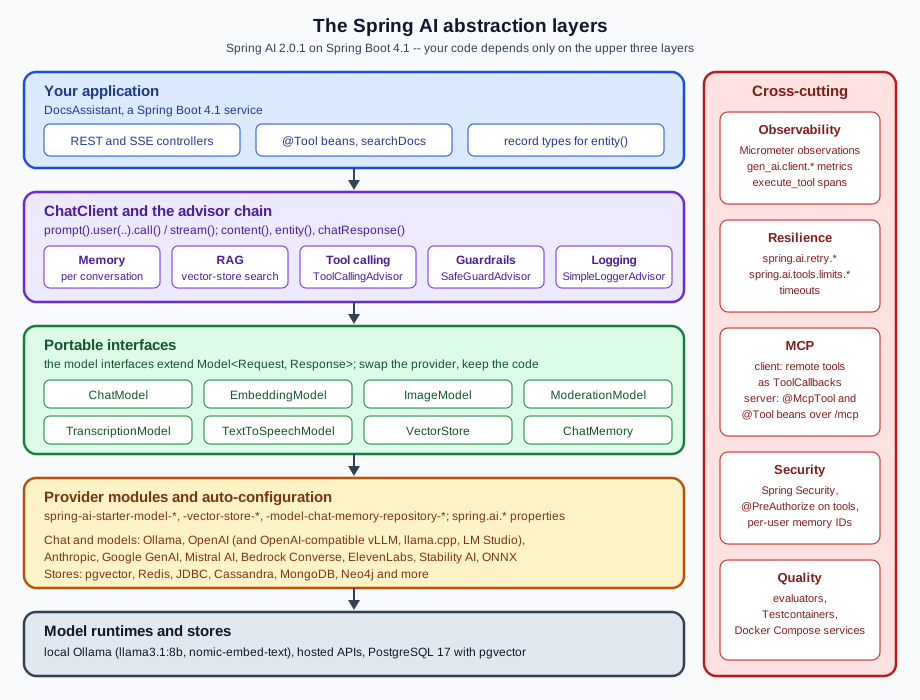
Application code talks to the upper layers only. A starter brings a provider module and its auto-configuration, the
auto-configuration reads spring.ai.* properties and registers beans for the portable interfaces, and the code injects
those interfaces or a ChatClient.Builder. Changing provider is therefore mostly a matter of changing a dependency and
a few properties. The portable interfaces in the 2.0.1 jars are:
| Interface | What it does | Page |
|---|---|---|
|
Sends a |
|
|
Turns text into vectors for semantic search. |
|
|
Generates images from an |
|
|
Speech to text; in 2.0 it extends |
|
|
Text to speech from a |
|
|
Classifies text against content-safety categories. |
|
|
Stores documents with their embeddings and runs similarity searches with metadata filters. |
ChatModel, EmbeddingModel, ImageModel, TranscriptionModel, TextToSpeechModel and ModerationModel all
extend the generic Model<TReq, TRes> interface in org.springframework.ai.model. ChatMemory sits beside them as the
store of conversation history (Chat Memory). The class below uses two of the
interfaces and never names a provider; the starter on the classpath decides which models answer.
package com.example.docsassistant;

import org.springframework.ai.chat.client.ChatClient;
import org.springframework.ai.embedding.EmbeddingModel;
import org.springframework.stereotype.Service;

@Service
public class PortableDocsAssistant {

    private final ChatClient chatClient;
    private final EmbeddingModel embeddingModel;

    // The builder and the embedding model come from whichever starter is on the
    // classpath (Ollama here); this class never names a provider.
    public PortableDocsAssistant(ChatClient.Builder builder, EmbeddingModel embeddingModel) {
        this.chatClient = builder
                .defaultSystem("You answer questions about the Irurueta documentation.")
                .build();
        this.embeddingModel = embeddingModel;
    }

    public String ask(String question) {
        return chatClient.prompt()
                .user(question)
                .call()
                .content();
    }

    public int embeddingDimensions() {
        return embeddingModel.dimensions();
    }
}
Source: Spring AI — ChatClient API and Spring AI — Chat Model API.
Version baseline
Every version below was read from Maven Central and the official documentation on 2026-09-29. Each page repeats the subset it uses in its own lead paragraph.
| Area | Versions |
|---|---|
Spring AI |
2.0.1, the current stable release, managed by |
Spring Boot and Java |
Spring AI 2.0.x supports Spring Boot 4.0.x and 4.1.x; the examples use Spring Boot 4.1.1, Spring Framework 7,
Jackson 3 ( |
MCP |
The MCP Java SDK ( |
Agents |
The community |
Models and stores |
Ollama with |
The MCP versions come with a skew that matters when you mix Spring AI with the rest of this site. The protocol
constants of the MCP Java SDK 2.0.x stop at the 2025-11-25 revision of the specification, while the site’s
Model Context Protocol reference is written against the 2026-07-28 revision. A Spring
AI 2.0.x server or client therefore speaks 2025-11-25 (the initialize handshake, Streamable HTTP with sessions), and the
features that exist only in 2026-07-28 — the stateless request core, server/discover, multi-round-trip requests — are not available yet. MCP Server and MCP Client
spell out the consequences.
Material written for Spring AI 1.x, including every book in the bibliography, describes an older API. The differences that matter most, each flagged where it appears on the pages and collected on Migrating from 1.x to 2.x:
-
options classes are immutable builders changed with
mutate(), and the.optionssegment was dropped from property paths (spring.ai.openai.chat.options.modelbecamespring.ai.openai.chat.model); -
ChatClientalways registers theToolCallingAdvisor, which runs the tool loop, andChatModel.call()no longer executes tools by itself; -
chat-memory advisors need a conversation ID,
PromptChatMemoryAdvisoris gone, and tool messages are not stored; -
the
FunctionCallbackAPI becameToolCallback, andSpringBeanToolCallbackResolverandtoolNames()were removed; -
the MCP annotations moved to
org.springframework.ai.mcp.annotation, and the MCP Java SDK moved to 2.0; -
the tool span is named
execute_tool <tool-name>instead oftool_call <tool-name>.
Provider families
Spring AI groups providers by how they are reached. The table is a summary; the full starter list, and what each provider supports, is on Setup & Starters and the reference’s Chat Models Comparison.
| Family | Starters |
|---|---|
Local runtimes |
|
OpenAI and OpenAI-compatible APIs |
|
Anthropic, Google, Mistral AI, DeepSeek |
|
Cloud platforms |
|
Specialised |
|
With more than one starter of the same kind on the classpath, choose the active one with spring.ai.model.chat,
spring.ai.model.embedding, spring.ai.model.image, spring.ai.model.audio.speech,
spring.ai.model.audio.transcription or spring.ai.model.moderation.
The running example: DocsAssistant
Every page extends DocsAssistant, a Spring Boot 4.1 service that answers questions about this site’s documentation. It uses the same corpus, Ollama models and pgvector store as Integrating with Spring AI, so the two sections describe one application, and it is the Java counterpart of the DocsAssistant built in LangChain, AI Agents and Model Context Protocol. Each page adds one capability.
| Capability | What DocsAssistant does | Page |
|---|---|---|
Project skeleton |
Starts with the BOM, the Ollama and pgvector starters, and Docker Compose or Testcontainers services. |
|
Chat endpoint |
|
|
Prompt templates |
Keeps its system and user prompts in |
|
Advisors |
Wraps each call with logging and a canary-word check. |
|
Structured metadata |
|
|
Tools |
Calls |
|
Per-user memory |
Remembers each user’s conversation in JDBC, keyed by the authenticated user and session. |
|
Streaming |
|
|
MCP server and client |
Exposes its tools at |
|
Voice and images |
|
Audio Transcription & Speech, Multimodality, Image Generation |
Metrics and tracing |
Publishes |
|
Evaluator tests and security |
Tests its answers with evaluators and stubbed models, and guards its endpoints, memory and tools. |
|
Agents, local models and deployment |
Adds agent workflows, runs on local runtimes, and ships to Kubernetes with retries, limits and secrets. |
Reading path
Read the pages in the order of the navigation on a first pass; the shorter paths below are for readers who already know part of the material.
New to Spring AI
-
Setup & Starters to create the project.
-
ChatModel & ChatClient, Prompts & Templates and Chat Options.
-
Tool Calling and Chat Memory.
Upgrading from Spring AI 1.x, or coming from the books
-
Migrating from 1.x to 2.x for the old-to-new tables.
-
Tool Calling Advisor & Tool Search for the new tool loop.
-
Chat Memory Repositories for the JDBC schema change.
Building RAG and agents
-
Retrieval & RAG Bridge, then the vector-store reference in Integrating with Spring AI.
-
MCP Client and MCP Server.
Taking a service to production
Voice and vision
What’s covered
The pages are grouped the same way as the navigation.
Getting started
-
Setup & Starters — the BOM, starter naming, flattened properties, provider selection, Docker Compose and Testcontainers services, and Spring Initializr.
Core API
-
ChatModel & ChatClient — the two levels of the chat API, builder defaults,
call()andstream(),content(),entity()andchatResponse(), usage metadata and several clients. -
Prompts & Templates —
Prompt, message roles,PromptTemplate,.stresources and custom `TemplateRenderer`s. -
Chat Options — portable and provider options, immutable builders and
mutate(), per-request options, and reasoning settings. -
Advisors — the advisor chain and its ordering constants,
CallAdvisorandStreamAdvisor, recursive advisors and custom advisors. -
Structured Output —
entity(), the output converters, native structured output and validation with self-correction.
Tools and memory
-
Tool Calling —
@Tooland@ToolParam, the tool-callback types,ToolContext,returnDirectand exception handling. -
Tool Calling Advisor & Tool Search — the automatic tool loop, a manual loop,
ToolSearchToolCallingAdvisorandspring.ai.tools.limits.*. -
Chat Memory —
MessageWindowChatMemory, the mandatory conversation ID,MessageChatMemoryAdvisorand summarising long histories. -
Chat Memory Repositories — JDBC, Cassandra, MongoDB, Neo4j and Redis, a custom repository, retention and GDPR erasure.
Streaming and MCP
-
Streaming & Reactive —
Fluxresponses, server-sent-event endpoints, streaming with tools and memory, cancellation and virtual threads. -
MCP Client — connections,
mcp-servers.json,SyncMcpToolCallbackProvider,McpClientCustomizer, client annotations and the GitHub MCP server. -
MCP Server — protocols,
@McpTool,@McpResource,@McpPromptand@McpComplete, exposing@Toolbeans, OAuth and the Inspector.
Multimodal and voice
-
Multimodality —
Mediainput, vision questions and a provider matrix. -
Audio Transcription & Speech —
TranscriptionModel,TextToSpeechModelwith OpenAI and ElevenLabs, and a voice round trip. -
Image Generation —
ImageModel,ImagePrompt, OpenAI and Stability AI options, and storing the results.
Operations and quality
-
Observability — Micrometer observations,
gen_ai.*metrics, Prometheus and Grafana, OpenTelemetry traces and the logging flags. -
Evaluation —
RelevancyEvaluator,FactCheckingEvaluator, LLM-as-a-judge, custom evaluators and golden-set tests. -
Testing — stubbed models, WireMock, Testcontainers Ollama and slice tests.
-
Security & Guardrails — Spring Security, memory isolation,
@PreAuthorizeon tools,SafeGuardAdvisor,ModerationModeland document-level access.
Agents, local models and production
-
Agentic Patterns — the effective-agents workflows,
spring-ai-agent-utilsand Embabel. -
Local Models — Ollama, Docker Model Runner, OpenAI-compatible local servers and ONNX embeddings.
-
Production & Deployment — retries, rate limits, caching, timeouts, virtual threads, Kubernetes, secrets and cost.
-
Migrating from 1.x to 2.x — the upgrade notes as old-to-new tables and the OpenRewrite recipes.
RAG bridge
-
Retrieval & RAG Bridge — the RAG advisors around a
ChatClient, with deep links into the vector-store reference.
Cheat sheet
-
Cheat Sheet (PDF) — a single-page, printable summary of the sub-section.
Related material elsewhere on this site
The vector-store side of Spring AI is not repeated here. The canonical page is Integrating with Spring AI, whose sections on embeddings, the VectorStore API, filter expressions, the ETL pipeline, the RAG advisors, modular RAG, vector-backed chat memory, retrieval tools and testing cover it, and Spring Boot: Redis as a Vector Database covers Redis. Spring Boot itself is documented in Spring Boot. Framework-neutral background lives in the sibling sub-sections: LLM Foundations & Prompting for models and prompting, AI Agents for agent theory, Model Context Protocol for the protocol, Running LLMs Locally for local runtimes and LangChain for the LangChain4j alternative on the JVM, and RAG Systems in Production for running DocsAssistant as a production RAG service. Conversational Channels covers exposing it through chat channels; Hugging Face, Voice Agents, LLMOps & Evaluation and AI Security & Responsible AI are separate sub-sections of this AI section.
Bibliography
The following sources were consulted while preparing this sub-section’s pages. Every class, annotation, method,
starter, property and metric name was checked against the Spring AI 2.0.1 jars (with javap and the configuration
metadata in the starters), the official documentation or the sources listed here on 2026-09-29 — never copied from a
book. Every documentation URL cited on the pages of this sub-section is listed here once.
Requester-provided books, consulted for concepts only and never the source of an example. All three target an older Spring AI line (1.0.x, 0.8.x or a 1.0 milestone), so where they differ from the Spring AI documentation, the documentation is authoritative:
-
Walls, Craig. Spring AI in Action. Foreword by Rod Johnson. Manning Publications, 2026. ISBN 978-1-63343-611-4. Publisher page: https://www.manning.com/books/spring-ai-in-action. Official code repository: https://github.com/habuma/spring-ai-in-action-samples. Consulted as the backbone for the concepts of
ChatClientprompts, evaluation, prompt templates and options, retrieval, chat memory, tools, MCP clients and servers, voice and images, observability, safeguarding and agents. It targets Spring Boot 3.5 and Spring AI 1.0.3; the options, memory, tool and MCP changes of 2.0 are flagged on the pages that cover them. -
Parasuraman, Banu. Mastering Spring AI: The Java Developer’s Guide for Large Language Models and Generative AI. Apress (Springer Nature), 2024. ISBN 979-8-8688-1000-8 (print), 979-8-8688-1001-5 (ebook), DOI 10.1007/979-8-8688-1001-5. Publisher page: https://link.springer.com/book/10.1007/979-8-8688-1001-5. There is no Apress code repository; the author’s repositories are listed in the book’s appendix, for example https://github.com/banup-kubeforce/health-rag. Consulted for the Spring ecosystem around generative AI, prompting types, governance, LLMOps, and productionising concerns such as caching, retries and security. It targets the pre-1.0 0.8.x line, so its
ChatClientinterface,ImageClient,BeanOutputParserandFunctionCallbackWrapperare described on the pages only as history. The local copy consulted names "Edizioni Ensemble" and ISBN 9788868810009 in its file name; the publisher of record verified online is Apress, which is the record cited here. -
Anthapu, Ravindranatha, and Siddhant Agarwal. Building Neo4j-Powered Applications with LLMs. Packt Publishing, Jun 2025. ISBN 978-1-83620-623-1. Publisher page: https://www.packtpub.com/en-us/product/building-neo4j-powered-applications-with-llms-9781836206231. Official code repository: https://github.com/PacktPublishing/Building-Neo4j-Powered-Applications-with-LLMs. Chapters 7 and 9 were consulted for a Spring AI
ChatClientover Neo4j, LLM summaries stored as node embeddings, and a REST endpoint that triggers the augmentation.
packtpub.com answers automated fetches with an HTTP 403 response, but the publisher page above is a live, reachable
page when opened in a browser.
Official documentation — Spring AI reference (https://docs.spring.io/spring-ai/reference/):
-
Getting started and upgrading: Getting Started, Upgrade Notes, Docker Compose, Testcontainers
-
Chat and prompts: ChatClient API, Chat Model API, Prompts, Prompt Engineering Patterns, Chat Models Comparison
-
Providers: Ollama Chat, OpenAI Chat, Anthropic Chat, Anthropic migration, Google GenAI Chat, Mistral AI Chat, Bedrock Converse, Docker Model Runner, Transformers (ONNX) Embeddings
-
Advisors: Advisors API, Recursive Advisors
-
Structured output: Structured Output Converter, Converters, Validation, Native structured output
-
Memory and retrieval: Chat Memory, Retrieval Augmented Generation, ETL Pipeline, Vector Databases
-
MCP: MCP Overview, MCP Client Boot Starter, MCP Server Boot Starter, Streamable-HTTP MCP Servers, Stateless Streamable-HTTP MCP Servers, MCP Annotations, MCP Server Annotations, MCP Client Annotations, MCP Security, Getting Started with MCP
-
Multimodal, audio and images: Multimodality API, Transcription API, OpenAI Transcriptions, Text-To-Speech (TTS) API, OpenAI Text-to-Speech, ElevenLabs Text-to-Speech, Image Model API, OpenAI Image Generation, Stability AI Image Generation, Google GenAI Image Generation, Moderation
-
Observability, evaluation, testing and agents: Observability, Evaluation Testing, LLM-as-a-Judge, Building Effective Agents
Official documentation — Spring and related projects:
-
Spring Boot reference, in particular Metrics, Observability, Tracing, Kubernetes probes, Caching, Task Execution and Scheduling, Graceful Shutdown, Testing Spring Boot Applications and Testcontainers
-
Spring Framework: Resilience Features, Task Execution and Scheduling, Reactive Core, Asynchronous Requests
-
Spring Security: Method Security, OAuth 2.0 Resource Server JWT
-
Micrometer Observation, Reactor reference, Testcontainers Ollama module, WireMock stateful behaviour, JUnit tags, Resilience4j RateLimiter, Prometheus recording rules, Kubernetes Secrets
-
OpenRewrite, Spring AI 2.0.0-M3 recipes (raw form: migrate-to-2-0-0-M3.yaml), and the Arconia migrations for Spring AI 1.0 and Spring AI 2.0
-
Model and runtime documentation: Docker Model Runner, Foundry Local, OpenAI speech to text, OpenAI text to speech, OpenAI image generation, ElevenLabs text-to-speech API, Stability AI API reference
Specifications and standards:
-
Model Context Protocol, revision 2026-07-28 (the site baseline) and revision 2025-11-25 (targeted by the MCP Java SDK 2.0), including its authorization section
-
RFC 9728: OAuth 2.0 Protected Resource Metadata and RFC 8707: Resource Indicators for OAuth 2.0
-
OWASP Top 10 for LLM Applications, in particular LLM01: Prompt Injection
Samples, papers and engineering articles:
-
Spring AI repository and spring-ai-examples, in particular the agentic-patterns examples
-
Spring blog: Spring AI 2.0.0 GA, Building Effective Agents with Spring AI (2025-01-21), and the 2026 agentic patterns series: agent skills, the AskUserQuestion tool, TodoWrite, task subagents, A2A integration, memory tools and session management
-
Spring AI Community projects: spring-ai-agent-utils, mcp-security and spring-ai-session
-
Zheng, Lianmin, et al. "Judging LLM-as-a-Judge with MT-Bench and Chatbot Arena." 2023. arXiv:2306.05685
These books are consulted references, not the primary source of any example on this sub-section’s pages. On any discrepancy between a book and the Spring AI or Spring Boot official documentation, that documentation is authoritative.