The Collections Framework
|
This section documents the current Java release line, with Java 25 LTS as the reference point (no specific patch version is pinned), as published at the Java developer portal, the Java Tutorials, and the Java SE API specification — which are the references these pages are written and verified against. This content was generated with the assistance of AI and should be verified against the official documentation before being relied on in production. This section’s bibliography lists the reference material consulted while preparing these pages. |
The collections framework in java.util is a small set of interfaces for groups of objects together
with several general-purpose implementations of each. The rule of thumb is: declare variables and
parameters with the interface type (List, Set, Map), and choose the implementation for its
performance and ordering behaviour. This page follows
dev.java: The Collections Framework and the
Java Tutorials Collections trail; each type links to
its java.util
Javadoc.
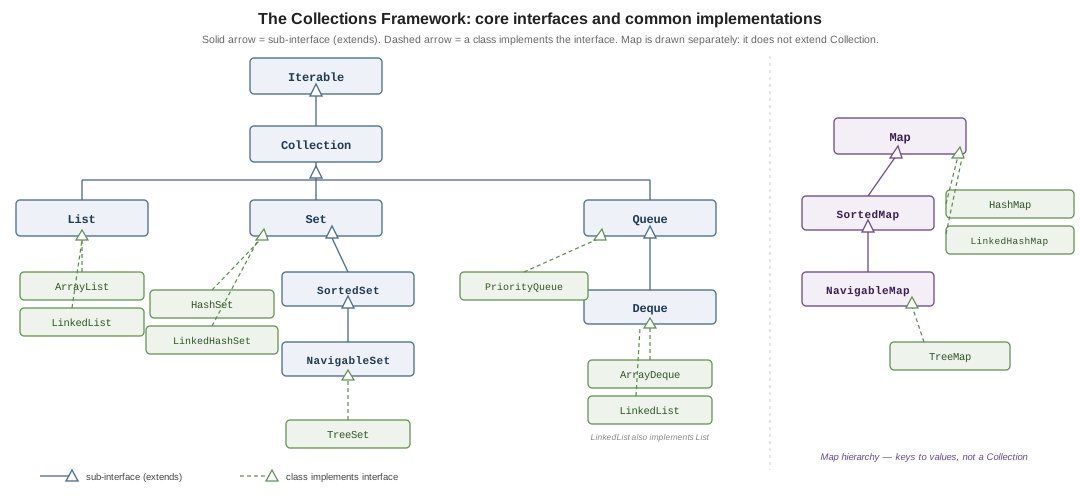
The Interface Hierarchy
Iterable<T> is the
root: anything iterable works with the enhanced for loop.
Collection<T>
adds size, membership, and bulk operations, and splits into
List (ordered, indexed,
duplicates allowed),
Set (no duplicates), and
Queue /
Deque (ends-oriented).
Map<K, V> is not a
Collection — it maps keys to values — but its keySet(), values(), and entrySet() views are. See
the Collection Interfaces lesson.
import java.util.*;

// declare as the interface, assign a concrete implementation
List<String> names          = new ArrayList<>();
Set<Integer> ids            = new HashSet<>();
Map<String, Integer> scores = new HashMap<>();
Deque<String> stack         = new ArrayDeque<>();

names.add("Ada");
ids.add(42);
scores.put("Ada", 9);
stack.push("top");

// a method that accepts the interface works for every implementation
static long size(Collection<?> c) {
    return c.size();
}

long total = size(names) + size(ids) + size(scores.values());
Coding to the interface lets you swap ArrayList for LinkedList, or HashMap for TreeMap, without
touching the callers.
Choosing an Implementation
import java.util.*;

// ArrayList: array-backed. Fast random access and iteration, cheap append. The default List.
List<Integer> list = new ArrayList<>();

// LinkedList: doubly-linked nodes. O(1) insert/remove once positioned, no cheap indexing.
// Worth using only as a Deque, rarely as a List.
Deque<Integer> nodes = new LinkedList<>();

// HashSet: unordered, near-O(1) membership. LinkedHashSet keeps insertion order.
// TreeSet: kept sorted (natural order or a Comparator), O(log n) operations.
Set<String> seen                = new HashSet<>();
Set<String> inInsertionOrder    = new LinkedHashSet<>();
NavigableSet<String> sortedSet  = new TreeSet<>();

// HashMap: unordered. LinkedHashMap: insertion (or access) order. TreeMap: keys sorted,
// with floorKey/ceilingKey/headMap/tailMap navigation.
Map<String, Integer> counts            = new HashMap<>();
NavigableMap<String, Integer> byKey    = new TreeMap<>();

// ArrayDeque: the modern stack and queue -- faster than the legacy Stack or LinkedList.
Deque<Integer> dq = new ArrayDeque<>();
dq.push(1);
int top = dq.pop();

// PriorityQueue: a binary heap; poll() returns the head per the ordering.
Queue<Integer> pq = new PriorityQueue<>(Comparator.reverseOrder());
pq.add(3); pq.add(1); pq.add(2);
int largest = pq.poll();   // 3
Approximate costs for the common operations (average case; HashMap/HashSet degrade to O(n) only
under pathological hashing):
operation              ArrayList     LinkedList    HashMap/HashSet   TreeMap/TreeSet   ArrayDeque
random access get(i)    O(1)          O(n)          n/a               n/a               n/a
insert / remove at end  O(1) amort.   O(1)          n/a               n/a               O(1) amort.
insert / remove at head O(n)          O(1)          n/a               n/a               O(1) amort.
contains / get by key   O(n)          O(n)          O(1)              O(log n)          O(n)
iteration order         insertion     insertion     unspecified       sorted by key     head-to-tail
Default to ArrayList and HashMap. Choose a Linked* variant when you need predictable iteration
order, a Tree* variant when you need sorting or range queries, and ArrayDeque for stack/queue work.
Iterating
Every Collection supplies an
Iterator, which
the enhanced for loop uses under the hood. See
dev.java: Iterating over the Elements.
var list = new ArrayList<>(List.of("a", "b", "c", "d"));

// idiomatic read-only traversal
for (var s : list) {
    System.out.println(s);
}

// explicit Iterator when you must remove during traversal
for (var it = list.iterator(); it.hasNext(); ) {
    if (it.next().equals("b")) {
        it.remove();          // safe; list.remove(...) inside the loop is not
    }
}

// removeIf: the concise equivalent of the loop above
list.removeIf(s -> s.compareTo("c") >= 0);

// ListIterator: bidirectional, with set() and add()
for (var lit = list.listIterator(); lit.hasNext(); ) {
    lit.set(lit.next().toUpperCase());
}
Structurally modifying a collection during a for loop — through anything other than the loop’s own
iterator — makes the iterator fail-fast: the next next() throws
ConcurrentModificationException.
It is a best-effort bug detector, not a concurrency guarantee.
for (String s : list) {
    if (s.isBlank()) {
        list.remove(s);       // throws ConcurrentModificationException on the next iteration
    }
}
Utilities and Immutable Factories
java.util.Collections
holds static helpers; the List.of / Set.of / Map.of factories (Java 9) build compact,
unmodifiable, null-hostile collections. See
Implementations and
dev.java: Creating
Immutable Collections.
import java.util.*;

var nums = new ArrayList<>(List.of(3, 1, 2));
Collections.sort(nums);                               // in place -> [1, 2, 3]
Collections.sort(nums, Comparator.reverseOrder());    // -> [3, 2, 1]
int threes           = Collections.frequency(nums, 3);
List<String> nothing = Collections.emptyList();
List<Integer> view   = Collections.unmodifiableList(nums);   // live read-only view

// immutable factories: fixed size, reject null, throw on any mutator
List<String> days   = List.of("Mon", "Tue", "Wed");
Set<Integer> primes = Set.of(2, 3, 5, 7);
Map<String, Integer> ages = Map.of("Ada", 36, "Bo", 24);
Map<String, Integer> more = Map.ofEntries(
        Map.entry("Ada", 36),
        Map.entry("Bo", 24));

// unmodifiable snapshot detached from the source
List<String> snapshot = List.copyOf(days);
unmodifiableList wraps a collection that someone else can still change; List.copyOf copies the
elements so the result is independent.
Sequenced Collections (Java 21)
SequencedCollection,
SequencedSet, and SequencedMap give every collection with a defined encounter order the same
first/last vocabulary and a reversed() view. See
dev.java: Sequenced Collections.
import java.util.*;

SequencedCollection<String> sc = new ArrayList<>(List.of("a", "b", "c"));
sc.addFirst("start");                 // [start, a, b, c]
sc.addLast("end");                    // [start, a, b, c, end]
String head = sc.getFirst();          // "start"
String tail = sc.getLast();           // "end"
SequencedCollection<String> back = sc.reversed();   // reverse-ordered view

SequencedMap<String, Integer> sm = new LinkedHashMap<>();
sm.putFirst("a", 1);
sm.putLast("z", 26);
Map.Entry<String, Integer> first = sm.firstEntry();
SequencedMap<String, Integer> smReversed = sm.reversed();List, Deque, LinkedHashSet, TreeSet, LinkedHashMap, and TreeMap all implement the sequenced
interfaces. reversed() returns a view — writes through it are reflected in the backing collection.
The equals / hashCode Contract
Hash-based collections locate an element by its
hashCode(),
then confirm the match with
equals(Object).
Override both together, from the same fields, or lookups fail silently. The full contract is on
Inheritance and Polymorphism.
import java.util.*;

// a record derives a correct equals/hashCode/toString from its components
record Point(int x, int y) { }

Set<Point> points = new HashSet<>();
points.add(new Point(1, 2));
boolean here = points.contains(new Point(1, 2));   // true -- value equality

// TreeSet/TreeMap order by a Comparator or Comparable, not by equals
NavigableSet<Point> byX = new TreeSet<>(
        Comparator.comparingInt(Point::x).thenComparingInt(Point::y));
byX.add(new Point(3, 0));
byX.add(new Point(1, 9));
Point smallest = byX.first();                       // Point[x=1, y=9]
An object whose equals/hashCode fields mutate while it sits in a hash collection becomes
unreachable — keep keys and set elements immutable. Building multi-key orderings with
Comparator
factories (comparing, thenComparing, reversed) is covered on Interfaces.
The Hierarchy at a Glance
The diagram shows Iterable at the root of Collection, the List / Set / Queue / Deque
branches with their sorted sub-interfaces, and Map drawn separately because it does not extend
Collection:
See Also
-
Streams and Collectors — processing the contents of a collection with a lazy pipeline instead of an explicit loop.
-
Generics — the type parameters (
List<E>,Map<K, V>, bounded wildcards) that every collection interface is built on. -
Interfaces —
Comparablevs.Comparatorand the factory methods used to sortTreeSet,TreeMap, andPriorityQueue. -
Inheritance and Polymorphism — the full
equals/hashCodecontract that hash-based collections depend on.