Unions and Narrowing
|
This section documents the current TypeScript release line as published at the official TypeScript documentation, which is the reference these pages are written and verified against. No specific patch version is pinned. This content was generated with the assistance of AI and should be verified against the official documentation before being relied on in production, since TypeScript iterates quickly. This section’s bibliography lists the reference material consulted while preparing these pages. |
A union type describes a value that may be one of several types. TypeScript only lets you use operations valid for every member until you narrow the union — prove, with a runtime check the compiler understands, which member you actually hold. The full catalogue of narrowing constructs is in the handbook’s Narrowing chapter.
Declaring Unions
Write a union with |. Only members common to all constituents are accessible without narrowing:
function format(id: string | number): string {
  // id.toFixed(2)        // Error: 'toFixed' does not exist on 'string'
  return id.toString();   // OK: both string and number have toString
}
Union members can be literal types, giving a closed set of values — see Enums and Literal Alternatives for literal unions as an enum alternative.
The "billion-dollar mistake" and strictNullChecks
With strictNullChecks on (implied by strict), null and undefined are not assignable to other
types — add them to the union explicitly, and TypeScript then forces you to handle them:
function firstChar(s: string | null): string {
  // return s[0];         // Error: 's' is possibly 'null'
  if (s === null) return "";
  return s[0];            // OK: s is 'string' here
}
Turn the check off ("strictNullChecks": false) and every type silently admits null again — the
original "billion-dollar mistake". Keep it on. See The Type System for the
strict-mode flags.
Narrowing Guards and Control-Flow Analysis
TypeScript tracks the type of each variable along every code path — control-flow analysis. After a guard, the variable has a more specific type in the branch where the guard held, and often in the branch where it did not.
typeof
function pad(value: string | number, width: number): string {
  if (typeof value === "string") {
    return value.padStart(width);                      // value: string
  }
  return " ".repeat(Math.max(0, width - 1)) + value;   // value: number
}
The recognised results are "string", "number", "bigint", "boolean", "symbol",
"undefined", "object", and "function". Note typeof null === "object" — a classic trap that
does not narrow away null.
Truthiness
A bare condition removes null, undefined, 0, "", NaN, and false:
function greet(name?: string): string {
  if (!name) return "Hello, stranger";
  return `Hello, ${name}`;          // name: string
}
Truthiness also excludes the empty string and 0, which may be valid inputs — prefer an explicit
name === undefined when only nullishness matters.
Equality and ===
Comparing two variables narrows both to their shared type:
function compare(a: string | number, b: string | boolean): void {
  if (a === b) {
    // a and b are both 'string' here
    console.log(a.toUpperCase(), b.toUpperCase());
  }
}
Comparison against a literal (x === "done") narrows to that literal; x != null removes both null
and undefined.
in
The in operator narrows by property presence:
type Admin = { role: "admin"; permissions: string[] };
type Member = { role: "member"; lastLogin: Date };

function summarise(account: Admin | Member): string {
  if ("permissions" in account) {
    return `${account.permissions.length} permissions`;   // account: Admin
  }
  return `last seen ${account.lastLogin.toISOString()}`;   // account: Member
}
instanceof
function describeError(e: Error | string): string {
  if (e instanceof TypeError) return `type error: ${e.message}`;
  if (e instanceof Error) return e.message;
  return e;                          // e: string
}
Assignment narrowing
Assigning a value narrows the variable to that value’s type from that point on, within its declared type:
let result: string | number = fetchRaw();   // string | number
result = result.length;                     // assigned a number
result.toFixed(2);                          // OK: result is 'number' here
Control-flow: the type at each point
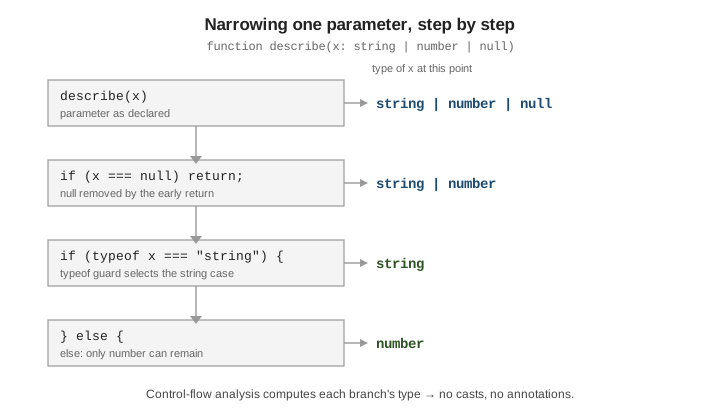
TypeScript re-derives the type after return, throw, break, and continue cut a path short — the SVG above traces exactly this function:
function label(x: string | number | null): string {
  if (x === null) return "none";   // below here: string | number
  if (typeof x === "string") {
    return x.trim();               // x: string
  }
  return x.toFixed(0);             // x: number  (string already handled)
}
Discriminated (Tagged) Unions
Give every member a common literal property — the discriminant — so a check on it narrows the whole object. This is the pattern TypeScript optimises for; see Discriminated unions.
type Circle = { kind: "circle"; radius: number };
type Square = { kind: "square"; side: number };
type Rect = { kind: "rect"; w: number; h: number };
type Shape = Circle | Square | Rect;

function area(shape: Shape): number {
  switch (shape.kind) {
    case "circle": return Math.PI * shape.radius ** 2;
    case "square": return shape.side ** 2;
    case "rect":   return shape.w * shape.h;
    default:       return assertNever(shape);
  }
}
Exhaustiveness with assertNever
In the default: branch every case is handled, so shape has type never. A helper that only
accepts never turns a missing case into a compile error — add a fourth Shape member and area
stops compiling until the new case is handled:
function assertNever(value: never): never {
  throw new Error(`Unhandled union member: ${JSON.stringify(value)}`);
}
Type Predicates and Assertion Functions
Type predicates (x is Fish)
A function whose return type is param is Type is a user-defined type guard: callers narrow on its
boolean result.
type Fish = { swim: () => void };
type Bird = { fly: () => void };

function isFish(pet: Fish | Bird): pet is Fish {
  return typeof (pet as Fish).swim === "function";
}

function move(pet: Fish | Bird): void {
  if (isFish(pet)) pet.swim();
  else pet.fly();
}
Since 5.5 TypeScript also infers a predicate for a simple function such as p ⇒ p !== null, so
array.filter(x ⇒ x !== null) yields the non-null element type without an explicit annotation.
Assertion functions (asserts x is …)
An assertion function throws instead of returning a boolean; on a normal return the compiler treats the assertion as proven from that point on. Documented under Assertion functions.
function assert(condition: unknown, msg?: string): asserts condition {
  if (!condition) throw new Error(msg ?? "Assertion failed");
}

function assertIsString(val: unknown): asserts val is string {
  if (typeof val !== "string") throw new Error("Not a string");
}

function loud(input: unknown): string {
  assertIsString(input);
  return input.toUpperCase();       // input: string from here on
}
asserts condition with no is narrows using the truthiness of the argument — after assert(x),
x is known to be truthy.
"Evolving" any
A let with no annotation and no initialiser starts as evolving any: its type follows each
assignment until first use, without noImplicitAny complaining.
let value;                 // evolving any
value = 42;                // value: number
value.toFixed(1);          // OK
value = "text";            // value: string
value.toUpperCase();       // OK
Reach for this only in tight local code; an explicit union is clearer to a reader.
Keeping Narrowing
Alias narrowed values consistently
Narrowing follows a symbol, not an expression. Give a narrowed sub-expression a const name and use
that name — not the original property path — afterwards:
type Box = { contents: string | null };

function render(box: Box): string {
  const contents = box.contents;
  if (contents === null) return "(empty)";
  return contents.toUpperCase();   // stays 'string'; box.contents would re-widen
}
Narrowing does not cross a function boundary
A check in the caller is invisible inside a nested function or callback — extract a guard instead:
function process(items: (string | null)[]): string[] {
  // items.filter(x => x != null).map(x => x.toUpperCase())  // pre-5.5: x still string | null
  return items
    .filter((x): x is string => x !== null)
    .map(x => x.toUpperCase());
}
The explicit x is string predicate carries the narrowing across the .filter() boundary.
See Also
-
The Type System — how unions sit in the wider type system, and the strict flags.
-
Type Design and Best Practices — modelling data so illegal states are unrepresentable.
-
Enums and Literal Alternatives — literal unions as the discriminant and as an enum replacement.