Resilience
|
This content was generated with the assistance of AI and should be verified against the official documentation before being relied on in production. The reference material consulted while preparing these pages is listed in the section bibliography. |
This Backend Development section is a practical guide, focused on Spring Boot services, to making a service tolerate the
failures of the services it calls (it complements the SpringBoot Reference). It
documents Resilience4j 2.4.0 (released 2026-03-14, Java 17
or later) on Spring Boot 4.1.x and Spring Framework 7.0.x with Java 21, together with the pieces of the
Spring ecosystem that sit around it: Spring Cloud CircuitBreaker, the Spring Cloud Gateway and OpenFeign
integrations, and the native @Retryable and @ConcurrencyLimit of Spring Framework 7. Where the Spring Boot 3.5
starter differs, the pages show a short "Spring Boot 3" delta. The versions were verified on 4 October 2026.
Next to Resilience4j, the section documents Bucket4j 8.21.0 (released
2026-10-02, Java 17 or later), the token-bucket library for what an in-process limiter cannot do: per-client API quotas,
limits shared by every replica through Redis, a JDBC database or a data grid, and one quota of a third-party API shared
across instances. Its pages cover the library itself, its Spring Boot integration by hand, through the community
bucket4j-spring-boot-starter and in Spring Cloud Gateway, and how it combines with Resilience4j; the Bucket4j pages were
verified on 5 October 2026. Start with Resilience4j versus
Bucket4j to see which library answers which need.
What resilience means for a Spring Boot service
A service that calls other services inherits their failures. A dependency that answers slowly holds your threads and connections; one that fails intermittently turns every request into a coin toss; one that is down makes every caller wait for a timeout; and a caller that retries aggressively can keep a struggling dependency from ever recovering. Resilience is the set of techniques that keep one failing dependency from becoming your failure:
-
timeouts so that no call waits forever (TimeLimiter, plus the HTTP client’s own timeouts)
-
retries with exponential backoff and jitter for transient errors, on idempotent operations only (Retry)
-
circuit breakers that stop calling a dependency that is clearly failing, and probe it again later (CircuitBreaker)
-
bulkheads that cap how much of your capacity one dependency can consume (Bulkhead, ThreadPoolBulkhead)
-
rate limiters that keep you under a dependency’s quota, or keep clients under yours (RateLimiter)
-
fallbacks that degrade gracefully instead of failing: a cached value, a default, an empty list
Resilience4j is the lightweight, functional fault-tolerance library that Netflix recommends in place of
Hystrix, which has been in maintenance mode since 2018. Each pattern is a small
module with no dependencies beyond its own modules, composed by decorating a function; the Spring Boot starter adds
registries bound to application.yml, annotations, Actuator endpoints, health indicators and Micrometer metrics.
This section is for developers who:
-
build or maintain Spring Boot services that call other HTTP, gRPC or database-backed services, and want to know which pattern answers which failure
-
are on Spring Boot 4 (or still on 3.5) and need the starter, the AspectJ dependency and the configuration that actually work, because the official Resilience4j documentation does not cover Spring Boot 4
-
come from Hystrix, Spring Retry or Spring Cloud Netflix, and need the migration path
-
want to test the failure paths, observe them in production, and tune the numbers from real traffic
The version baseline
| Component | Version |
|---|---|
Resilience4j |
2.4.0 (2026-03-14), group |
|
2.4.0, both needing |
Spring Boot |
4.1.1 (baseline); 3.5.16 for the deltas |
Spring Framework |
7.0.9 (6.2.19 on Boot 3.5, which has no native resilience API) |
Spring Cloud / Spring Cloud CircuitBreaker |
2025.1.3 "Oakwood" / 5.0.3 (which still pins Resilience4j 2.3.0 and the Boot 3 starter) |
Java |
21 (Resilience4j 2.4.0 itself needs 17) |
Bucket4j |
8.21.0 (2026-10-02), group |
|
0.20.0-RC1 for Spring Boot 4.1 (pre-release; no GA yet), 0.14.0 for Spring Boot 4.0, 0.13.0 for Spring Boot 3.5 |
Spring Cloud Gateway (Bucket4j filters) |
5.0.3, Web MVC and WebFlux; Bucket4j is an optional dependency the application declares itself |
The Resilience4j BOM does not manage resilience4j-spring-boot4, and Spring Boot does not manage Resilience4j at
all, so the Maven snippets import the BOM and pin the starter explicitly. The
Getting Started page has the details, and
Migration & What’s Changed collects every place
where the official readme.io documentation is stale. Spring Boot does not manage Bucket4j either, so the Bucket4j pages import
bucket4j_jdk17-bom; Bucket4j: Overview and
Getting Started has the module table, and
Bucket4j: Migration & What’s Changed collects
the places where the Bucket4j reference is stale.
The Bookshelf scenario
Every example builds on Bookshelf, the book-catalogue domain already used by the
Python FastAPI, NestJS,
Django, Next.js and
Kubernetes sections, so that the stacks can be compared page by page. Here it
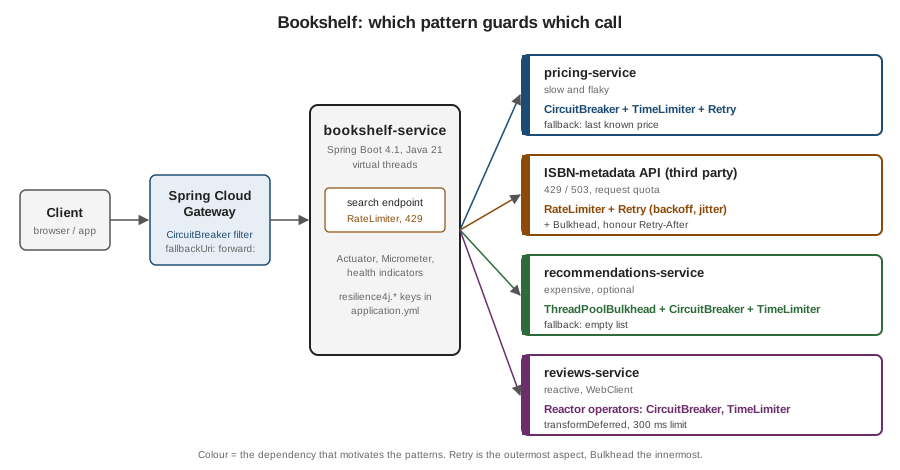
is a Spring Boot 4.1 bookshelf-service (Java 21, virtual threads enabled) that calls four downstream dependencies.
Each dependency motivates one set of patterns:
| Dependency | Behaviour | Patterns |
|---|---|---|
|
Slow and flaky. |
CircuitBreaker, TimeLimiter and a short Retry, with a fallback to the last known price. |
A third-party ISBN-metadata API |
Has a request quota and answers 429 or 503. |
A client-side RateLimiter, a Bulkhead, and Retry with exponential backoff and jitter that honours |
|
Expensive and optional. |
A ThreadPoolBulkhead with a CircuitBreaker and a TimeLimiter, degrading to an empty list. |
|
Called reactively through |
The Reactor operators of |
Spring Cloud Gateway sits in front of bookshelf-service with a CircuitBreaker filter, the service’s own search
endpoint is protected by a RateLimiter that answers 429 with Retry-After, and the tests inject faults with WireMock
and Toxiproxy (through Testcontainers).
Rate limits and quotas with Bucket4j
The Bucket4j pages extend the same service with the limits an in-process limiter cannot enforce:
| Need | Behaviour | Bucket4j answer |
|---|---|---|
A public REST API with per-API-key plans |
Most pages use a free plan of 20 requests per minute, pro 200 and partner 2 000; the comparison page uses 100 per hour plus 10 per second for free. The quota must hold across every replica. |
One bucket per API key, its configuration chosen by plan, stored in Redis through Lettuce; rejections answer 429 with
|
The third-party ISBN-metadata API |
Its daily quota (1 000 calls) applies to the whole service, not to each replica. |
One distributed bucket shared by every replica, where the Resilience4j RateLimiter above admits the limit once per replica. |
The |
Expensive. |
Weighted consumption: each call costs 5 tokens. |
Teams without Redis |
Need the same limits. |
A PostgreSQL (JDBC) variant of the bucket store, with its table created by Flyway. |
Spring Cloud Gateway |
Sits in front of every replica. |
A coarse per-client limit at the edge with the Web MVC Bucket4j filter. |
Resilience4j keeps guarding the outbound calls, including the calls to the bucket store itself, so a Redis outage fails open or closed deliberately. The Bookshelf with both libraries puts the two together.
The final layout
The layout below is where the pages end up. Individual examples sit in whichever package keeps them short (most
in the base package com.example.bookshelf), so treat the sub-packages as the tidy version of the same classes.
bookshelf-service/
├── pom.xml                                   # resilience4j-bom + resilience4j-spring-boot4 pinned,
│                                             # spring-boot-starter-aspectj, -actuator, -web, -webflux
└── src/
    ├── main/
    │   ├── java/com/example/bookshelf/
    │   │   ├── BookshelfApplication.java
    │   │   ├── pricing/                      # PricingClient (@CircuitBreaker, @TimeLimiter, fallback)
    │   │   ├── isbn/                         # IsbnMetadataClient (@RateLimiter, @Retry, @Bulkhead)
    │   │   ├── recommendations/              # RecommendationsClient (@Bulkhead(type = THREADPOOL))
    │   │   ├── reviews/                      # ReviewsClient (WebClient + Reactor operators)
    │   │   ├── search/                       # SearchController (@RateLimiter, 429 + Retry-After)
    │   │   ├── config/                       # BookshelfResilienceConfig (customizers, Clock)
    │   │   ├── MdcContextPropagator.java     # named in application.yml
    │   │   └── TransientHttpFailure.java     # named in application.yml
    │   └── resources/
    │       ├── application.yml               # shown below
    │       ├── application-test.yml          # tiny windows and waits
    │       └── application-local.yml         # breakers that stay closed while debugging
    └── test/java/com/example/bookshelf/      # registry unit tests, @SpringBootTest aspect checks,
                                              # WireMock faults, Toxiproxy (Testcontainers)
The configuration file is the complete resilience configuration of the service. It is the one explained, key by key, on Spring Boot Configuration, where its effective values were read back from the registries on Spring Boot 4.1.1 and 3.5.16.
spring:
  application:
    name: bookshelf-service

resilience4j:
  circuitbreaker:
    tags:
      application: ${spring.application.name}
    configs:
      default:                                  # what an unlisted breaker gets
        slidingWindowType: COUNT_BASED
        slidingWindowSize: 20
        minimumNumberOfCalls: 10
        failureRateThreshold: 50
        waitDurationInOpenState: 30s
        permittedNumberOfCallsInHalfOpenState: 3
        automaticTransitionFromOpenToHalfOpenEnabled: true
        registerHealthIndicator: true
        eventConsumerBufferSize: 50
        recordExceptions:
          - org.springframework.web.client.ResourceAccessException
          - org.springframework.web.client.HttpServerErrorException
          - java.util.concurrent.TimeoutException
        ignoreExceptions:
          - org.springframework.web.client.HttpClientErrorException
    instances:
      pricing:                                  # critical, high traffic: time-based window
        baseConfig: default
        slidingWindowType: TIME_BASED
        slidingWindowSize: 10
        minimumNumberOfCalls: 20
        slowCallDurationThreshold: 800ms
        slowCallRateThreshold: 70
        waitDurationInOpenState: 20s
        enableExponentialBackoff: true
        exponentialBackoffMultiplier: 2
        exponentialMaxWaitDurationInOpenState: 2m
        permittedNumberOfCallsInHalfOpenState: 5
        maxWaitDurationInHalfOpenState: 10s
        allowHealthIndicatorToFail: false
      isbn:                                     # third-party API: jitter the probes
        baseConfig: default
        waitDurationInOpenState: 10s
        enableRandomizedWait: true
        randomizedWaitFactor: 0.25
        registerHealthIndicator: false
      recommendations:                          # optional feature: open early, tolerate slowness
        baseConfig: default
        failureRateThreshold: 30
        slowCallDurationThreshold: 1s
      reviews:
        baseConfig: default

  retry:
    configs:
      default:
        maxAttempts: 3
        waitDuration: 200ms
        enableExponentialBackoff: true
        exponentialBackoffMultiplier: 2
        enableRandomizedWait: true
        randomizedWaitFactor: 0.5
        ignoreExceptions:
          - io.github.resilience4j.circuitbreaker.CallNotPermittedException
    instances:
      pricing:
        baseConfig: default
        maxAttempts: 2
        retryExceptions:
          - org.springframework.web.client.ResourceAccessException
      isbn:
        baseConfig: default
        maxAttempts: 4
        exponentialMaxWaitDuration: 5s
        retryExceptionPredicate: com.example.bookshelf.TransientHttpFailure
        eventConsumerBufferSize: 200

  ratelimiter:
    configs:
      default:
        limitForPeriod: 10
        limitRefreshPeriod: 1s
        timeoutDuration: 0
    instances:
      isbn:                                     # client side: stay under the third-party quota
        baseConfig: default
        limitForPeriod: 5
        timeoutDuration: 500ms
        subscribeForEvents: true
        registerHealthIndicator: true
      search:                                   # server side: protect our own endpoint
        baseConfig: default
        limitForPeriod: 3
        limitRefreshPeriod: 2s
        subscribeForEvents: true

  bulkhead:
    configs:
      default:
        maxConcurrentCalls: 10
        maxWaitDuration: 0
    instances:
      isbn:
        baseConfig: default
        maxConcurrentCalls: 2
        maxWaitDuration: 100ms
        writableStackTraceEnabled: false

  thread-pool-bulkhead:
    configs:
      default:
        coreThreadPoolSize: 2
        maxThreadPoolSize: 4
        queueCapacity: 2
        keepAliveDuration: 20ms
        contextPropagators:
          - com.example.bookshelf.MdcContextPropagator
    instances:
      recommendations:
        baseConfig: default

  timelimiter:
    configs:
      default:
        timeoutDuration: 2s
        cancelRunningFuture: true
    instances:
      pricing:
        baseConfig: default
        timeoutDuration: 800ms
      recommendations:
        baseConfig: default
        timeoutDuration: 1s
      reviews:
        baseConfig: default
        timeoutDuration: 300ms
        cancelRunningFuture: false

management:
  endpoints:
    web:
      exposure:
        include: health,circuitbreakers,circuitbreakerevents,retries,ratelimiters,bulkheads,timelimiters,metrics,prometheus
  endpoint:
    circuitbreakers:
      access: read-only                         # no CLOSE / FORCE_OPEN / DISABLE over HTTP
    health:
      show-details: when-authorized
  health:
    circuitbreakers:
      enabled: true
    ratelimiters:
      enabled: true
Source: Resilience4j: Spring Boot 2 & 3 and the property classes at the v2.4.0 tag; the same file, bound and run, is on Spring Boot Configuration.
The Grafana dashboard
Resilience4j ships a dashboard in its repository
(grafana_dashboard.json). It reads
the resilience4j.* meters that Micrometer exports to Prometheus and shows circuit-breaker states, failure rate, call
rate and call duration, retry calls and the semaphore bulkhead. The observability page imports it for Bookshelf,
explains the application tag it filters on and the panel that queries a meter 2.4.0 no longer publishes, and lists
the panels to add for rate limiters, time limiters and thread-pool bulkheads. See
Observability.
Reading path
The pages are ordered so that each one builds on the previous ones. Read them in this order the first time, then use them as a reference:
-
Foundations: why remote calls fail and which pattern answers which failure, then the dependencies and a first
@CircuitBreaker, then the registry, configuration and decorator model that every module shares. -
Core modules: CircuitBreaker first (the deepest page), then Retry, RateLimiter, Bulkhead and TimeLimiter, then fallbacks and how the patterns compose, then Cache and Hedge.
-
Spring Boot integration: the complete
application.yml, the annotations and their aspect order, programmatic use without annotations, reactive code, observability, Spring Cloud CircuitBreaker, the Gateway and OpenFeign, and the native resilience of Spring Framework 7. -
Quality and operations: testing the failure paths, production tuning and anti-patterns, and migration.
-
Bucket4j: first Resilience4j versus Bucket4j (which library answers which need), then the Bucket4j core (overview, token bucket and bandwidths, the Bucket API), distributed rate limiting and its backends, the Spring Boot integration (by hand, with the community starter, in Spring Cloud Gateway), and observability, testing, the production checklist and migration.
-
The cheat sheets: the Resilience4j pages and the Bucket4j pages, each condensed onto one printable page.
Readers who already run Resilience4j can start with Migration & What’s Changed, then Annotations & Aspect Order and Production Tuning & Anti-patterns. Readers who only need rate limits or API quotas can read RateLimiter and Resilience4j versus Bucket4j, then Bucket4j: Overview and Getting Started. The Cheat Sheets (PDF) condense the section for quick lookup.
What’s covered
Each page builds on the Bookshelf scenario, lists every configuration property with its default where it has any, and ends with the official sources it derives from.
Foundations
-
Resilience Fundamentals — failure modes (latency, partial and cascading failure, retry storms, thundering herds, resource exhaustion), the pattern catalogue, idempotency as the precondition for retries, fail fast versus degrade gracefully, where resilience belongs (client library, gateway, service mesh), the history from Hystrix to Resilience4j, and the same patterns in Quarkus, NestJS and .NET.
-
Getting Started — the module map, Maven and Gradle (Kotlin DSL) dependencies for Boot 4 and Boot 3, why AspectJ is optional but annotations need it, a first
@CircuitBreakerwith a fallback on the pricing call, and the/actuator/circuitbreakersendpoint. -
Registries, Configuration & Decorators — the programming model shared by every module: registries, shared configurations, tags, a custom
RegistryStore, registry events, decorating functions, theDecoratorsbuilder, per-instance events, the instance-management best practices, andresilience4j-commons-configuration.
Core modules
-
CircuitBreaker — the CLOSED, OPEN and HALF_OPEN state machine and the special states, manual transitions, count-based and time-based sliding windows, failure rate versus slow-call rate, every property with its default, what counts as a failure,
CallNotPermittedException, events and metrics, and a worked tuning example. -
Retry — how
maxAttemptscounts the first call, every property, the interval functions (fixed, exponential, randomized), the Boot backoff keys and their traps, jitter, retry storms and budgets, honouringRetry-After, idempotency, and a comparison with Spring Framework 7@Retryable. -
RateLimiter — the cycle model,
AtomicRateLimiterversusSemaphoreBasedRateLimiter,drainPermissionsOnResult, changing limits at runtime,RequestNotPermittedand HTTP 429, client-side throttling of the ISBN API, and what an in-process limiter does not do. -
Bulkhead —
SemaphoreBulkheadversusFixedThreadPoolBulkhead, every property, choosing between them, virtual threads and@ConcurrencyLimit, context propagation (MDC, security context, tracing), andBulkheadFullException. -
TimeLimiter —
timeoutDurationandcancelRunningFuture, the blockingFutureand non-blockingCompletionStageforms, why@TimeLimiterneeds an asynchronous return type, and timeout layering across the HTTP client, the TimeLimiter and the gateway. -
Fallbacks & Composition — fallback semantics, the method-resolution rules, fallbacks for reactive and asynchronous types, composing patterns with
Decoratorsor annotations, the recommended order and why, and the*AspectOrderproperties. -
Cache & Hedge — the JCache (JSR-107)
Cachedecorator, its relation to Spring’s@Cacheable, and theresilience4j-hedgemodule for tail latency.
Spring Boot integration
-
Spring Boot Configuration — the complete YAML structure for every
resilience4j.*prefix,configs,instancesandbaseConfig, durations and class names, Boot-only properties, customizers, precedence, profiles, SpEL instance names,@RefreshScoperegistries, a property reference for every module, and the complete Bookshelf configuration. -
Annotations & Aspect Order — the six annotations and their attributes, supported return types, Spring AOP proxy pitfalls (self-invocation,
finalandprivatemethods,@Transactionalordering), stacking, the effective default order, and changing it. -
Programmatic Usage — injecting the auto-configured registries, decorating
RestClient,WebClient, the JDKHttpClientand@HttpExchangeclients without annotations, and mapping 5xx and 429 responses to recorded failures. -
Reactive, Kotlin & RxJava — the
resilience4j-reactoroperators withtransformDeferred, annotations onMonoandFlux, RxJava 2 and 3, Kotlin suspend functions andFlow, and virtual threads as the blocking alternative. -
Observability — every Actuator endpoint, the
circuitbreakerswrite operation and how to secure it, health indicators and keeping them out of the liveness probe, every Micrometer meter, Grafana, logging the event streams, alerting rules, and tracing through bulkhead threads. -
Spring Cloud CircuitBreaker — the vendor-neutral
CircuitBreakerFactory, the Resilience4j starters and customizers, the TimeLimiter that is on by default, bulkhead wrapping, precedence, the Framework Retry implementation, and Resilience4j version alignment. -
Gateway & OpenFeign — the Spring Cloud Gateway CircuitBreaker filter for WebFlux and Web MVC, 503 and 504 semantics, the Redis
RequestRateLimiter, OpenFeign circuit-breaker support, and plainResilience4jFeign. -
Spring Framework Native Resilience —
@Retryable,@ConcurrencyLimitand@EnableResilientMethods, the programmaticRetryTemplate, the migration from the archived Spring Retry, a feature comparison with Resilience4j and Spring Cloud CircuitBreaker, and a decision guide.
Quality and operations
-
Testing Resilience — unit tests that drive breakers through the registry, deterministic time with a custom
Clock,@SpringBootTestchecks that the aspects apply, fault injection with WireMock and Toxiproxy, asserting on Actuator and meters,StepVerifier, and chaos testing. -
Production Tuning & Anti-patterns — choosing thresholds from real traffic, one instance per backend, retry amplification, timeout ordering, load shedding, runbooks such as forcing a breaker open, and the anti-patterns table.
-
Migration & What’s Changed — Hystrix to Resilience4j, 1.x to 2.x, Boot 2 to 3 to 4, Spring Retry to Spring Framework 7, the 2.3.0 and 2.4.0 changes, and the full list of places where the readme.io documentation is stale.
Cheat sheet
-
Cheat Sheets (PDF) — two printable A4 pages: the Resilience4j pages on one, the Bucket4j pages on the other.
Alternatives and complementary libraries
Bucket4j is the token-bucket rate-limiting library that complements Resilience4j: per-client quotas, limits shared by every replica, and quotas of third-party APIs. Gateway-level quotas, plans and API managers are the subject of a separate follow-up issue (#184).
Positioning
-
Resilience4j versus Bucket4j — an outbound fault-tolerance toolkit versus a rate-limiting and quota library, the cycle model and the token bucket side by side with the burst at a cycle boundary, the feature comparison, a decision guide, using both together (fail open or fail closed when the bucket store is down, Retry honouring
Retry-After), and the same idea in other stacks.
Bucket4j core
-
Bucket4j: Overview and Getting Started — what Bucket4j is and when to use it, the 8.21.0 module table and artifact history, Maven and Gradle setup with
bucket4j_jdk17-bom, a first local bucket, and the ecosystem. -
Bucket4j: Token Bucket and Bandwidths — the algorithm and its formula, other limiter shapes, the
Bandwidth.builder()stages and refill styles, initial tokens and ids, several bandwidths per bucket, long periods and short bursts, technical limitations, and the deprecated API. -
Bucket4j: The Bucket API —
tryConsume,ConsumptionProbe, weighted consumption, returning tokens, the verbose, blocking and scheduling APIs,replaceConfigurationwith everyTokensInheritanceStrategy, listeners,TimeMeter, synchronization strategies, and the path to HTTP 429.
Bucket4j distributed
-
Bucket4j: Distributed Rate Limiting — why local limits multiply with replicas,
ProxyManagerandAsyncProxyManager,RemoteBucketBuilder, the atomicity models, every client-side setting, key design, implicit configuration replacement, optimizations, clock skew, and the distributed checklist. -
Bucket4j: Backends — every 8.21.0 backend module with its builder and atomicity model, Redis and JDBC in depth, the data grids, MongoDB, Couchbase, Memcached, Cassandra, Caffeine, and choosing a backend.
Bucket4j and Spring Boot
-
Bucket4j: Spring Boot Manual Integration — plans as
@ConfigurationProperties, aProxyManagerbean over Redis or PostgreSQL, a servlet filter or interceptor and its order relative to Spring Security, key resolution, 429 withRetry-Afterand a ProblemDetail, a WebFluxWebFilter, a method-level limiter, the shared outbound quota, and what to do when the store is down. -
Bucket4j: The Spring Boot Starter — the community
bucket4j-spring-boot-starter, its versions and modules, every property with its default, SpEL cache keys, the filter order and Spring Security, headers,@RateLimiting, the LettuceRedisClientbean, metrics, and starter versus manual integration. -
Bucket4j: Spring Cloud Gateway — the Web MVC
Bucket4jFilterFunctions.rateLimitfilter, the WebFlux Bucket4j limiter ofRequestRateLimiter, the Redis limiter for contrast, version alignment, and edge versus in-service limits.
Bucket4j quality and operations
-
Bucket4j: Observability — Micrometer through
BucketListener, request-level meters, the starter’s meters and endpoint, Prometheus, Grafana, alerting, logging and tracing 429 responses, and aHealthIndicatorfor the bucket store. -
Bucket4j: Testing Rate Limits — deterministic time with a custom
TimeMeter, concurrency tests, MockMvc and WebTestClient assertions, a tiny-bandwidth test profile, Testcontainers with Redis and PostgreSQL, a Redis outage with Toxiproxy, and testing the starter’s YAML. -
Bucket4j: Production Checklist — the official generic and distributed checklists, eight anti-patterns, capacity planning, cleaning up expired JDBC rows, and login limits and API keys.
-
Bucket4j: Migration & What’s Changed — 7.x to 8.x, the 8.5.0 bandwidth builder, the 8.11.1 artifact rename, the 8.16 to 8.21 entry points and modules, the starter from 0.12 to 0.20, and the full table of places where the official documentation is stale.
Where related material lives elsewhere on this site
The section links to existing pages instead of repeating them.
| Topic | Where |
|---|---|
Base Actuator, Micrometer and Prometheus setup |
|
|
|
Reactor basics, virtual threads and coroutines |
|
Configuration, profiles and |
|
Caching with Spring’s |
|
JUnit, Mockito and Testcontainers |
Unit & Integration Testing and Spring Boot Integration Tests with Testcontainers |
Messaging retries are Kafka-native, not Resilience4j |
|
Retry and skip in batch jobs; guarding remote calls from a batch job |
|
The API gateway pattern and the cost of many network hops |
API Gateway and Backends for Frontends and Benefits and Drawbacks of Microservices |
Rate limiting and concurrency for LLM calls |
|
The same patterns in other stacks |
Quarkus Fault Tolerance and Resilience, Quarkus vs. Spring Boot, NestJS Resilience, Idempotency & Locks and ASP.NET Core HTTP Client and Resilience |
Liveness and readiness probes (never wire breaker health into liveness) |
Bibliography
Every source used to write this section, each linked to its official documentation. Individual pages list the subset
they derive from under their own == References heading. Where the official Resilience4j documentation is stale, the
pages follow the v2.4.0 source and link both.
Official Resilience4j documentation
The readme.io slugs are unusual (examples-3 is the Bulkhead examples page), so the exact URLs are listed.
-
Getting started: Getting Started; Comparison to Netflix Hystrix; Maven; Gradle
-
Core modules:
-
RxJava 2 and 3: Getting Started and Examples
-
Spring Reactor: Getting Started and Examples
-
Metrics: Micrometer and Grafana
Official Resilience4j project resources
-
The source repository and README, including the instance-management best practices
-
Releases, the v2.4.0 release notes (2.4.0 has no section in
RELEASENOTES.adoc), the v2.4.0RELEASENOTES.adocand the v2.4.0settings.gradle -
The official demos: resilience4j-spring-boot3-demo and resilience4j-spring-boot2-demo
Official Spring documentation
-
Spring Boot reference: the Actuator endpoints and health, Micrometer metrics and profiles
-
Spring Framework: resilience features (
@Retryable,@ConcurrencyLimit,RetryTemplate) and Spring Framework: Aspect Oriented Programming (proxying) -
Core Spring Resilience Features (Spring blog)
-
Spring Retry (archived; superseded by Spring Framework 7)
-
Spring Cloud CircuitBreaker:
-
Spring Cloud Gateway:
-
Spring Cloud OpenFeign (circuit-breaker support)
-
The project pages for Spring Boot and Spring Cloud (versions and compatibility)
The same patterns in other stacks
-
SmallRye Fault Tolerance (Quarkus)
-
@nestjs/resilience(NestJS) -
Polly and
Microsoft.Extensions.Http.Resilience(.NET)
Specifications and standards
-
RFC 9110: HTTP Semantics (idempotent methods,
Retry-After, 503)
Official Bucket4j documentation
The Bucket4j pages follow the 8.21.0 reference, which has no "latest" path, and the 8.21.0 source where the reference is stale.
-
Overview and setup: What is Bucket4j; Adding the dependency; Basic features
-
Core:
-
Production and limitations: Generic production checklist; Be wary of long periods; Short-timed bursts; Technical limitations; Maximum refill rate; Limitation on refill period
-
Distributed:
-
Distributed features, Distributed concepts, ProxyManager and BucketProxy
-
Client-side configuration, Request timeout, Max retries for CAS operations and Custom retry strategy for CAS operations
-
Expiration policy, Implicit configuration replacement, Asynchronous API and Attaching a default listener at proxy-manager build time
-
Distributed checklist, Frequently asked questions and Framework for implementing support for a custom database
-
-
Backends:
-
Redis: Redis, how compare-and-swap works in Redis, Lettuce, Redisson, Jedis, Vert.x and GLIDE
-
JDBC: JDBC integrations, PostgreSQL, MySQL, MariaDB, Oracle, SQL Server and DB2
-
Data grids: JCache, Hazelcast, Ignite, Ignite 3, Infinispan, Coherence and Geode
-
Others: MongoDB sync and MongoDB async, Couchbase, Memcached and Cassandra
-
-
Release notes: 8.21.0 release notes and 8.11.1 release notes (the JDK 17 artifact rename); Previous releases; Commercial Java 8 builds
Official Bucket4j project resources
-
The source repository and README, including its Spring boot starter and Third-party integrations sections
-
Releases and the 8.21.0 release
-
Source files cited where the reference is silent or stale, at the 8.21.0 tag:
Bucket.java,SynchronizationStrategy.java,Optimizations.java,RetryStrategies.javaand theBucket4jXxxbuilders such asBucket4jLettuce.java,Bucket4jPostgreSQL.javaandBucket4jCaffeine.java -
The asciidoc sources of the reference and the JMH benchmarks module
-
A non-formal overview of the token bucket, by the author of Bucket4j, linked from the documentation
bucket4j-spring-boot-starter (community project)
The starter is maintained by its own community, not by Bucket4j or Spring; Bucket4j’s README recommends it.
Official Spring documentation for the Bucket4j pages
-
Spring Cloud Gateway:
-
Spring blog: Spring Cloud 2025.0.0 is available (the Bucket4j limiter for WebFlux) and API Rate Limiting with Spring Cloud Gateway
-
Spring Framework: servlet filters, interceptors, WebFlux filters and error responses and
ProblemDetail -
Spring Boot: registering servlet filters, connecting to Redis,
spring.security.filter.orderand database initialization with Flyway -
Spring Security:
SecurityContextHolder
Specifications and standards for the Bucket4j pages
-
Token bucket (background, linked from the official documentation)
References
The entry points this landing page draws on; every page of the section lists its own subset, and the full list is the Bibliography above.
-
Resilience4j: Getting Started and Resilience4j: Spring Boot 2 & 3
-
Resilience4j on GitHub and its v2.4.0 release
-
bucket4j-spring-boot-starter (community project)