Opaque and Boxed Protocol Types
|
This section documents the Swift 6 language mode as shipped by Swift 6.3, as published in The Swift Programming Language at docs.swift.org, which is the reference these pages are written and verified against. 6.4-beta-only features are always flagged as such — never presented as baseline. This content was generated with the assistance of AI and should be verified against docs.swift.org before being relied on in production. This section’s bibliography lists the reference material consulted while preparing these pages. |
Swift has three ways to write "a value conforming to protocol P`" as a type: a generic parameter (see
Generics), `some P (an opaque type), and any P (a boxed
protocol type, formally an existential). This page covers the latter two — what problem each solves, what
each costs at runtime, and how to choose between them and an ordinary generic.
The Problem Opaque Types Solve
protocol Shape {
    func area() -> Double
}

struct Square: Shape {
    let side: Double
    func area() -> Double { side * side }
}

struct Circle: Shape {
    let radius: Double
    func area() -> Double { .pi * radius * radius }
}

// func makeShape() -> Shape { Square(side: 2) }   // legal, but erases which concrete Shape came back
A function that wants to return "some conforming Shape`" without committing to which one has, historically, only
`any Shape (or a plain protocol return type, which means the same thing) available — and that erases the
concrete type entirely, which matters whenever the caller needs it back for something the protocol itself does
not expose (equality against another value of the exact same concrete type, for instance). An opaque type
exists to return a value that is guaranteed to be one single concrete type, chosen entirely by the function’s
implementation, while hiding exactly which one from the caller.
Returning some P
func makeSquare(side: Double) -> some Shape {    // the caller only ever sees "some Shape"...
    Square(side: side)                            // ...but every call returns the *same* concrete type: Square
}

let a = makeSquare(side: 2)
let b = makeSquare(side: 3)
// a and b are both, in reality, Square -- the compiler knows this even though the caller's code cannot name it
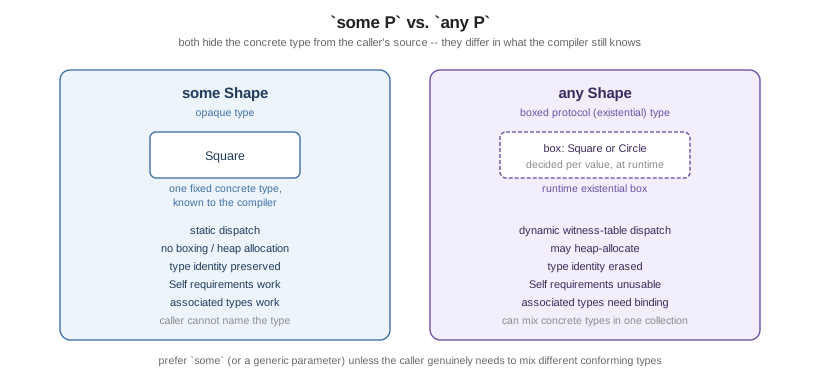
some Shape as a return type promises the caller a single, specific, compiler-known concrete type — just one
whose name is not spelled out — and every return statement in that function must produce a value of that
same concrete type (an if/else returning Square on one branch and Circle on the other does not compile).
Because the underlying type is fixed and known to the compiler, some Shape retains everything a concrete type
gives up under erasure: static dispatch (no protocol-witness indirection), no heap allocation forced by the
protocol type itself, and — crucially — type identity, covered next.
Boxed Protocol (Existential) Types: any P, and Their Runtime Cost
let shapes: [any Shape] = [Square(side: 2), Circle(radius: 1)]   // a heterogeneous mix -- impossible with `some`
for shape in shapes {
    print(shape.area())          // dispatches dynamically -- the concrete type differs per element
}
any Shape — a boxed protocol type, or existential — names not one concrete type but "whichever type
conforms, decided per value at runtime", which is exactly what lets shapes mix Square and Circle in the
same array. That flexibility has a real runtime cost: a value stored as any P is boxed (heap-allocated when it
doesn’t fit inline in a small fixed-size buffer), every member access goes through dynamic witness-table
dispatch rather than being resolved statically, and the compiler can no longer specialize the calling code for
one concrete type the way it can for some P or an ordinary generic parameter.
some vs. any: Type Identity, Associated Types, and Self Requirements
protocol Container {
    associatedtype Item          // a protocol with an associated type...
}

// let boxed: any Container            // ...cannot be named this way at all before Swift 5.7's `any` for PATs
func makeContainer() -> some Container {   // ...but `some` has always worked, since the concrete type is fixed
    Stack<Int>()
}

protocol Comparable2 {
    static func < (lhs: Self, rhs: Self) -> Bool   // a `Self` requirement
}
// let values: [any Comparable2] = []   // legal to write, but < cannot be called on two boxed values:
                                          // the box only guarantees "conforms", not "both sides are the same type"
The two differ in three concrete ways. Type identity: some P guarantees the compiler (and, indirectly, the
caller, since two some P values from the same call site are known to share a type) that every value really is
one specific type, while any P deliberately discards that information. Associated types: a protocol with an
associatedtype (a "protocol with associated types", or PAT) can always be used with some, since the concrete
type — and therefore its associated type — is fixed and known; using it with any requires either binding the
associated type explicitly (any Container<Item == Int>) or accepting that operations depending on it are
unavailable. Self requirements: a requirement like Comparable’s `< that takes or returns Self cannot be
called through an any box at all (the box cannot guarantee both operands are the same concrete type), whereas
some — and an ordinary generic parameter — both preserve enough information for it to work.
Opaque Parameter Types
func sum(_ values: some Sequence<Int>) -> Int {   // shorthand for a generic parameter, in parameter position too
    values.reduce(0, +)
}
some P is not only a return-type feature: written on a parameter, it is exactly the lightweight generic-
parameter syntax covered in Generics — the caller still chooses
the concrete type (unlike in return position, where the function chooses it), so an opaque parameter type is,
in every respect that matters, an ordinary generic parameter spelled without a name.
Implicitly Opened Existentials
protocol Shape2 { func area() -> Double }
func double<S: Shape2>(_ shape: S) -> Double { shape.area() * 2 }   // a generic function requiring a concrete S

let anyShape: any Shape2 = Square(side: 2)
print(double(anyShape))          // legal since Swift 5.7: the box is "opened" so S can bind to its real type
Before SE-0352, passing an any P value to a generic function expecting a concrete, conforming type did not
compile, since the generic function needs one real type to substitute for its parameter and the box, by design,
hides which one that is. Implicitly opened existentials let the compiler recover that real type at the call
site itself: double(anyShape) opens the box, discovers the value’s actual dynamic type, and calls double as
if it had been invoked directly on a value of that concrete type — entirely automatically, with no syntax at the
call site beyond an ordinary function call.
Choosing Between some, any, and Explicit Generics
A generic parameter and some in parameter position are, semantically, the same choice already covered in
Generics; the decision that matters on this page is between
some and any, and it comes down to one question — does the calling (for a parameter) or the returning (for
a result) code need to mix different concrete conforming types at the same call site or in the same
collection? If every value really is, or must be treated as, one single concrete type, prefer some (or a plain
generic parameter): it is faster, allocates nothing extra, and preserves Self requirements and associated
types. Reach for any only when heterogeneity is the actual requirement — a mixed-type array or dictionary
value, a protocol stored as a property whose concrete type genuinely varies over the property’s lifetime, or a
boundary (a plugin API, a delegate slot) that must accept whichever conforming type shows up at runtime.
See Also
-
Generics —
some Pas parameter-position generic-parameter syntax, and generic constraints in full. -
Protocols — protocols as types, associated types, and protocol composition.
-
Type Casting and Reflection —
is/as?for downcasting out of ananybox, andAny/AnyObject.
References
TSPL: Opaque and Boxed Protocol Types; SE-0335, SE-0352.
-
The Swift Programming Language — Opaque and Boxed Protocol Types.
-
Swift.org — Announcing Swift 5.7 (existential
anyand implicitly opened existentials both shipped in 5.7).