Containers
|
This section documents C++23 (ISO/IEC 14882:2024), as published by ISO/IEC JTC1/SC22/WG21 (wg21), verified against the freely available working draft N5046 (eel.is/c++draft) and cppreference.com. This content was generated with the assistance of AI and should be verified against the working draft and cppreference.com before being relied on in production. This section’s bibliography lists the reference material consulted while preparing these pages. |
Sequence Containers
#include <vector>
#include <array>
#include <deque>
#include <list>
#include <forward_list>

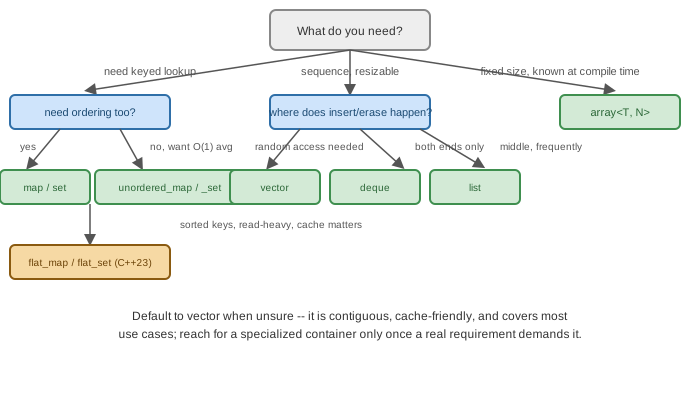
std::vector<int> v = {1, 2, 3};          // contiguous, growable -- the default choice for almost everything
std::array<int, 3> a = {1, 2, 3};         // fixed-size, contiguous, stack-allocated -- a "safe C array"
std::deque<int> d = {1, 2, 3};             // double-ended queue: fast push/pop at both ends, NOT contiguous
std::list<int> l = {1, 2, 3};               // doubly-linked list: O(1) insert/erase anywhere, no random access
std::forward_list<int> fl = {1, 2, 3};       // singly-linked list: smaller than list, forward iteration only
Associative Containers
Ordered by key (typically a red-black tree), giving O(log n) lookup/insert/erase and in-order iteration:
#include <map>
#include <set>

std::map<std::string, int> ages = {{"Ada", 36}};            // unique keys, sorted
std::multimap<std::string, int> scores;                       // duplicate keys allowed, sorted
scores.insert({"Ada", 90});
scores.insert({"Ada", 85});                                    // both entries kept

std::set<int> unique = {3, 1, 2};                              // sorted, unique elements: {1, 2, 3}
std::multiset<int> withDupes = {3, 1, 2, 1};                    // sorted, duplicates allowed: {1, 1, 2, 3}
Unordered Containers
Hash-table based, giving average O(1) lookup/insert/erase but no ordering guarantee — needs std::hash<Key>
for a custom key type (see Standard Library
Overview):
#include <unordered_map>
#include <unordered_set>

std::unordered_map<std::string, int> fastAges = {{"Ada", 36}};
std::unordered_set<int> fastUnique = {3, 1, 2}; // no ordering guarantee when iteratedflat_map/flat_set (C++23)
std::flat_map/std::flat_set store keys and values in sorted, contiguous vectors rather than a tree — much better cache locality and lower memory overhead for read-heavy workloads, at the cost of O(n) insertion
(shifting elements) instead of a tree’s O(log n):
#include <flat_map>

std::flat_map<std::string, int> config = {{"retries", 3}, {"timeout", 30}};
config["retries"] = 5;             // same interface as std::map for lookup/insert
// internally: two sorted vectors (keys, values), not a tree -- far fewer allocations, better cache behavior
<flat_map>/<flat_set> are standard-conformant C++23 (verified against cppreference and the working
draft) but are not yet shipped by this environment’s libstdc++ 13 — they need GCC 14+, a recent libc++, or
MSVC (see Getting Started); every other container on this
page does compile locally.
|
Container Adaptors
An adaptor restricts a sequence container’s interface to a specific access pattern, rather than implementing storage itself:
#include <stack>
#include <queue>

std::stack<int> s;              // LIFO, backed by std::deque by default
s.push(1); s.push(2);
s.pop();                          // removes 2

std::queue<int> q;               // FIFO, backed by std::deque by default
q.push(1); q.push(2);
q.pop();                           // removes 1

std::priority_queue<int> pq;      // max-heap, backed by std::vector by default
pq.push(3); pq.push(1); pq.push(2);
pq.top();                          // 3 -- the largest
std::span and std::mdspan
std::span<T> (C++20) is a non-owning (pointer, length) view over a contiguous sequence — the array/vector
analogue of std::string_view:
#include <span>
#include <vector>
#include <array>

void printAll(std::span<const int> values) {   // accepts a C array, std::array, or std::vector -- no copy
    for (int v : values) { (void)v; }
}

int carr[3] = {1, 2, 3};
std::vector<int> vec = {4, 5, 6};
std::array<int, 3> arr = {7, 8, 9};
// printAll(carr); printAll(vec); printAll(arr);   // all three bind without any conversion overhead
std::mdspan<T, Extents> (C++23) generalizes std::span to multiple dimensions over one flat buffer, with
a customizable layout (row-major, column-major, or a custom stride) — useful for numeric/matrix code that
would otherwise hand-roll index arithmetic:
#include <mdspan>
#include <vector>

std::vector<double> buffer(6, 0.0);
std::mdspan<double, std::extents<std::size_t, 2, 3>> matrix(buffer.data());
matrix[1, 2] = 5.0;    // row 1, column 2 -- no manual "row * cols + col" arithmetic
<mdspan> is standard-conformant C++23 syntax (verified against cppreference and the working draft) but
is not yet shipped by this environment’s libstdc++ 13 — see the note on flat_map above; std::span itself
does compile locally.
|
std::bitset and vector<bool>
std::bitset<N> was covered in Numbers and Math.
std::vector<bool> is a notorious special case: it’s specialized to pack bits (8 per byte) rather than storing
one bool per element, so operator[] returns a proxy object, not bool& — code generic over vector<T>
that assumes T& from operator[] breaks for T = bool:
#include <vector>

std::vector<bool> flags = {true, false, true};
// bool& ref = flags[0];         // error: vector<bool>::reference is a proxy, not bool&
auto ref = flags[0];              // fine: deduces the proxy type
bool copy = flags[0];              // fine: converts to a real bool
For a genuine array-of-bool with real references, prefer std::vector<char>, std::array<bool, N>, or
std::deque<bool> (which is not specialized this way).
Iterator/Reference Invalidation
Modifying a container can invalidate existing iterators/references/pointers into it — the exact rule differs per container and operation, and using an invalidated iterator is undefined behavior:
| Container | Invalidation on insert/erase |
|---|---|
|
|
|
Insert/erase at either end rarely invalidates; insert/erase in the middle invalidates everything. |
|
Erase invalidates only the erased element’s iterator; insert never invalidates any. |
|
Erase invalidates only the erased element’s iterator; insert never invalidates any. |
std::erase_if (covered in Iterators and
Algorithms) sidesteps hand-writing an erase-in-a-loop that must reason about which iterators survive each step.
See Also
-
C: Arrays and Strings — raw arrays and pointer/length pairs — the starting point
std::vector,std::arrayandstd::spanimprove on.