Versions, Licensing and History
|
This content was generated with the assistance of AI and should be verified against the official documentation before being relied on in production. |
Before writing a line of Unreal code it helps to know which Unreal you are using, what it costs and where it came from. The engine has been rewritten in public three times, its scripting language has changed from UnrealScript to C++ and Blueprints, its price has gone from a studio licence to "free until you succeed", and almost every book written before 2022 describes a version that no longer exists. This page gives the map: the generations, the 5.x timeline, what Epic labels production-ready, beta or experimental, the announced UE6 direction, and the licence terms in force.
The facts on this page were checked in November 2026. The version documented throughout this sub-section is Unreal Engine 5.8, released on 2026-06-17, together with its latest hotfix found at that
date, 5.8.4. Licence terms are legal terms and Epic can change them: read them on Epic’s own pages before you ship. The sections about licensing apply to every
platform Unreal targets; the version facts apply to the desktop editor (Windows, macOS and Linux) and to the targets it builds for. The running example of
this sub-section, the Bookshelf (a Third Person template project with a Bookshelf module that grows from a book actor into a co-op game, built on the shared
bookshelf.glb), starts from the choices made here: the engine version, the licence situation and the EngineAssociation entry of the project file.
Generations of the engine
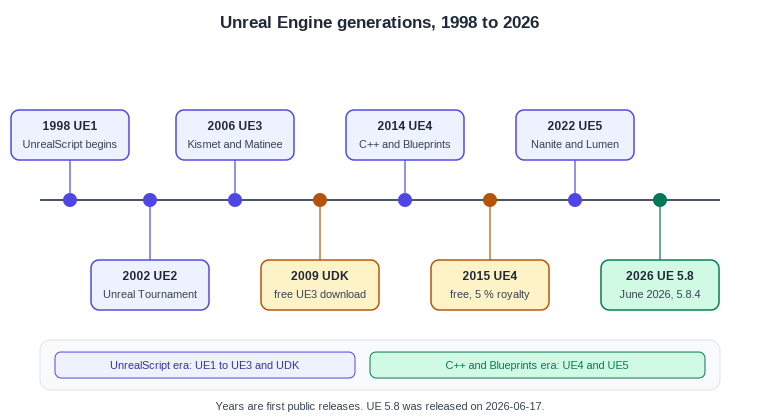
The engine has a long history, which explains many names that still appear in the editor, the source tree and older tutorials. The summary below is about the technology; the general history of real-time graphics is in History of Real-Time Graphics.
-
UE1 (1998). The engine that shipped with the first-person game Unreal. It introduced UnrealScript, a Java-like scripting language compiled to bytecode that ran on a virtual machine. Gameplay was written in UnrealScript while the engine core was native code.
-
UE2 (2002). A heavier rewrite of rendering and tools, used for Unreal Tournament 2003 and its successors. UnrealScript stayed the gameplay language.
-
UE3 (2006). The generation of Gears of War. UnrealScript was still the language, and two visual tools appeared: Kismet, a node-based event editor for gameplay logic that was the ancestor of Blueprints, and Matinee, a keyframe tool for cinematics and animated actors that was later replaced by Sequencer.
-
UDK (2009). The Unreal Development Kit packaged UE3 as a free download with its own licence terms. UDK content was organised in
.uscript packages and.upkcontent packages, and the Kismet and UnrealScript workflow of that era is the one described in the 2011 UDK book listed under Where the books are outdated. -
UE4 (2014). Epic dropped UnrealScript. Gameplay is written in C++ with the reflection macros described in UObject, Reflection and Garbage Collection, or in the visual language Blueprints (see Blueprints Visual Scripting), which is Kismet’s successor and a first-class citizen with a bytecode virtual machine. The engine launched in 2014 as a paid subscription with a royalty and became free to download in 2015 with a royalty on gross revenue.
-
UE5 (2022). Released on 2022-04-05 after a preview in 2021. The headline systems are Nanite (virtualised geometry), Lumen (dynamic global illumination), World Partition (streaming of large worlds), the Chaos physics engine and the MetaSounds audio graphs, with Enhanced Input and Niagara replacing the older input and particle systems. Epic’s migration guide lists the replacements that matter when reading older material, summarised in the table below.
| UE4 system | UE5 replacement | Notes from the migration guide |
|---|---|---|
Matinee |
Sequencer |
Sequencer replaces Matinee, covered in Sequencer Cinematics. |
PhysX |
Chaos Physics |
Chaos is the default simulation, with its own fixed-rate physics thread. |
Cascade |
Niagara |
See Niagara VFX. |
World Composition |
World Partition |
A |
Light Propagation Volumes, DFGI |
Lumen |
Dynamic global illumination is Lumen’s job. |
Movie Scene Capture |
Movie Render Queue |
In 5.8 the Movie Render Graph is labelled production ready. |
Sequence Recorder |
Take Recorder |
Recording of actor animation into Sequencer. |
Event-driven loader |
Zen loader |
Zenserver is the default cooked output store in 5.8. |
Source: Unreal Engine 5 Migration Guide
The 5.x timeline
UE5 is not a single version. Epic ships a minor version about every four to eight months, each with a release-notes page, and issues hotfixes (5.8.1, 5.8.2 and so on) for the latest minor version in between. Project files remember which minor version they were last saved with, and an editor refuses or warns when asked to open a project from a different one, so the minor version matters in practice.
| Version | Released | Headline items |
|---|---|---|
5.0 |
April 2022 |
Nanite, Lumen, World Partition, One File Per Actor, Chaos as the default physics engine, MetaSounds. |
5.1 |
November 2022 |
Virtual Shadow Maps and refinements to Nanite and Lumen. |
5.2 |
May 2023 |
The Procedural Content Generation framework and the first Substrate material work, both experimental at the time. |
5.3 |
September 2023 |
See the release notes. |
5.4 |
April 2024 |
Motion Matching and animation workflow improvements; see the release notes. |
5.5 |
November 2024 |
MegaLights appears as an early feature; see the release notes. |
5.6 |
June 2025 |
See the release notes. |
5.7 |
2025-11-12 |
Nanite Foliage, PCG production ready, Substrate, an in-editor assistant. |
5.8 |
2026-06-17 |
MegaLights production ready, Lumen Lite and Control Rig Physics in beta, Iris for licensees, Mutable, Movie Render Graph, the unified Enhanced Input and CommonUI work. |
The 5.8 hotfix stream reached 5.8.4 as the latest found for this page (announced on the Epic forums). The rule of thumb for a team is simple: start a project on the latest minor version with its latest hotfix, stay on it until the release date approaches, and upgrade between milestones rather than the week before shipping.
Source: Unreal Engine 5.8 Release Notes and 5.8.4 Hotfix Released
What the stability labels mean
Epic marks each feature in the release notes as Production Ready, Beta or Experimental. Production ready means Epic recommends it for shipping; beta means the feature is usable but may still change; experimental features can change or be removed between releases and should not be the foundation of a shipping project. In 5.8:
| Label | Features named in the 5.8 release notes |
|---|---|
Production ready |
MegaLights, Audio Insights, Movie Render Graph, Iris (the release notes word it "for licensees"), Mutable, USD import through Interchange. |
Beta |
Lumen Lite, Control Rig Physics, RigMapper, Incremental Cooking, Audio Subtitles, Waveform Editor. |
Experimental |
Substrate NPR, Mesh Terrain, Fast Geometry Streaming, the Procedural Vegetation Editor, Animation Mixing in Sequencer, MetaSound Node Configuration and Templates, iOS SM6, the MCP Server, Fog Screen Space Scattering. |
Two platform defaults also changed in 5.8: Zenserver is the default cooked output store, and WASAPI is the default Windows audio backend (XAudio2 is opt-in). The pages of this sub-section state the label of every feature they teach, because a tutorial that does not mention that something is experimental is a trap.
Source: Unreal Engine 5.8 Release Notes
Pinning the version in the Bookshelf project
The project file Bookshelf.uproject is JSON, and its EngineAssociation entry says which engine installation opens it. For a Launcher install the value is the
version string; for a source build it is a GUID registered by the engine’s setup scripts. The next page, Installing and Building from Source,
shows how to install the engine, and
Project Structure and Modules describes the file in full.
{
    "FileVersion": 3,
    "EngineAssociation": "5.8",
    "Category": "",
    "Description": "Bookshelf: a tiny game that grows from a book actor into a co-op library.",
    "Modules": [
        {
            "Name": "Bookshelf",
            "Type": "Runtime",
            "LoadingPhase": "Default"
        }
    ]
}
Source: Unreal Engine Modules
Right-clicking a .uproject file and choosing Switch Unreal Engine version changes EngineAssociation and regenerates the project files. Always copy or commit the project first: a
project opened in a newer editor is converted on save and cannot be opened by the older one afterwards.
The UE6 outlook
Epic announced UE6 in 2026: it was teased on 2026-05-24 and unveiled at the State of Unreal on 2026-06-17. According to Epic’s recap of the show, Epic targets Early Access at the end of 2027, merges the UE5 editor and the editor behind Unreal Editor for Fortnite (UEFN) into one, and builds the combined editor around the Verse programming language. Blueprints stay supported through Early Access and the initial releases. Epic’s road-map post, "The road to UE6", adds that the full release is planned 12 to 18 months after Early Access, and that Actors and Blueprints are in the early versions of UE6 and are to be deprecated later, once the new framework is mature, with conversion tools to move projects from one framework to the other.
What follows for you: nothing in the Bookshelf code needs to change for 5.8, and Epic’s post describes a path for existing UE5 projects with no hard break, but Actors and Blueprints are not permanent in the long-term plan. What does follow is a reason not to bet a long project on experimental features, and a reason to learn the concepts (modules, actors and components, the gameplay framework) rather than only editor clicks. The page Verse, UEFN and UE6 Context covers Verse and the convergence in more detail. Nothing here should be read as a statement that 5.8 is the last 5.x release.
Licensing
Unreal Engine is not open source, but its source is available to registered users on GitHub, and the licence is a royalty model rather than a per-seat price for most users. Four things matter: the royalty, the exemptions, the reduced rate and the seat licence for non-game companies.
The royalty
\[ R = 0.05 \times \max\left( 0,\; G - 1\,000\,000 \right) \]
For each product, the royalty \( R \) is 5 percent of the lifetime gross revenue \( G \) above US$1,000,000. Epic’s licence page states that all lifetime gross revenue above US$1M that is directly attributable to the product, regardless of who collects it, is subject to the royalty. Four details trip people up:
-
It is per product, not per company. Each game, each application, each separately sold title has its own US$1M. A new product starts again at zero.
-
It is lifetime, not per year. The first US$1M is counted over the whole life of the product, cumulatively across quarters.
-
Revenue earned through the Epic Games Store is royalty free. Sales through the Epic Games Store do not count toward the royalty at all; the Store’s own revenue share applies instead.
-
You must tell Epic. Epic’s FAQ says you notify Epic when you begin collecting revenue from the product, and royalties are reported and paid quarterly, due 45 days after the close of each calendar quarter. Epic introduced a revised royalty reporting system in 2025 that sends a quarterly reminder to companies that owe royalties.
The flowchart is a simplification: the exact conditions, in particular what counts as gross revenue and which launches qualify, are defined in Epic’s licence, FAQ and EULA, and a custom licence can replace them.
Source: Unreal Engine licence and Unreal Engine FAQ
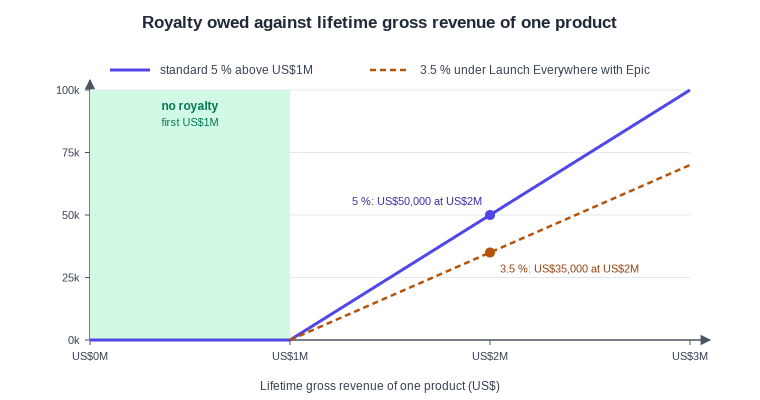
A worked example: a Bookshelf spin-off sells US$1.8 million over its life, all outside the Epic Games Store. The royalty is \( 0.05 \times (1\,800\,000 - 1\,000\,000) = 40\,000 \) dollars. Had US$600,000 of that revenue come through the Epic Games Store, that part is exempt, so the revenue that counts is US$1.2 million and the royalty is \( 0.05 \times 200\,000 = 10\,000 \) dollars. The helper below does the same arithmetic, which is handy for a spreadsheet check.
#!/usr/bin/env bash
# usage: royalty.sh <lifetime gross excluding Epic Games Store> [rate, default 0.05]
gross="${1:?lifetime gross revenue in USD}"
rate="${2:-0.05}"
awk -v g="$gross" -v r="$rate" 'BEGIN {
    over = g - 1000000
    if (over < 0) over = 0
    printf "royalty: USD %.2f\n", over * r
}'
Source: Unreal Engine FAQ
Launch Everywhere with Epic
Epic’s post of 2025-03-25 describes a reduced royalty of 3.5 percent for games that launch on the Epic Games Store under the programme Launch Everywhere with Epic. Eligibility, as reported by the trade press and set out in Epic’s announcement, depends on launching on the Epic Games Store at the same time as, or before, other stores, and the rate reverts to 5 percent when a game is on another PC or Android store without also being on the Epic Games Store; mobile and console conditions have their own rules. The 3.5 percent figure dates from that post, and terms can change, so confirm them before basing a business plan on them.
Seat licence for non-game companies
Companies outside games (film and television, architecture, automotive, simulation) that earn more than US$1M in annual revenue use the Unreal Subscription, a per-seat licence priced at US$1,850 per user per year at the time of writing. There is no royalty on such a licence; the seat fee replaces it. Below the revenue threshold the engine is free to use under the EULA. Large customers can negotiate a custom licence with Epic for different terms and support.
The EULA and the source code
The End User License Agreement governs use of the engine, its tools and its content: what you may ship, what you may not redistribute (the engine source itself, for example, may not be passed on) and the terms for the Marketplace content that now lives in Fab. GitHub access to the source needs an Epic account linked to a GitHub account and acceptance of the EULA; the steps are in Installing and Building from Source.
Never put licence keys, royalty reports or account credentials in a project repository. The Unreal Engine has no per-seat key to protect for ordinary use, and the Bookshelf project contains none.
Common mistakes
-
Opening a project in a newer editor "just to try". The conversion on save cannot be undone. Duplicate the project first, or use source control and a branch.
-
Reading a UE4 or UE3 tutorial literally. Steps for Matinee, Cascade, PhysX, UnrealScript and Kismet do not map one-to-one onto 5.8. The table in this page and the later pages of this sub-section give the replacement.
-
Counting the first US$1M per company instead of per product, or per year instead of lifetime.
-
Forgetting the Epic Games Store exemption when estimating royalties, or assuming 3.5 percent is automatic: it requires launching under the programme.
-
Building a production feature on an experimental label. Substrate NPR, Mesh Terrain and the MCP Server are experimental in 5.8.
-
Staying on the first release of a minor version. The hotfixes (5.8.1 to 5.8.4) fix crashes and regressions that the original build contains.
-
Treating the Preview builds as production builds. Epic’s install page says Preview builds are for testing and not for production project development.
-
Assuming Epic’s defaults satisfy store rules. Google Play, for instance, sets its own target API level deadlines that a project must meet itself; see Android and Mobile.
Performance notes
A version choice is also a hardware choice. Some of the headline features of UE5 need a recent GPU: Epic’s Windows requirements page lists Shader Model 6, DirectX 12 and an AMD RX 6000 series, Intel Arc A-series or NVIDIA RTX 2000 series or newer for Lumen and MegaLights. On Apple silicon the same page lists Lumen with hardware ray tracing and MegaLights as experimental on M2 and later, and Nanite as beta. Epic’s recommended development machine is Windows 11 with a quad-core 2.5 GHz or faster processor, 32 GB of RAM and a graphics card with 8 GB or more of memory. Plan test devices around the lowest hardware you intend to support, not the machine you author on.
Upgrading does not make a project faster by itself: every minor version changes defaults (for example the 5.8 defaults for the cooked output store and the Windows audio backend), so profile again after an upgrade with the tools in Profiling and Optimization.
What changed recently
| Date | Change | Effect for you |
|---|---|---|
October 2026 |
5.8.4 hotfix |
Install the latest hotfix of 5.8 for new work. |
2026-06-17 |
UE 5.8 released; UE6 unveiled at the State of Unreal |
MegaLights is production ready; UE6 Early Access is targeted for the end of 2027. |
2025-11-12 |
UE 5.7 released |
Nanite Foliage, PCG production ready, Substrate. |
2025-03-25 |
Epic’s post on royalty reporting and Launch Everywhere with Epic |
3.5 percent reduced rate for qualifying launches; improved royalty reporting. |
2022-04-05 |
UE5.0 released |
Nanite, Lumen, World Partition, Chaos by default. |
2015 |
UE4 becomes free to download |
Royalty model with no subscription. |
Where the books are outdated
Two of the books in the bibliography describe licensing and history that no longer apply.
-
Royalty terms. Nitish Misra’s Learning Unreal Engine Android Game Development (chapter 1) and the learning path Unreal Engine: Game Development from A to Z by Joanna Lee, John P. Doran and Nitish Misra (module 3, chapter 1) describe a royalty of 5 percent after the first US$3,000 per product per quarter. Today the royalty starts only after US$1M of lifetime gross revenue per product, is reduced to 3.5 percent under Launch Everywhere with Epic, and non-game companies above the revenue threshold use the seat licence.
-
The whole UDK book. Rachel Cordone’s Unreal Development Kit Game Programming with UnrealScript: Beginner’s Guide teaches UDK from 2011 (UE3): UnrealScript classes, Kismet sequences,
.upackages and the UDK licence. UnrealScript was dropped in UE4 in 2014 in favour of C++ and Blueprints, Kismet became Blueprints, and the UDK licence was replaced. Read it as history of where Blueprints and the gameplay framework came from, not as instructions. Verse, the language of UEFN, is the only other scripting language Epic ships and is planned to take a central role in UE6.
See also
-
Unity: Licensing and Pricing for the equivalent page in the Unity sub-section