Triangles and Polygons
| This documentation was generated with the assistance of AI. Please report any inaccuracies. |
Triangle2D/Triangle3D and Polygon2D/Polygon3D are composite entities built directly from Point2D/
Point3D. They live in the flat com.irurueta.geometry package (no dedicated subpackage).
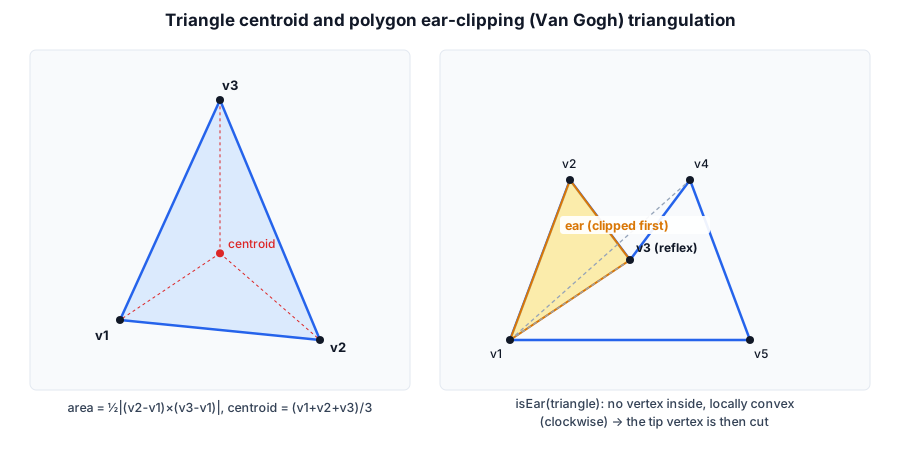
Triangle2D / Triangle3D
A triangle is just three vertices (vertex1, vertex2, vertex3). Both classes provide:
| Operation | Notes |
|---|---|
|
; the signed version’s sign
encodes winding order ( |
|
Sum of the three edge lengths. |
|
|
|
Splits the triangle into three sub-triangles (vertex, vertex, query point) and checks that their areas sum to the original triangle’s area — this is the library’s barycentric-coordinate-equivalent point-in-triangle test; there is no separate barycentric-coordinates accessor. |
|
Treats the triangle as three finite line segments ( |
Triangle3D additionally requires the query point to lie in the triangle’s own plane for isInside, and adds
toPlane() (builds the infinite Plane through the 3 vertices) and getOrientation() (unit normal vector,
via the cross product of two edge vectors, throwing CoincidentPointsException if the triangle is degenerate).
A TODO comment in Triangle2D notes that the circumscribed/inscribed circle are not implemented.
Polygon2D / Polygon3D
A polygon is an ordered list of vertices (the last implicitly connects back to the first), plus a lazily computed, cached triangulation. Key operations:
-
Area — the shoelace formula in 2D; a 3D generalization (sum of cross products around a vertex fan from the first vertex) that is exact for planar polygons and an average otherwise.
-
isInside(point)— delegates to the cached triangulation and returns true if the point falls inside any triangle. The javadoc is explicit about the caveat: this only works correctly for polygons without holes or crossing borders (self-intersecting polygons are not handled). -
getOrientation()(3D only) — average normal vector from a vertex-fan cross-product sum; exact for planar polygons, an approximation for non-planar ones. -
There is no dedicated
isConvex()method on either class — convexity is only tested implicitly, and locally, inside the triangulator (see below).
Triangulation: ear clipping ("Van Gogh" algorithm)
TriangulatorMethod currently has a single supported value, VAN_GOGH_TRIANGULATOR (a DELAUNAY_TRIANGULATOR
is listed as a TODO but not implemented). VanGoghTriangulator2D/3D implement the classic ear-clipping
algorithm:
-
Repeatedly scan the (mutable) vertex list; at each vertex, form the candidate triangle with its two neighbors.
-
A candidate is an ear if (a) no other vertex of the polygon lies inside it, and (b) it is locally convex (
areVerticesClockwise()). -
If it is an ear, emit the triangle and remove ("clip") the middle vertex; otherwise move to the next vertex.
-
Stop when only 3 vertices remain — they form the final triangle.
This is exactly what the diagram above shows: the reflex vertex v3 cannot be an ear (it’s concave), so the
algorithm clips one of the convex vertices (v1/v2/v3 triangle) first, then continues on the remaining
smaller polygon.
References
No book, paper or external URL is cited anywhere in Triangle2D/3D, Polygon2D/3D,
Triangulator2D/3D, or VanGoghTriangulator2D/3D — only the informal algorithm name "Van Gogh or Ear
Cutting algorithm" appears in the javadoc (with the source’s own typos, "Trangulator"/"Vang Gogh", preserved
for context). Ear-clipping triangulation is standard computational-geometry material; a commonly cited
treatment (not referenced by the source, provided here for context) is
O’Rourke, Computational Geometry in C — see the
full bibliography for the full citation.
Related pages
-
Points, Lines and Planes — the
Point2D/Point3Dvertices triangles/polygons are built from. -
Boxes and KD-Trees —
Box2D/Box3D, used for spatial indexing of point sets rather than polygons. -
Pinhole Camera — projecting 3D triangles/polygons into the image.