Boxes and KD-Trees
| This documentation was generated with the assistance of AI. Please report any inaccuracies. |
Box2D/Box3D are axis-aligned bounding boxes; KDTree/KDTree2D/KDTree3D use them as the node type of a
k-d tree for efficient nearest-neighbor and range searches over a point set. Both live in the flat
com.irurueta.geometry package — there is no dedicated spatial-indexing subpackage.
Box
The generic abstract Box<P extends Point<P>> stores just a low corner lo and a high corner hi (both of
type P). Its one substantial piece of logic is point-to-box distance:
-
getSqrDistance(point)— zero if the point is inside the box; otherwise the sum, per dimension, of the squared excess beyondlo/hion that axis (the standard axis-aligned-box point distance): -
getDistance(point)— .
Box2D and Box3D add dimension-specific constructors (a no-arg unit box centered at the origin, construction
from two corner points, or setBounds(…) from raw coordinates); Box2D additionally converts to/from the
library’s Rectangle class.
KDTree
KDTree<P> (abstract; KDTree2D/KDTree3D are thin dimension-specific subclasses) stores the whole tree as a
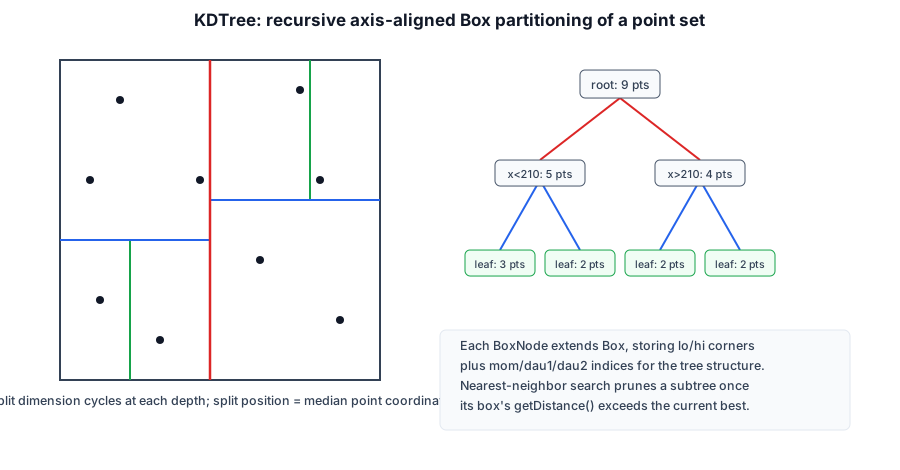
flat array of nodes (BoxNode<P>[] boxes), each of which is itself a Box<P> — KDTree.BoxNode extends Box<P> directly, adding parent/child indices (mom, dau1, dau2) and the range
of point indices (ptLo, ptHi) that fall inside that node.
Construction
-
Start with one root
BoxNodecovering the whole space (lo/hiset to ±a large sentinel value) and containing every point. -
Maintain an explicit task stack of "(box, split dimension)" pairs still to be split — the tree is built iteratively, not recursively.
-
For each task, find the median point along the current split dimension using an in-place, quickselect-style partition (
selecti), then create two child boxes: one keeping the parent’slobut clampinghiat the median coordinate, the other keeping the parent’shibut clampingloat the same median value. -
The split dimension cycles round-robin at each level (
(dim + 1) % numDimensions); the split position is always the median point’s coordinate, not the geometric midpoint of the box — this is the "median-of-points" k-d tree variant, which keeps the tree balanced regardless of point distribution. -
Recurse (via the task stack) until a box holds a small number of points (a handful), at which point it becomes a leaf.
Searching: branch-and-bound pruning
nearestPoint/nearestIndex (1-NN), nNearest (k-NN, using a bounded max-heap), and locateNear (radius/range
search) all follow the same pattern:
-
Descend directly to the leaf box most likely to contain the query point, using the split dimension/position stored at each internal node.
-
Scan that leaf’s points to get an initial candidate answer.
-
Walk the rest of the tree with an explicit task stack, and at each node call
Box.getDistance(point)— if that box-to-point distance cannot possibly improve on the current best answer, the entire subtree is skipped without visiting any of its points.
This is the standard k-d tree branch-and-bound search, and it is exactly why Box is reused as the tree node
type: the same axis-aligned-box distance computation used for simple containment queries is also the pruning
test for nearest-neighbor and range search.
References
No book, paper, or URL is cited anywhere in Box.java, Box2D.java, Box3D.java, or KDTree*.java. That
said, the internal structure and naming of KDTree (mom/dau1/dau2, ptIndx/rPtIndx,
taskmom/taskdim, selecti, siftDown, the sentinel BIG) closely mirrors the well-known k-d tree
implementation described in Press et al., Numerical Recipes: The Art
of Scientific Computing — see the full bibliography for the full citation.
This attribution is an inference from the code’s structure, not a citation present in the source.
Related pages
-
Points, Lines and Planes — the
Point2D/Point3Dtypes indexed by aKDTree. -
Triangles and Polygons — polygons/triangles are a different kind of composite entity, not indexed by
KDTreein this library.