Rotations
| This documentation was generated with the assistance of AI. Please report any inaccuracies. |
Rotations are the orientation-only part of a rigid motion. irurueta-geometry provides a single 2D
representation (Rotation2D, one angle) and three interchangeable 3D representations
(MatrixRotation3D, AxisRotation3D, Quaternion), all implementing the abstract Rotation3D.
2D rotations
Rotation2D stores a single angle theta (radians) and can convert to/from a 2×2 (inhomogeneous) or
3×3 (homogeneous) orthonormal matrix. Composing two rotations is simply adding angles; there is no
axis/quaternion equivalent in 2D since the rotation axis (out of plane) is always the same.
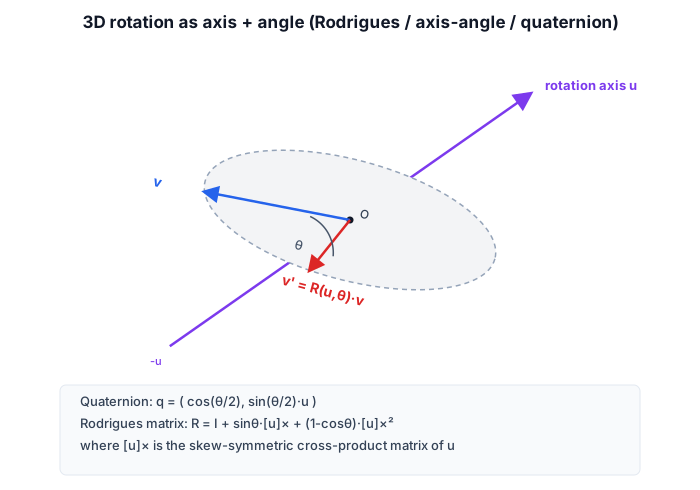
3D rotations: three representations of the same group
| Class | Internal representation | Notes |
|---|---|---|
|
3×3 orthonormal matrix, determinant +1 |
Direct matrix multiplication to rotate/compose; supports two Euler-angle parameterizations ( |
|
unit axis |
Matrix built from Rodrigues' rotation formula; explicitly handles the identity (θ=0) and 180° singularities when recovering axis/angle from a matrix. |
|
4 components |
|
Rotation3D.create() defaults to Rotation3DType.QUATERNION. Every representation can convert to every other
one (toMatrixRotation(), toAxisRotation(), toQuaternion()), and combine/combineAndReturnNew will
convert its argument to the receiver’s own representation first if the runtime types differ.
Numerical subtleties the code explicitly guards against
-
Gimbal lock (
MatrixRotation3D.hasGimbalLock()) — when the pitch angle approaches ±90°, roll and yaw become coupled and the aerospace Euler decomposition is undefined; the library detects this via a threshold on the matrix element that would otherwise blow up, and documents that the returned yaw is an arbitrary (but consistent) 0.0 in that case. -
Sign ambiguity recovering an angle from a matrix —
MatrixRotation3D.getRotationAngle()computesacos(…), which cannot distinguish+thetafrom-theta; the method tries both and keeps whichever reproduces the original matrix with less numerical error. -
SLERP double-cover and degeneracy —
Quaternion.slerpnormalizes both inputs first, returns the first quaternion unchanged when the two are (anti)parallel (to avoid dividing bysin(theta0) ≈ 0), and flips the sign of the second quaternion when the dot product is negative so the interpolation always takes the shorter arc (sinceqand-qrepresent the same rotation). -
Small-angle rotation vectors —
Quaternion.rotationVectorToQuaternionswitches to a first/second-order Taylor approximation below a small-norm threshold, avoiding thesin(x)/xdivision blowing up near zero.
References
Unlike the transformation classes, the rotation classes are unusually well-annotated with external references in their javadoc. Full citations are collected in the bibliography; in summary:
-
AxisRotation3Dis explicitly based on Martin Baker’s axis-angle rotation code — euclideanspace.com. -
The roll/pitch/yaw Euler-angle methods on
MatrixRotation3Dcite James Diebel’s widely used technical note — Representing Attitude: Euler Angles, Unit Quaternions, and Rotation Vectors. -
Quaternion,RotationUtilsand the Euler-angle conversions repeatedly cite MATLAB functions (au2q.m,qProd.m,e2R.m,q2au.m,R2q.m,w2omega.m, …) from Joan Solà's SLAM toolbox; the formal, citable write-up of the same material is Solà, Quaternion kinematics for the error-state Kalman filter. -
Quaternion.matrixRotationToQuaternionimplements Shepperd’s method for recovering a quaternion from a rotation matrix.
Related pages
-
Transformations — Euclidean and metric transformations embed a
Rotation2D/Rotation3D. -
Pinhole Camera — camera orientation is stored as a
Rotation3D(MatrixRotation3Dafter RQ decomposition of the camera matrix).