Conics and Quadrics
| This documentation was generated with the assistance of AI. Please report any inaccuracies. |
Conics are second-degree curves in the 2D projective plane; quadrics are their 3D analogue, second-degree surfaces. Both come with a dual representation (tangent lines / tangent planes instead of points) and both have familiar specializations — circle/ellipse for conics, sphere/ellipsoid for quadrics.
Conics
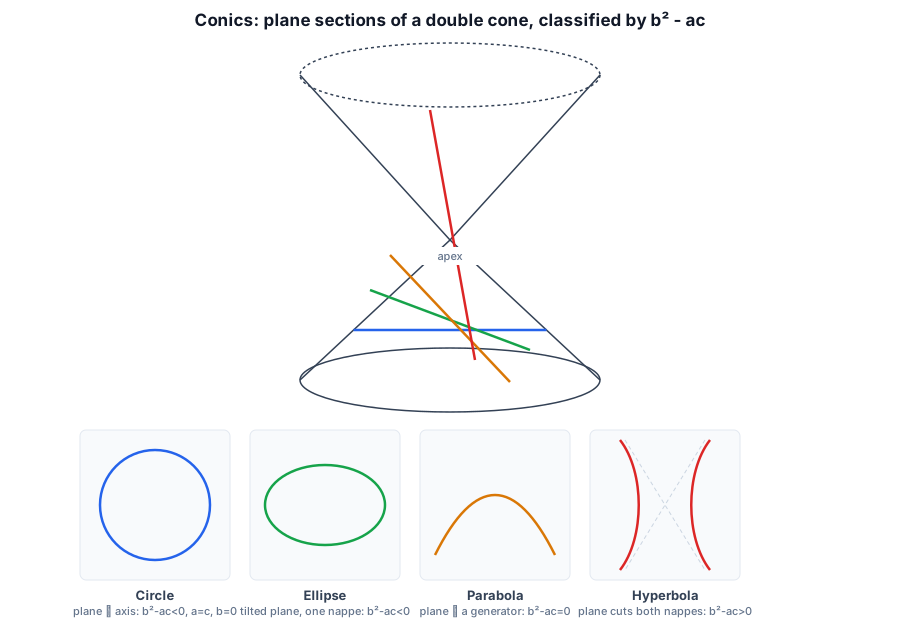
BaseConic is an abstract 3×3 symmetric-matrix base class for both Conic and DualConic. A conic is the
locus ; its matrix form is:
| a | b | d |
|---|---|---|
b |
c |
e |
d |
e |
f |
Conic.isLocus(point) tests . Conic.getConicType() classifies the
conic from the sign of :
ConicType |
Condition |
|---|---|
|
, and additionally , |
|
|
|
|
|
|
|
, and additionally |
This matrix form, its expansion into , and the discriminant-based classification above are worked out from first principles in Irurueta’s PhD report, §1.2.5 "Conics" (eq. 1.24-1.27 and table 1.1, printed pp. 6-8 / PDF pp. 18-20).
Circle and Ellipse are independent, parametric classes (center+radius; center+semi-axes+rotation) — they do not extend Conic. They convert via toConic() / setFromConic(Conic), and setFromConic checks
the conic type above (Circle requires CIRCLE_CONIC_TYPE; Ellipse accepts ELLIPSE_CONIC_TYPE or
CIRCLE_CONIC_TYPE, since every circle is also an ellipse).
Quadrics
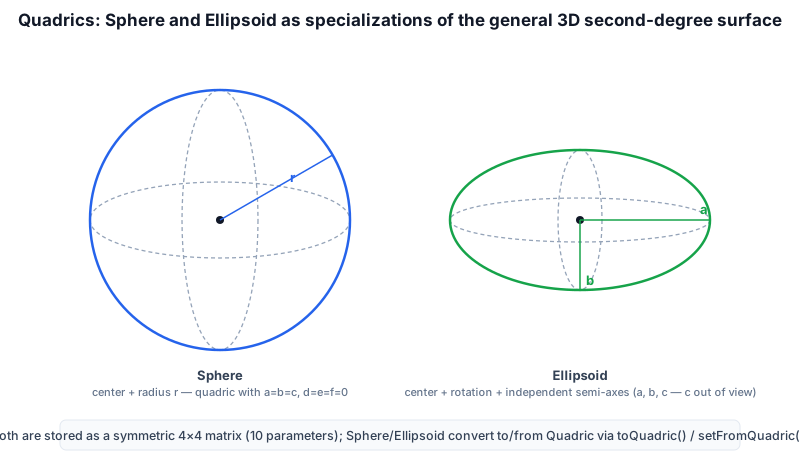
BaseQuadric is the 3D analogue: a 4×4 symmetric matrix with 10 parameters
, for the surface
. Quadric
tests point incidence and exposes getTangentPlaneAt(point) (derived in
Tangent lines and tangent planes). The 4×4 quadratic-form matrix, its 9-parameter expansion, and the
non-degenerate/degenerate standard-form tables (ellipsoid/paraboloid/hyperboloid vs. cone/cylinder) are the
direct 3D analogue of the conic case, worked out in the PhD report,
§1.3.5 "Quadrics" (eq. 1.75-1.91, tables 1.2-1.3, printed pp. 15-16 /
PDF pp. 27-28).
Unlike conics, quadrics have no built-in type-classification enum — there is no QuadricType equivalent
to ConicType, and no generic ellipsoid/hyperboloid/paraboloid classifier.
Sphere (center + radius) and Ellipsoid (center + rotation + three independent semi-axes) are, again,
independent parametric classes rather than Quadric subclasses:
-
Sphere.setFromQuadric(Quadric)requiresa==b==c,a≠0,d=e=f=0. -
Ellipsoid.toQuadric()builds a canonical diagonal quadric then applies anEuclideanTransformation3Dfor center and rotation; there is no generalsetFromQuadricforEllipsoid— only conversion from aSphere. Recovering an arbitrary ellipsoid’s parameters from a generalQuadricis not implemented. -
Ellipsoid.getSurface()uses Knud Thomsen’s well-known closed-form approximation (exponent ), since the exact ellipsoid surface area has no elementary closed form.
Quadric.intersectWith(Plane) computes the Conic obtained by slicing a quadric with a plane, by substituting
the plane equation into the quadric equation — the algebra is carried out step by step in inline comments in
the source.
Duality: DualConic and DualQuadric
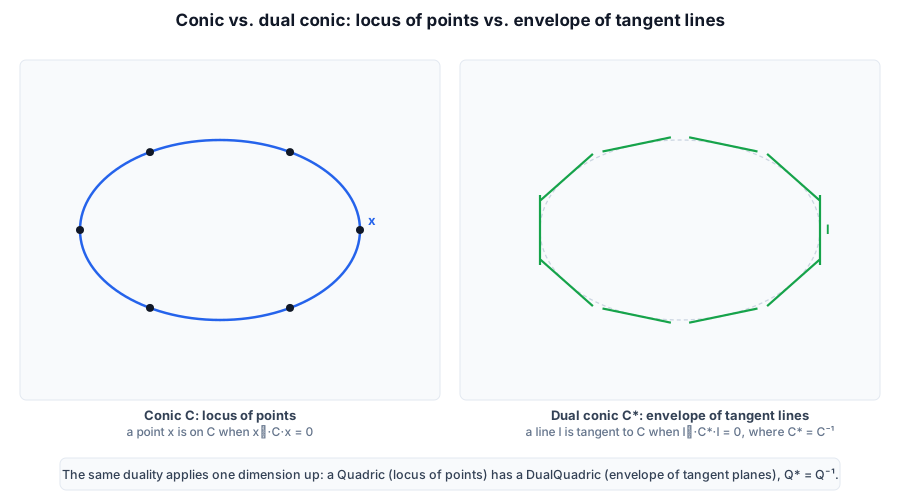
A Conic/Quadric is a locus of points: . Its dual, DualConic/
DualQuadric, describes the exact same shape but as an envelope of tangent lines (2D) or
tangent planes (3D) instead: for a tangent line l, where
.
| Class | Represents | Locus test |
|---|---|---|
|
points on the curve |
|
|
lines tangent to the curve |
|
|
points on the surface |
|
|
planes tangent to the surface |
|
Both pairs share the same base-class matrix representation (BaseConic for Conic/DualConic,
BaseQuadric for Quadric/DualQuadric). The rest of this section derives, rather than just asserts, the
three facts the library’s API relies on: how the tangent line/plane at a locus point is computed, why the dual
is the plain matrix inverse, and why the transform rule for conics/quadrics has that particular
inverse-transpose form.
Tangent lines and tangent planes
Let be a locus point of conic (so ), and let a line through meet the conic again at a second point . Every point of the line can be written ; substituting into and expanding with the bilinear form gives a quadratic in :
which always has (up to) two roots — a line meets a conic in two points. This is exactly what the internal
TODO at Conic.java:478 cites (see References for the resolved citation); the full derivation is
PHD, §1.2.6.1 "Line-conic intersections", Proof 1.2, eq. 1.34-1.44
(printed pp. 8-9 / PDF pp. 20-21).
The two intersection points coincide — the line is tangent — exactly when that quadratic’s discriminant vanishes. Fixing on the conic ( ), the discriminant condition collapses to the linear equation , which forces . Writing this as identifies the tangent line at , up to scale, as:
(PHD, §1.2.6.2 "Line-conic tangency", eq. 1.46-1.51, printed
pp. 10-11 / PDF pp. 22-23; the identical result appears as
Result 2.7 in
Hartley & Zisserman, chapter 2, p. 31). Conic.getTangentLineAt/
tangentLineAt (Conic.java:420-460) implement precisely this product:
Line2D tangent = conic.getTangentLineAt(point); // l = C·mThe same argument, one dimension up, uses three coplanar points instead of two collinear ones (PHD §1.3.6.1 "Plane-quadric intersections", eq. 1.92-1.100, printed pp. 17-18 / PDF pp. 29-30 — it is literally the same proof technique applied to a plane cutting a quadric instead of a line cutting a conic) and gives the tangent plane at a locus point as:
implemented by Quadric.getTangentPlaneAt/tangentPlaneAt (Quadric.java:516-560):
Plane tangentPlane = quadric.getTangentPlaneAt(point); // Π = Q·MThe dual is the inverse: C* = C⁻¹ and Q* = Q⁻¹
Insert into the conic equation:
Since is the tangent line at (previous section), , so the expression above is — which is exactly the dual conic’s own defining equation . Matching the two forces, assuming is non-singular:
(PHD, §1.2.6.3 "Relation between conic and dual conic", eq. 1.52-1.54,
printed p. 11 / PDF p. 23; the same derivation from the
tangent-line result is given in
Hartley & Zisserman, chapter 2, p. 31). Conic.getDualConic/
dualConic (Conic.java:236-269) and the mirror DualConic.getConic/conic (DualConic.java:246-277)
compute exactly this matrix inverse (symmetrizing the result against numerical round-off), throwing
DualConicNotAvailableException/ConicNotAvailableException when the matrix is singular:
DualConic dual = conic.getDualConic(); // C* = C⁻¹The identical algebra, one dimension up, gives for quadrics, implemented by
Quadric.getDualQuadric/dualQuadric (Quadric.java:262-299) and DualQuadric.getQuadric/quadric
(DualQuadric.java:272-307).
Transforming conics, quadrics, and their duals
Under a point homography , lines transform contragradiently, . Substituting into and demanding that the transformed conic reproduce the same locus in the new coordinates forces (up to scale):
and the parallel argument on lines gives the dual rule . Substituting the first rule into a plain inversion shows that transformation and duality commute:
(PHD, §1.2.7 "Transforming conics and dual conics", eq. 1.55-1.63 and Proof 1.3, printed pp. 11-12 / PDF pp. 23-24; the transform rules alone also appear as Results 2.13-2.14 in Hartley & Zisserman, chapter 2, pp. 36-37). The identical algebra one dimension up gives , , and the same duality-commutes identity for quadrics (PHD §1.3.7, eq. 1.114-1.116, printed pp. 20-21 / PDF pp. 32-33). Transformations gives the general table of how every geometric entity in this library (points, lines, planes, conics, quadrics, cameras) transforms under each transformation class it implements — this section only shows why the conic/quadric rule takes that particular inverse-transpose form.
The absolute conic and the dual absolute quadric
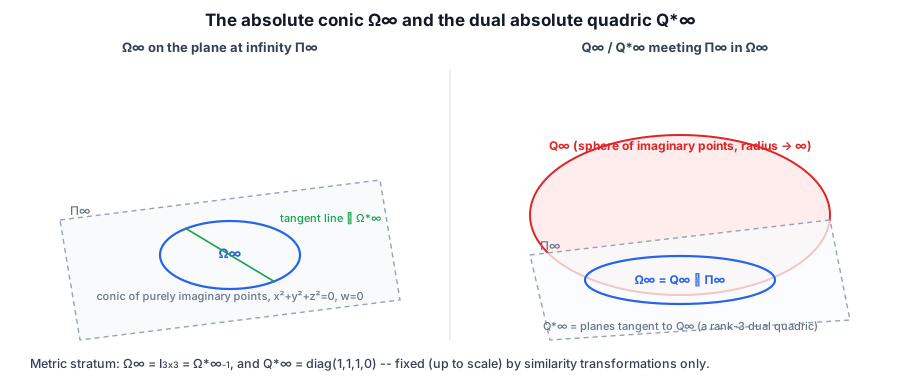
Conic.createCanonicalAbsoluteConic() / DualConic.createCanonicalDualAbsoluteConic() return the identity
conic (1,0,1,0,0,1), i.e. ; and
DualQuadric.createCanonicalDualAbsoluteQuadric() returns .
There is no Quadric.createCanonicalAbsoluteQuadric() — the (non-dual) absolute quadric is never directly
instantiated in the library, only its degenerate dual. These are exactly the canonical forms derived in
PHD, §1.4.3.1-1.4.3.3 (eq. 1.137-1.169, printed pp. 28-34 /
PDF pp. 40-46): the absolute conic is the point conic where the (non-dual) absolute
quadric meets the plane at infinity, and in the metric stratum both it and its dual reduce
to the identity/ forms above precisely because that is the condition under
which the conic-based orthogonality test matches the ordinary
Euclidean dot product (the same construction is cross-referenced in
Hartley & Zisserman, chapter 3, §§3.6-3.7, pp. 81-83).
Which transformation brings an arbitrary projective reconstruction’s dual absolute quadric back to this
canonical diagonal form — the stratification story of upgrading a projective or affine reconstruction to the
metric stratum — is the subject of Transformations; this page only establishes what the canonical
target looks like and why, since Conic/DualQuadric are the classes that hold it (also used in camera
self-calibration, see Pinhole Camera).
References
Full citations are in the bibliography; in detail:
-
The conic/dual-conic derivations above (tangent line, dual-is-inverse, transform rule) and the quadric/dual- quadric derivations that mirror them one dimension up are drawn from Alberto Irurueta’s PhD thesis (cover title Fixed Scene 3D Reconstruction for Mobile Applications; the document’s running header instead reads "3D Face and Object Reconstruction for Mobile Applications" — same document), Irurueta’s PhD thesis: §1.2.5-1.2.7 (printed pp. 6-12 / PDF pp. 18-24) for conics and dual conics, §1.3.5-1.3.7 (printed pp. 15-21 / PDF pp. 27-33) for quadrics and dual quadrics, and §1.4.3.1-1.4.3.3 (printed pp. 28-34 / PDF pp. 40-46) for the absolute conic and dual absolute quadric in the metric stratum.
-
Conic.java:478carries the internal TODO comment//TODO: intersection of Line2D with Conic results in two points (page 9 PHD report.pdf), alongside two still-unimplemented sibling TODOs atConic.java:476-477(shortest distance to conic, closest point to conic) and an analogous unimplemented pair atQuadric.java:704-705(shortest distance to quadric, closest point to quadric) — none of these five carry code today. "page 9 PHD report.pdf" refers to the same thesis cited above: printed page 9 (PDF page 21) is §1.2.6.1 "Line-conic intersections", Proof 1.2, which proves eq. 1.34-1.44 — that a line meeting a conic at a fixed point yields a second intersection point where solves — i.e. exactly "intersection of Line2D with Conic results in two points". The TODO names the precise theoretical result (worked out by the same author, on paper, before this codebase existed) that would justify adding aLine2D-Conicintersection method; the method itself, like its two siblings, simply has not been written yet. See Irurueta’s PhD thesis for the full citation. -
Ellipse.javacites its formulas directly from Wikipedia — Ellipse. -
The Thomsen ellipsoid-surface-area approximation used by
Ellipsoid.getSurface()is not cited in the source either. -
No other book, author, or paper is cited directly in
Conic,DualConic,BaseConic,Quadric,DualQuadric,BaseQuadric,Circle, orSphere. The tangent-line/tangent-plane, dual-inverse and transform-rule formulas those classes implement are cross-checked above against a second, independent source: Hartley & Zisserman, Multiple View Geometry in Computer Vision — chapter 2, pp. 30-37 for conics and dual conics (Results 2.7, 2.13, 2.14 and the exercise 2.8(viii) construction on p. 64, the rank-2 dual conic for the pair of points where a line meets a conic); chapter 3, §3.2.3-3.2.4 and §§3.6-3.7, pp. 73-83, for quadrics, dual quadrics, and the absolute conic/absolute dual quadric.
Related pages
-
Points, Lines and Planes — points, lines and planes are the primitives conics/quadrics are built from.
-
Transformations — how conics/quadrics transform under Euclidean/metric/affine/projective maps.
-
Pinhole Camera — the absolute conic and camera self-calibration.