Pinhole Camera Estimators
| This documentation was generated with the assistance of AI. Please report any inaccuracies. |
PinholeCamera is the richest estimator hierarchy in com.irurueta.geometry.estimators: instead of one
non-robust algorithm wrapped five ways, PinholeCameraEstimatorType names six distinct non-robust
algorithms — DLT_POINT, WEIGHTED_POINT, DLT_LINE_PLANE, WEIGHTED_LINE_PLANE, EPNP, UPNP — and only
four of them get the usual RANSAC/LMedS/MSAC/PROSAC/PROMedS robust treatment described in
Estimators. This page covers what’s specific to camera estimation; the camera model itself (the
3×4 matrix, decomposition into K/R/C, cheirality, back-projection) is already covered in depth by
Pinhole Camera and is not repeated here.
| Algorithm | What it needs | Robust wrapper? |
|---|---|---|
DLT, point correspondences |
6+ 3D↔2D point pairs |
yes — |
DLT, line/plane correspondences |
6+ 3D plane ↔ 2D line pairs |
yes — |
EPnP, point correspondences |
6+ point pairs and known intrinsics |
yes — |
UPnP, point correspondences |
6+ point pairs, intrinsics not required |
yes — |
Weighted, point correspondences |
point pairs + a per-pair weight |
no robust wrapper |
Weighted, line/plane correspondences |
line/plane pairs + a per-pair weight |
no robust wrapper |
DLT: the same SVD null-space pattern, one dimension up from a homography
`DLTPointCorrespondencePinholeCameraEstimator’s algorithm is the camera-matrix analogue of the 2D homography DLT described on the transformation-estimators page, and HZ presents it that way too: chapter 7 opens by remarking that estimating "is evident" to be the same problem as chapter 4’s homography estimation, "the only difference [being] the dimension of the problem" (§7.1, p.178). Concretely, each 3D↔2D point correspondence \$\mathbf{X}_i \leftrightarrow \mathbf{x}_i\$ gives the relation (HZ eq. 7.1), of which only 2 of the 3 rows are independent, exactly as in the homography case (HZ eq. 7.2, p.179):
where are the rows of stacked into a 12-vector . Stacking this block for every correspondence gives the design matrix whose null-space (smallest right singular vector, proof) is :
// DLTPointCorrespondencePinholeCameraEstimator.java (row layout matches HZ eq. 7.2 exactly)
a.setElementAt(counter, 0, homImageW * homWorldX);   //  w'·X  in columns 0-3 (row "1")
a.setElementAt(counter, 1, homImageW * homWorldY);
a.setElementAt(counter, 2, homImageW * homWorldZ);
a.setElementAt(counter, 3, homImageW * homWorldW);
// columns 4-7 left at zero
a.setElementAt(counter, 8, -homImageX * homWorldX);  // -x'·X  in columns 8-11
...
final var decomposer = new SingularValueDecomposer(a); // a: up to 2n x 12 design matrix
decomposer.decompose();
// P is the right singular vector for the smallest singular value, reshaped to 3x4
The "5½ points" minimal count, exactly matched
HZ counts the minimal sample precisely: has 12 entries but only 11 degrees of freedom once scale
is factored out, and since each point gives 2 equations, "at a minimum 5½ such correspondences are
required" (§7.1, p.179) — five full point correspondences plus a sixth point’s (or
) coordinate alone, for exactly 11 equations. The library’s own
DLTPointCorrespondencePinholeCameraEstimator.MIN_NUMBER_OF_EQUATIONS = 11
(DLTPointCorrespondencePinholeCameraEstimator.java:36) implements this exactly: when LMSE is disabled, the
design-matrix loop break`s the instant 11 rows have been filled (`counter >= MIN_NUMBER_OF_EQUATIONS, same
file, verified in source), i.e. it uses all of the 6th correspondence’s 2 equations only if a 7th point isn’t
available to replace it, functionally reaching HZ’s "11 independent equations" bound with a same-or-simpler
"6 whole points" rule instead of "5 points plus one coordinate" bookkeeping.
PointCorrespondencePinholeCameraEstimator.MIN_NUMBER_OF_POINT_CORRESPONDENCES = 6
(PointCorrespondencePinholeCameraEstimator.java:46) is exactly this rounded-up count, , and every robust wrapper on this page reuses it unchanged.
Line and plane correspondences: back-projection reused as a constraint
DLTLinePlaneCorrespondencePinholeCameraEstimator extends the same linear system to 2D line
↔ 3D plane correspondences using exactly the back-projection identity Pinhole Camera already
establishes, (the plane through the camera centre and an image line). HZ
derives the same extension explicitly (§7.1 "Line correspondences", p.180, eq. 7.3): if a 3D line is given
by two points on it, then each must lie on the back-projected plane, so
for — two linear equations in the entries of
per line/plane correspondence, added into the same design matrix alongside any point
correspondences. This is the exact camera-estimation analogue of how Points, Lines and Planes and
Conics and Quadrics treat point/plane duality one dimension down, and it reuses
MIN_NUMBER_OF_EQUATIONS = 11 unchanged (DLTLinePlaneCorrespondencePinholeCameraEstimator.java:36).
Alberto Irurueta’s PhD thesis independently derives the point-correspondence construction above, in §2.5.1 "The DLT algorithm for camera estimation" (printed pp.68-71) and its LMSE extension for over-determined systems in §2.5.1.1 (pp.71-72) — both pre-date and match the code exactly, since the same author wrote the thesis chapter and the estimator class.
What "normalize" actually means here
The estimator calls point2D.normalize(); point3D.normalize(); before building each row
(DLTPointCorrespondencePinholeCameraEstimator.java:191-193). It is worth being precise about what this does
and does not do, since HZ’s own chapter 7 (§"Data normalization", p.180) prescribes something more
elaborate: translate the image points so their centroid is at the origin and their RMS distance from it is
(as in the 2D case, detailed there), and
separately translate/scale the 3D points so their centroid is at the origin with RMS distance
— then denormalize afterwards. The library’s Point2D.normalize()/
Point3D.normalize() calls here do something much narrower: each rescales one point’s own homogeneous
coordinate vector to unit norm, , independently of every
other point — a per-row numerical courtesy before it enters the design matrix, not HZ’s dataset-wide
centroid-and-RMS-distance preconditioning transform (the same
gap already noted for the 2D homography estimators). Neither this class nor
DLTLinePlaneCorrespondencePinholeCameraEstimator implements HZ’s full normalize-solve-denormalize pipeline.
EPnP and UPnP: restricted camera estimation, calibrated vs. uncalibrated
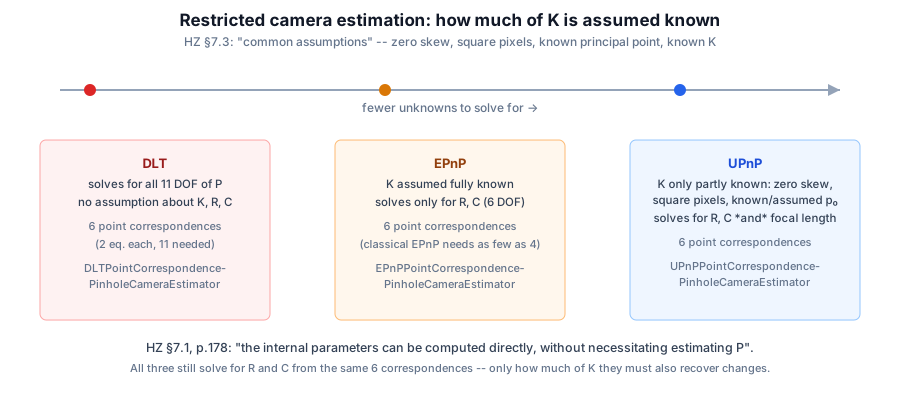
DLT solves for the whole camera matrix with no assumption about its internal structure — 11 free parameters, no more, no less. HZ frames exactly the opposite case, where extra knowledge about the camera is available, as restricted camera estimation (§7.3, p.184): "If additional constraints apply to the matrix P, such as that the pixels are square, then a restricted camera matrix subject to these constraints may be estimated." Its own list of "common assumptions" reads almost like a specification for this hierarchy’s two remaining algorithms: "(i) The skew s is zero. (ii) The pixels are square. (iii) The principal point is known. (iv) The complete camera calibration matrix K is known" — and HZ adds, of the most restrictive case, that "the internal parameters can be computed directly, without necessitating estimating P" (§7.1, p.178, cross-referencing what was then chapter 8). EPnP and UPnP are exactly this idea, made concrete for `PinholeCamera’s factorization ] (Pinhole Camera):
-
EPnPPointCorrespondencePinholeCameraEstimatorrequires the intrinsic parameters to be supplied in advance and solves only for pose ( , ) — "an implementation following the one proposed by Vincent Lepetit… on 'EPnP: An Accurate O(n) Solution to the PnP Problem'", already cited on this site as Lepetit, Moreno-Noguer & Fua. -
UPnPPointCorrespondencePinholeCameraEstimatordoes not require at all — it additionally solves for the focal length (assuming a unitary aspect ratio, zero skew, and a known/assumed principal point): "This class is an implementation following the one proposed by Adrian Penate-Sánchez et al. on 'Exhaustive Linearization for Robust Camera Pose and Focal Length Estimation'" (UPnPPointCorrespondencePinholeCameraEstimator.java, which links directly to the paper PDF — see Penate-Sánchez et al.).
Both are still wrapped by the standard five robust algorithms
({RANSAC|LMedS|MSAC|PROSAC|PROMedS}EPnPPointCorrespondencePinholeCameraRobustEstimator and the UPnP
equivalents), and both inherit the same MIN_NUMBER_OF_POINT_CORRESPONDENCES = 6 minimal sample as DLT — even though EPnP’s own formulation is usually stated as needing as few as 4 general (non-coplanar) points. This
library standardizes all point-correspondence camera algorithms on the same minimal-sample size for
consistency, rather than exploiting EPnP/UPnP’s theoretically smaller minimum.
var estimator = new RANSACEPnPPointCorrespondencePinholeCameraRobustEstimator(intrinsic, points3D, points2D);
estimator.setThreshold(2.0); // reprojection error, in pixels
PinholeCamera camera = estimator.estimate();
Weighted estimation: a different, non-robust way to favor good correspondences
WeightedPointCorrespondencePinholeCameraEstimator and WeightedLinePlaneCorrespondencePinholeCameraEstimator
solve the same DLT-style linear system as above, but scale each correspondence’s rows by an externally supplied
per-sample double[] weights (larger weight, more influence on the fit) before the SVD solve, and use a
com.irurueta.numerical.robust.WeightSelection helper to pick and sort only the top-N weighted correspondences
rather than using all of them (WeightedPointCorrespondencePinholeCameraEstimator.java:25,38-64).
This is precisely HZ’s weighted least-squares normal-equation problem (Appendix A5.2.1, p.591): instead of minimizing the plain algebraic error equally over every row, weighting minimizes it in a norm defined by a positive-definite matrix (in the simplest, and this library’s, case a diagonal matrix of per-correspondence weights):
so a row’s weight enters the problem exactly as a diagonal entry of , scaling that row’s
contribution to the normal equations before they are solved — concretely, in this library, by directly
multiplying each correspondence’s two design-matrix rows by (a monotonic function of) its weight before the SVD
step, rather than forming explicitly. HZ’s own Result A5.1 (p.591) is the special
case (equal weights) reducing to the ordinary pseudo-inverse , the same
pseudo-inverse already cited on Pinhole Camera for Camera.backProject(Point2D, Point3D).
Neither of these two algorithms has a robust wrapper — there is no RANSACWeightedPointCorrespondence…
class anywhere in the package (verified: ls src/main/java/com/irurueta/geometry/estimators/ | grep -i weighted
returns only the two non-robust classes above). This is intentional, not an oversight: weighting is a
deterministic way to favor correspondences you already trust more (e.g. from a better feature-matching
score), whereas RANSAC/LMedS/MSAC/PROSAC/PROMedS solve the different problem of not knowing in advance which
correspondences to trust at all (estimators.adoc#non-robust-vs-robust). The two ideas are not combined
in this library; PROSAC/PROMedS’s qualityScores mechanism (below) is the closest thing to "weighting" that
does have a robust wrapper, and it biases sampling order, not the linear system’s row scaling.
Robust camera estimation: RANSAC, independently re-derived
Section §2.5.2 "Robust camera estimation using RANSAC" of Alberto Irurueta’s PhD thesis (printed pp.75-77) works out the RANSAC iteration-count formula from first principles, independently of — but arriving at the same result as — HZ’s eq. 4.18. Using for the probability a single correspondence is an inlier and for the minimal sample size, the probability that all points in one random sample are inliers is , so the probability of finding at least one outlier-free sample within trials is ; setting this to a desired confidence and solving for gives (PHD eq. 2.130-2.132):
which is exactly eq. 4.18 with and
— the same formula, derived independently by the same author who wrote this
library’s RANSACDLTPointCorrespondencePinholeCameraRobustEstimator. The thesis also notes explicitly (its own
words) that "although the DLT algorithm can be used with as many s points as we want (with a minimum of
s=6)… in order to obtain the smallest possible number of iterations M… we will always choose the smallest
possible value for s" — the same minimal-sample principle that motivates every hierarchy on this site.
Every concrete {RANSAC|LMedS|MSAC|PROSAC|PROMedS}DLTPointCorrespondencePinholeCameraRobustEstimator scores a
candidate camera by reprojecting each 3D point through it and measuring pixel distance to the observed 2D
point — a true geometric residual, exactly like the transformation estimators in
Transformation Estimators and unlike the algebraic residuals in
Conic and Quadric Estimators:
// RANSACDLTPointCorrespondencePinholeCameraRobustEstimator.java:333-343 (abridged)
public double computeResidual(final PinholeCamera currentEstimation, final int i) {
    currentEstimation.project(points3D.get(i), testPoint); // project 3D point through candidate camera
    return testPoint.distanceTo(points2D.get(i));           // reprojection error, in pixel units
}
The PhD thesis additionally folds in cheirality (Pinhole Camera) directly into the inlier test — its own Algorithm 2.1 classifies a correspondence as an inlier
only if its reprojection error is below threshold
and the world point is in front of the camera. The library’s computeResidual above does not itself check
cheirality (it is a pure distance), but PinholeCamera.getCheirality/getDepth are available separately for a
caller who wants that same combined test (Pinhole Camera).
Algebraic error in the fit, geometric error in the score
There is a subtlety worth making explicit, because it explains why computeResidual above and the DLT solve
that produced the candidate are not minimizing the same quantity. HZ’s DLT (both the 2D homography version and
this chapter’s camera version) minimizes the algebraic error subject to
; the residual every robust wrapper on this page scores candidates with is the
true geometric (reprojection) error . HZ calls the procedure that minimizes
geometric error directly, rather than as an afterthought, the Gold Standard algorithm (§7.2, Algorithm
7.1, p.181): use the DLT solution purely as a starting point, then run Levenberg-Marquardt on
HZ’s own worked example (Table 7.1, p.182, calibrating against a 197-point checkerboard target) found the
difference between the linear DLT result and the fully iterated Gold Standard result to be "insignificant" — about a thousandth of a pixel of residual — for well-conditioned data with many correspondences, which is
exactly why this library is content to let the cheap DLT/EPnP/UPnP solve generate candidates inside the
RANSAC loop (where it must run many times, fast) and reserve full geometric optimization for
com.irurueta.geometry.refiners.PointCorrespondencePinholeCameraRefiner (and its
LinePlaneCorrespondencePinholeCameraRefiner/Decomposed*/NonDecomposed* siblings), invoked once via
attemptRefine on only the winning consensus set
(the identical two-stage pattern already described for 2D/3D
transformations). Scoring candidates by geometric reprojection error, as computeResidual already does, means
RANSAC selects the same consensus set a fully-refined Gold Standard fit would also select — only the final
polish of the winning camera itself is deferred to the optional refinement step.
PROSACDLTPointCorrespondencePinholeCameraRobustEstimator/PROMedSDLTPointCorrespondencePinholeCameraRobustEstimator
(and the EPnP/UPnP/line-plane equivalents) take an extra double[] qualityScores constructor argument, one
entry per correspondence — identical to every other PROSAC/PROMedS class in this package
(estimators.adoc#shared-architecture):
// PROSACDLTPointCorrespondencePinholeCameraRobustEstimator.java:165
public PROSACDLTPointCorrespondencePinholeCameraRobustEstimator(final double[] qualityScores) { ... }
20 concrete robust classes total (5 algorithms × {DLT-point, DLT-line/plane, EPnP, UPnP}) — the Weighted pair has no robust counterpart, as explained above.
References
Full citations are in the bibliography. In detail:
-
Alberto Irurueta’s PhD thesis, Irurueta’s PhD thesis, §2.5.1 "The DLT algorithm for camera estimation" (printed pp.68-71) and §2.5.1.1 "LMSE solution" (pp.71-72) — the exact DLT-for-cameras construction
DLTPointCorrespondencePinholeCameraEstimatorimplements; §2.5.2 "Robust camera estimation using RANSAC" (pp.75-77, eq. 2.125-2.132, its own "Algorithm 2.1") — an independently-derived RANSAC iteration-count formula matching HZ's eq. 4.18, used above. -
Hartley & Zisserman, chapter 7 "Computation of the Camera Matrix P" in full: §7.1 "Basic equations" (pp.178-180, eq. 7.1-7.3, the exact 2×12 design-matrix row layout and the "5½ points"/11-equations minimal count, and the line-correspondence extension via back-projection); §7.2 "Geometric error" and Algorithm 7.1 "The Gold Standard algorithm" (pp.180-182, Table 7.1); §7.3 "Restricted camera estimation" (pp.184-186, the assumptions — zero skew, square pixels, known principal point, known K — that motivate EPnP/UPnP); Appendix A5.1-A5.2 "The pseudo-inverse" and A5.2.1 "Linear least-squares using normal equations" (pp.589-591, the weighted normal equations behind this page’s Weighted section); Appendix A5.3-A5.4 (pp.592-593, the smallest-singular-vector proof, reused from the transformation-estimators page).
-
Lepetit, Moreno-Noguer & Fua — already cited on Pinhole Camera; reused here for EPnP’s robust-estimator family.
-
Penate-Sánchez et al. — verified directly against `UPnPPointCorrespondencePinholeCameraEstimator.java’s own javadoc, which links the paper’s PDF.
-
Numerical Recipes §2.6 — reused citation for the SVD null-space technique behind the DLT camera solve (already cited on Pinhole Camera and Transformation Estimators for the same technique).
Key classes
The classes exercised by the code examples above, with links to their source and Javadoc:
| Class | Links |
|---|---|
|
|
|
|
|
|
|
|
|
Related pages
-
Estimators — the general robust-estimation theory (RANSAC/LMedS/MSAC/PROSAC/PROMedS, non-robust-vs-robust, the shared
com.irurueta.numerical.robustarchitecture) this page specializes. -
Pinhole Camera — the camera model itself: the 3×4 matrix,
K/R/Cdecomposition, cheirality, back-projection. -
Transformation Estimators — the 2D/3D homography DLT algorithm this page’s camera DLT generalizes.
-
Point, Line and Plane Estimators, Conic and Quadric Estimators — the simpler estimator hierarchies whose point/line/plane and conic/quadric entities a camera projects to and from.