Conic and Quadric Estimators
| This documentation was generated with the assistance of AI. Please report any inaccuracies. |
com.irurueta.geometry.estimators has four robust-estimator hierarchies for the curved second-degree
entities described in Conics and Quadrics: Circle, Sphere, Conic/DualConic and
Quadric/DualQuadric. Every one of them follows the general pattern laid out in Estimators:
draw a minimal sample, build a candidate entity from it with a closed-form (non-iterative) construction,
score the candidate against the rest of the data, and repeat — with RANSAC, LMedS, MSAC, PROSAC and PROMedS
differing only in the scoring rule (estimators.adoc#ransac, estimators.adoc#lmeds,
estimators.adoc#msac, estimators.adoc#prosac-promeds). None of these four entities has a
standalone, public non-robust XxxEstimator class — unlike some of the other hierarchies in
Estimators, the minimal-sample closed form is inlined directly inside each concrete robust
subclass’s estimatePreliminarSolutions, calling straight into a constructor already documented in
Conics and Quadrics (new Circle(p1,p2,p3), new Conic(p1..p5), etc.).
What is genuinely specific to these four hierarchies — and the actual subject of this page — is why the minimal sample has the size it does, how the closed-form construction behind each one actually solves for the entity’s parameters, and what residual formula each robust estimator uses to score a candidate against the rest of the data. All three turn out to split the six classes into two families with a sharp difference in kind, not just degree:
| Family | Circle / Sphere | Conic / DualConic / Quadric / DualQuadric |
|---|---|---|
Minimal sample |
3 / 4 |
5 / 5 / 9 / 9 |
Linear system solved |
square, inhomogeneous ( |
rectangular, homogeneous ( |
Residual scored by the robust wrapper |
geometric Euclidean distance to the boundary |
algebraic residual |
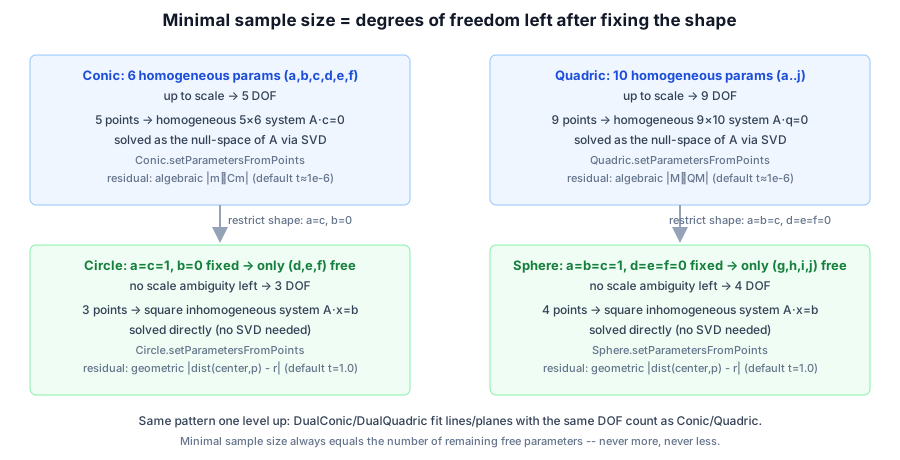
Circle and Sphere: a conic/quadric with its shape already fixed
CircleRobustEstimator’s javadoc states it finds "the best circle that fits in a collection of 2D points";
`SphereRobustEstimator
the analogous "the best sphere that fits in a collection of 3D points"
(CircleRobustEstimator.java:26-29, SphereRobustEstimator.java:26-29). Both are, as
Conics and Quadrics notes, independent parametric classes rather than Conic/Quadric subclasses — but their degrees of freedom are still exactly a conic/quadric’s degrees of freedom with the shape
constrained: a circle is the conic with ,
(ConicType.CIRCLE_CONIC_TYPE, see Conics and Quadrics); a sphere is the quadric with
and .
Why 3 points, why 4 points
A general conic has 6 homogeneous coefficients, i.e. 5 degrees of freedom once the overall scale is divided
out — which is exactly why ConicRobustEstimator.MINIMUM_SIZE is 5 (next section). Fixing a=c and b=0
removes 2 of those degrees of freedom and removes the scale ambiguity at the same time: once
is forced non-zero, the whole equation can be divided by it, leaving the non-homogeneous circle equation
with exactly 3 free real numbers (equivalently: center
and radius ). That is why
CircleRobustEstimator.MINIMUM_SIZE = 3 (CircleRobustEstimator.java:36): 3 points, 3 unknowns, one equation
per point. The identical argument one dimension up — a quadric’s 10 homogeneous coefficients (9 DOF) reduced
by the 5 constraints , to the 4 free reals in
— is why SphereRobustEstimator.MINIMUM_SIZE = 4
(SphereRobustEstimator.java:36).
The closed-form construction: a direct, non-homogeneous linear solve
Because fixing the shape also removes the scale ambiguity, the minimal-sample system is not the homogeneous
A·x=0 this library solves elsewhere via SVD null-space (Points, Lines and Planes,
Conics and Quadrics) — it is an ordinary square, inhomogeneous system A·x=b with a unique
solution. Circle.setParametersFromPoints (Circle.java:176-249) builds, for each of the 3 points, the row
of A and the entry (each row normalized
first to improve conditioning), then solves the 3×3 system directly with Utils.solve(m, b) — no SVD,
because there is nothing left to disambiguate. Sphere.setParametersFromPoints (Sphere.java:181-276) does
the identical thing one dimension up with a 4×4 system. Both robust estimators simply call the
three-argument/four-argument constructor on the minimal sample and catch the degenerate case:
// RANSACCircleRobustEstimator.estimatePreliminarSolutions (RANSACCircleRobustEstimator.java:179-190)
try {
    final var circle = new Circle(point1, point2, point3); // solves A·x=b directly, x = (d,e,f)
    solutions.add(circle);
} catch (final ColinearPointsException e) {
    // if points are collinear, A is singular: no solution is added
}
Sphere’s constructor throws `CoplanarPointsException in the equivalent degenerate case (4 coplanar points
cannot pin down a unique sphere).
The residual: true geometric distance, not an algebraic proxy
Unlike the other four hierarchies below, CircleRobustEstimator.residual/SphereRobustEstimator.residual
score a candidate with the actual Euclidean distance from the point to the circle/sphere boundary, via
Circle.getDistance/Sphere.getDistance (CircleRobustEstimator.java:728-732,
SphereRobustEstimator.java:723-727):
(Circle.signedDistance/Sphere.signedDistance, Circle.java:369-371). This is possible only because a
circle/sphere’s inhomogeneous, scale-free parameterization already carries real physical units (the same
units as the input points) — there is no matrix to normalize and no arbitrary scale to divide out first, so
the natural residual is just the point-to-boundary distance. That is also why both robust estimators default
their inlier threshold to 1.0 (RANSACCircleRobustEstimator.DEFAULT_THRESHOLD,
RANSACSphereRobustEstimator.DEFAULT_THRESHOLD, both 1.0): one unit of distance, matching a "typical
resolution of 1 pixel/voxel" per their own javadoc. Contrast this with the algebraic residual and
correspondingly tiny default thresholds used by Conic/DualConic/Quadric/DualQuadric below.
var estimator = new RANSACCircleRobustEstimator(points);
estimator.setThreshold(1.0); // same units as the points; default is already 1.0
Circle circle = estimator.estimate();
Both hierarchies expose the same five concrete robust subclasses named after the pattern established in
estimators.adoc#shared-architecture: RANSACCircleRobustEstimator, LMedSCircleRobustEstimator,
MSACCircleRobustEstimator, PROSACCircleRobustEstimator, PROMedSCircleRobustEstimator (and the Sphere
equivalents), created through CircleRobustEstimator.create(…)/SphereRobustEstimator.create(…) factory
overloads exactly like every other hierarchy in this package.
Conic and DualConic: the full 5-point/5-line problem
ConicRobustEstimator finds "the best conic that fits in a collection of 2D points"; DualConicRobustEstimator
the dual statement, "the best dual conic that fits in a collection of 2D lines" (ConicRobustEstimator.java:27-
29, DualConicRobustEstimator.java:27-29) — mirroring the point/tangent-line duality Conics and Quadrics
establishes for Conic/DualConic in general.
Why 5 points (or 5 lines)
A conic has 6 homogeneous coefficients, hence 5 degrees of freedom
once scale is factored out — which is exactly ConicRobustEstimator.MINIMUM_SIZE = 5
(ConicRobustEstimator.java:39). This is also worked out explicitly in
Hartley & Zisserman §2.2, "Five points define a conic" (pp.
30-31): each point places one linear constraint
on the 6-vector of coefficients, so 5 points give a 5×6 homogeneous system whose 1-dimensional null-space
is the conic, "determined uniquely (up to scale) by five points in general position" — HZ’s own words. By the
point/tangent-line duality of the previous section, a dual conic (an envelope of tangent lines) is likewise
fixed by 5 lines, hence DualConicRobustEstimator.MINIMUM_SIZE = 5 (DualConicRobustEstimator.java:39).
The closed-form construction: a homogeneous linear system, solved by SVD null-space
Unlike Circle/Sphere, a conic has no way to remove the scale ambiguity, so
Conic.setParametersFromPoints (Conic.java:313-409) builds exactly the homogeneous 5×6 system HZ
describes — for each point the row (row-normalized for
numerical accuracy) — and finds its null-space via SingularValueDecomposer
(Conic.java:387-408), the same general technique this library uses for every other homogeneous join/meet
problem (Points, Lines and Planes, Numerical Recipes §2.6,
"Singular Value Decomposition", pp. 65-67). If the decomposed rank is below 5, the 5 points are coincident or
otherwise degenerate and CoincidentPointsException is thrown instead of a spurious solution
(Conic.java:390-391). DualConic.setParametersFromLines (DualConic.java:291-390) is the line-dual mirror
of the same 5×6 SVD null-space computation. RANSACConicRobustEstimator.estimatePreliminarSolutions
simply calls the 5-point constructor on the minimal sample:
// RANSACConicRobustEstimator.estimatePreliminarSolutions (RANSACConicRobustEstimator.java:180-195)
try {
    final var conic = new Conic(point1, point2, point3, point4, point5); // SVD null-space of a 5x6 system
    solutions.add(conic);
} catch (final CoincidentPointsException e) {
    // if points are coincident/degenerate, no solution is added
}
RANSACDualConicRobustEstimator is the identical pattern with new DualConic(line1..line5) and
CoincidentLinesException.
The residual: algebraic, not geometric
ConicRobustEstimator.residual (ConicRobustEstimator.java:731-759) and its dual counterpart
DualConicRobustEstimator.residual (DualConicRobustEstimator.java:730-758) both score a candidate with the
absolute value of the conic’s own defining bilinear form — an algebraic residual, not a true geometric
distance to the curve:
computed by normalizing / and the point/line first, then literally multiplying
the three matrices (ConicRobustEstimator.java:748-757). This is the same quantity Conic.isLocus/
DualConic.isLocus threshold against (Conics and Quadrics) — residual zero means exactly "on the
locus" — but it is not in the same units as a Euclidean distance, and it scales non-linearly with how far a
point actually is from the curve. That mismatch in scale is directly visible in the library’s own defaults:
RANSACCircleRobustEstimator.DEFAULT_THRESHOLD is 1.0, while
RANSACConicRobustEstimator.DEFAULT_THRESHOLD is 1e-6
(RANSACConicRobustEstimator.java:45) and RANSACDualConicRobustEstimator.DEFAULT_THRESHOLD is 1e-7
(RANSACDualConicRobustEstimator.java:44) — three to seven orders of magnitude smaller, because
is a genuinely different (and much smaller, for normalized inputs near the locus)
quantity than a pixel distance.
var estimator = new RANSACConicRobustEstimator(points);
estimator.setThreshold(1e-6); // algebraic residual |m^T C m|, not a pixel distance
Conic conic = estimator.estimate();
Both hierarchies again expose the standard five concrete subclasses — {RANSAC,LMedS,MSAC,PROSAC,
PROMedS}ConicRobustEstimator and the DualConic equivalents, 10 classes total — built through
ConicRobustEstimator.create(…)/DualConicRobustEstimator.create(…).
Quadric and DualQuadric: the same argument, one dimension up
QuadricRobustEstimator finds "the best quadric that fits in a collection of 3D points";
DualQuadricRobustEstimator "the best dual quadric that fits in a collection of 3D planes"
(QuadricRobustEstimator.java:27-29, DualQuadricRobustEstimator.java:29-31) — the point/tangent-plane
duality of Conics and Quadrics one dimension up from Conic/DualConic.
Why 9 points (or 9 planes)
A quadric has 10 homogeneous coefficients,
hence 9 degrees of freedom once scale is factored out — exactly QuadricRobustEstimator.MINIMUM_SIZE = 9
(QuadricRobustEstimator.java:36) and, by the same point/tangent-plane duality argument as conics,
DualQuadricRobustEstimator.MINIMUM_SIZE = 9 (DualQuadricRobustEstimator.java:38). This is the direct 3D
analogue of HZ’s "five points define a conic" argument above, generalized to a 9×10 homogeneous system — the source PDFs used for this documentation pass do not contain an explicit "nine points define a quadric"
passage the way HZ spells out the conic case, but the linear-algebra argument (one constraint row per point,
minimal sample size = degrees of freedom) is identical and is the one the code itself implements.
The closed-form construction: the same SVD null-space pattern
Quadric.setParametersFromPoints (Quadric.java:317-506) builds, for each of the 9 points, the row
of a 9×10 matrix (row-normalized),
then takes its null-space via SingularValueDecomposer, exactly like Conic (Quadric.java:478-502),
throwing CoincidentPointsException if the decomposed rank is below 9 (Quadric.java:481-482).
DualQuadric.setParametersFromPlanes (DualQuadric.java:325-513) is the identical construction on plane
coefficients instead of point coordinates. Both concrete RANSAC estimators are again thin wrappers around the
9-argument constructor:
// RANSACQuadricRobustEstimator.estimatePreliminarSolutions (RANSACQuadricRobustEstimator.java:182-199)
try {
    final var quadric = new Quadric(point1, point2, point3, point4, point5, point6, point7, point8, point9);
    solutions.add(quadric); // SVD null-space of a 9x10 system
} catch (final CoincidentPointsException e) {
    // if points are coincident/degenerate, no solution is added
}
RANSACDualQuadricRobustEstimator mirrors this with 9 Plane arguments and CoincidentPlanesException.
The residual: algebraic again
QuadricRobustEstimator.residual (QuadricRobustEstimator.java:737-762) and
DualQuadricRobustEstimator.residual (DualQuadricRobustEstimator.java:735-760) score exactly the same kind
of algebraic quantity as the conic case, one dimension up:
and the same order-of-magnitude gap in default thresholds shows up again:
RANSACQuadricRobustEstimator.DEFAULT_THRESHOLD is 1e-6 (RANSACQuadricRobustEstimator.java:43) and
RANSACDualQuadricRobustEstimator.DEFAULT_THRESHOLD is 1e-7 (RANSACDualQuadricRobustEstimator.java:44) — both far smaller than the 1.0 used by the geometric-distance-based Circle/Sphere estimators, for exactly
the same reason as the conic/dual-conic case above.
var estimator = new RANSACQuadricRobustEstimator(points);
estimator.setThreshold(1e-6); // algebraic residual |M^T Q M|
Quadric quadric = estimator.estimate();
Again 10 concrete subclasses total: {RANSAC,LMedS,MSAC,PROSAC,PROMedS}QuadricRobustEstimator and the
DualQuadric equivalents, built through QuadricRobustEstimator.create(…)/
DualQuadricRobustEstimator.create(…).
References
Full citations are in the bibliography. In detail:
-
Hartley & Zisserman, Multiple View Geometry in Computer Vision, 2nd ed., §2.2 "Five points define a conic" (pp. 30-31) — the explicit 5×6 homogeneous linear system and null-space argument for why a conic needs exactly 5 points, which
Conic.setParametersFromPointsimplements (with a differently-ordered but equivalent row layout). Not previously cited for this specific construction elsewhere in this documentation set. -
Numerical Recipes, §2.6 "Singular Value Decomposition" (pp. 65-67) — the general null-space-via-SVD technique behind
Conic/DualConic/Quadric/`DualQuadric’s minimal-sample solve; already cited for the same technique (applied to points/lines/planes) in Points, Lines and Planes and (applied to camera matrices) in Pinhole Camera. -
Alberto Irurueta’s PhD thesis, Irurueta’s PhD thesis, covers the definitions of conics, dual conics, quadrics and dual quadrics in full (§1.2.5-1.2.7, §1.3.5-1.3.7 — see Conics and Quadrics), but its table of contents and the chapters themselves stop at duality and transformation; they do not contain a section on fitting a conic/quadric from a minimal point sample. No page of the thesis is cited above for that reason — stretching the existing conics-quadrics citation to cover estimation-from-samples would misrepresent what the thesis actually contains.
-
No book, paper or web source is cited directly in
Circle,Sphere,Conic,DualConic,Quadric,DualQuadricor any of their robust-estimator subclasses for the minimal-sample or residual code itself; the citations above are supplied as standard external context that matches the algorithms verified in the source (see estimators.adoc#shared-architecture for how every hierarchy in this package, including these four, shares its RANSAC/LMedS/MSAC/PROSAC/PROMedS iteration loop with a single implementation incom.irurueta.numerical.robust).
Related pages
-
Estimators — the general robust-estimation theory (RANSAC/LMedS/MSAC/PROSAC/PROMedS, non-robust-vs-robust, the shared
com.irurueta.numerical.robustarchitecture) this page specializes. -
Conics and Quadrics — the conic/dual-conic/quadric/dual-quadric math itself: the matrix representation, tangent lines/planes, duality ( ) and transformation rules that the entities estimated here obey.
-
Point, Line and Plane Estimators — the point/line/plane robust-estimator hierarchies, the simplest instances of the same pattern.
-
Transformation Estimators — robust estimation of the Euclidean/metric/affine/projective transformations that conics and quadrics transform under.
-
Pinhole Camera Estimators — robust camera estimation, including self-calibration via the absolute conic/dual absolute quadric introduced in Conics and Quadrics.