Estimators
| This documentation was generated with the assistance of AI. Please report any inaccuracies. |
Every geometric entity in com.irurueta.geometry that can be fit to noisy data — a Point2D/Point3D,
Line2D, Plane, Circle, Sphere, Conic/DualConic, Quadric/DualQuadric, a
Transformation2D/Transformation3D, or a PinholeCamera — has a counterpart in
com.irurueta.geometry.estimators. This page explains the one idea that recurs across all twelve of those
hierarchies: every entity gets a single non-robust algorithm, plus a family of five interchangeable robust
wrappers around it — and why that split exists at all, rather than just one "best" estimator per entity.
Why a non-robust algorithm is not enough
A non-robust estimator solves a well-posed algebraic or least-squares problem: given exactly the minimal number
of correspondences an entity needs (2 points for a line, 3 for a circle, 5 for a conic, 4 for a 2D homography,
6 for a camera, …), or more than that minimum, it produces the entity that fits them exactly, or in an
LMSE (Least Mean Squared Error) sense if over-determined. This is exactly what a class like PlaneEstimator-if
it existed as a public class-or the inlined closed-form constructors inside RANSACPlaneRobustEstimator do:
for 3 points, no iteration, no notion of "this correspondence might be
wrong".
The problem is that real correspondences — 2D/3D point matches from a feature detector, line matches from an edge detector — are never 100% correct. A single badly-matched point dragged into an LMSE fit can move the whole result arbitrarily far from the truth, because a least-squares cost grows quadratically with a point’s residual: one far-away outlier can dominate the sum of squared errors contributed by every other, correct, point. `irurueta-geometry’s own family portrait of this problem is exactly Transformations / Conics and Quadrics / Pinhole Camera's entities: none of their non-robust fits have any built-in outlier rejection.
Robust estimation solves a different, harder problem: simultaneously find the entity and the subset of
correspondences that agree with it (the inliers), while implicitly discounting the rest (the outliers) — without knowing in advance which is which. com.irurueta.geometry.estimators solves this the same way for
every one of its twelve hierarchies:
-
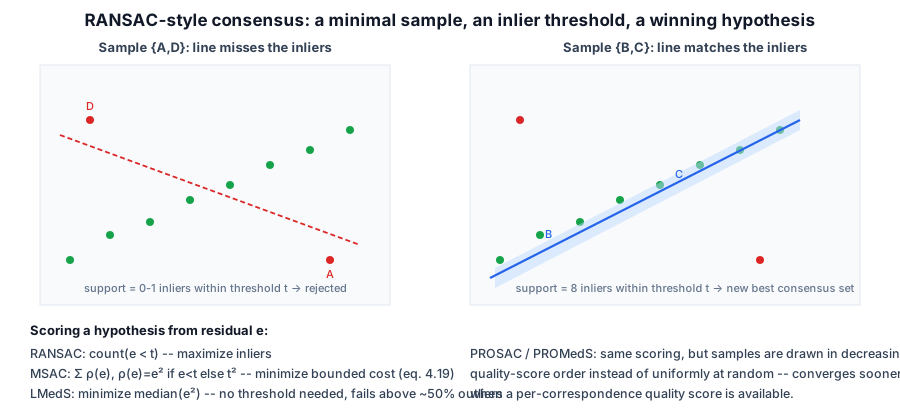
Repeatedly draw a minimal sample (the smallest number of correspondences the entity’s non-robust algorithm needs) and instantiate a candidate entity from it, exactly as the non-robust algorithm would.
-
Score that candidate against all the data using one of five interchangeable rules (RANSAC / LMedS / MSAC / PROSAC / PROMedS, below).
-
Keep the best-scoring candidate and its consensus set (the correspondences it explains), then optionally re-estimate the entity with the same non-robust LMSE algorithm using only that consensus set — a cheap way to fold "more data means a better fit" back in once the outliers have been identified.
That is why every hierarchy in this library has the same shape: one small, exact/LMSE algorithm, wrapped by five classes that differ only in step 2’s scoring rule. The next section works through each rule with the real equations behind it.
RANSAC
RANSAC (RANdom SAmple Consensus) is Fischler and Bolles' original 1981 algorithm (Fischler & Bolles, 1981), and the one all the others are variations of. Quoting the algorithm as stated in Hartley & Zisserman (chapter 4, Algorithm 4.4, p.119):
-
Randomly select a minimal sample of data points and instantiate the model from it.
-
Determine the set of points within a distance threshold of the model — the consensus set / inliers.
-
If exceeds a threshold , re-estimate the model from all of and stop.
-
Otherwise repeat from step 1 with a new sample.
-
After trials, keep the largest consensus set found and re-estimate from it.
Two constants make this concrete, and the library exposes both as configurable properties on every
XxxRobustEstimator:
-
The inlier threshold . If measurement error is zero-mean Gaussian with standard deviation , the squared residual follows a distribution with degrees of freedom ( = the codimension of the model — 1 for a line, 2 for a homography/camera). Choosing for confidence gives, e.g., for a line/fundamental matrix and for a homography/camera matrix (HZ table 4.2, p.119) — this is the
thresholdproperty onRANSACLine2DRobustEstimator,RANSACDLTPointCorrespondencePinholeCameraRobustEstimator, etc. -
The number of trials . For sample size , outlier proportion and target confidence (usually 0.99) that at least one sample is outlier-free:
(HZ eq. 4.18, p.119). Since is rarely known up front, the library — like HZ’s own Algorithm 4.5 (p.121) — computes it adaptively: after each sample it updates from the best consensus set found so far and shrinks the remaining accordingly, capping the total work at
maxIterations. Alberto Irurueta’s PhD thesis independently derives exactly the same formula for camera estimation (PHD, §2.5.2, printed pp.75-77, its own "Algorithm 2.1"), including the same worst-case-then-adaptive-refinement strategy, which is a useful second, independent derivation of eq. 4.18 grounded specifically in this library’s own camera-estimation use case.
LMedS (Least Median of Squares)
Instead of counting inliers under a fixed threshold, LMedS scores a candidate by the median of its squared residuals over the whole data set, and keeps the candidate with the smallest median (HZ §4.7.3, p.120: "Least Median of Squares (LMS) estimation… requires no setting of thresholds or a priori knowledge of the variance of the error"):
The number of samples is still drawn from the same eq. 4.18. The trade-off is symmetric to
RANSAC’s: no threshold to tune, but the median is only a meaningful "typical" residual while inliers are the
majority — LMedS breaks down once outliers exceed 50% of the data, exactly where thresholded RANSAC keeps
working provided is chosen well.
Numerical Recipes §15.7 "Robust Estimation" (p.818) frames the
same median-based idea for the simpler 1D case (Fitmed, a least-median/least-absolute-deviation line fit,
p.823) as a general antidote to the sensitivity of ordinary least squares to a "long tail of outliers" — the
1D special case of exactly the geometric problem LMedSLine2DRobustEstimator and its eleven siblings solve.
MSAC (and the robust-cost-function idea behind it)
RANSAC’s step-function score (an inlier contributes 0 cost, an outlier contributes a fixed cost, nothing in
between) throws away information: two inliers at different distances from the model score identically. HZ
proposes, without naming it, exactly the cost function that Torr and Zisserman later formalized as MSAC
(M-estimator SAmple Consensus, Torr & Zisserman, 2000) and the
library implements as its MSACXxxRobustEstimator classes:
(HZ eq. 4.19, p.120). Inliers still contribute their true squared residual (the maximum-likelihood cost under a Gaussian error model, HZ §4.3), but outliers are capped at rather than contributing 0 — so MSAC’s winning hypothesis is the one minimizing total cost, not maximizing inlier count, letting a model with slightly fewer, tighter inliers beat one with more, looser ones. Threshold and sample count are computed exactly as in RANSAC.
PROSAC and PROMedS
PROSAC (PROgressive SAmple Consensus, Chum & Matas, 2005) and this
library’s PROMedS keep RANSAC’s/LMedS’s scoring rules unchanged, but change which samples are drawn first: if
each correspondence carries a quality score (e.g. a feature descriptor’s match confidence), samples are
drawn in decreasing quality order instead of uniformly at random, so a sample entirely made of high-quality
matches — and thus likely outlier-free — is tried early rather than waiting for it to come up by chance. Every
PROSACXxxRobustEstimator/PROMedSXxxRobustEstimator constructor accordingly takes an extra
double[] qualityScores argument, one entry per correspondence (e.g.
PROSACDLTPointCorrespondencePinholeCameraRobustEstimator(double[] qualityScores)); RANSAC, LMedS and MSAC take
none. PROSAC postdates HZ's 2nd edition (2004) and neither it nor an
equally-named PROMedS reference was found in any of the three source PDFs used for this documentation pass; the
description above reflects the library’s own javadoc and constructor signatures rather than a page citation.
How the code shares one implementation across twelve hierarchies
None of the five robust algorithms above is reimplemented per entity. com.irurueta.geometry.estimators
delegates to a single, generic, entity-agnostic implementation in the sibling module
com.irurueta.numerical.robust: abstract RobustEstimator<T> plus concrete, type-parameterized
RANSACRobustEstimator<T>, LMedSRobustEstimator<T>, MSACRobustEstimator<T>, PROSACRobustEstimator<T>,
PROMedSRobustEstimator<T>. Every RANSACXxxRobustEstimator in com.irurueta.geometry.estimators is a thin
adapter: its estimate() builds an anonymous RobustEstimatorListener<T> whose
estimatePreliminarSolutions(int[] sampleIndices, List<T> solutions) plugs in that entity’s minimal-sample
closed-form construction, and whose computeResidual(T, int) plugs in that entity’s geometric distance formula — then hands both to new RANSACRobustEstimator<>(listener).estimate() (see e.g.
RANSACConicRobustEstimator.java:165-249). This is why adding a thirteenth entity to the library would not
require reimplementing RANSAC: only the two entity-specific hooks change.
| Concept | Where it lives |
|---|---|
|
|
|
|
|
|
|
Constructor/setter argument on every PROSAC/PROMedS class only; validated by the shared
|
LMSE re-estimation / non-linear refinement after robust estimation |
|
The twelve hierarchies
Every entity below follows exactly the pattern described above; the pages linked here work through each one’s specific minimal-sample algorithm, distance/residual formula, and any book equations that match it.
| Entity | Non-robust algorithm | Robust variants |
|---|---|---|
|
line∩line / plane∩plane∩plane closed form |
|
|
2-point closed form |
|
|
3-point closed form |
|
|
3-point closed form |
|
|
4-point closed form |
|
|
5-point / 5-line closed form |
|
|
9-point / 9-plane closed form |
|
|
Kabsch algorithm |
|
|
similarity least-squares |
|
|
3/4-point (or line/plane) closed form |
|
|
4/5-point (or line/plane) closed form |
|
|
DLT (point or line/plane), EPnP, UPnP, weighted |
Pinhole Camera Estimators (5×4, weighted has none) |
References
Full citations are in the bibliography. In summary: Fischler & Bolles for RANSAC itself; Hartley & Zisserman chapter 4 (§4.1-4.2 DLT algorithms and cost functions, §4.7 robust estimation, Algorithms 4.1-4.6) for the RANSAC/MSAC equations and thresholds used above; Irurueta’s PhD thesis §2.5 for an independently-derived RANSAC camera-estimation algorithm using the same sample-count formula; Numerical Recipes §15.7 for the 1D robust/median-fit analogue of LMedS; Torr & Zisserman for the formal MSAC/MLESAC name; and Chum & Matas for PROSAC.
Related pages
-
Point, Line and Plane Estimators, Conic and Quadric Estimators, Transformation Estimators, Pinhole Camera Estimators — the four hierarchy pages this page introduces.
-
Transformations, Conics and Quadrics, Points, Lines and Planes, Pinhole Camera — the geometric entities being estimated.