Newton-Raphson Method
| This documentation was generated with the assistance of AI. Please report any inaccuracies. |
When both a function and its derivative can be evaluated, extending the tangent line at the current estimate
until it crosses zero converges dramatically faster than any of the derivative-free methods described
elsewhere on this page — but only once the iteration is close enough to the root for that tangent-line
approximation to hold. This package implements both the classical, unguarded Newton-Raphson iteration and a
"safe" variant that falls back to bisection whenever the unguarded version would misbehave. Both are described
in Press et al., 2007, Section 9.4 (page 456), and implemented as
NewtonRaphsonSingleRootEstimator and SafeNewtonRaphsonSingleRootEstimator in the
com.irurueta.numerical.roots package.
The tangent-line step
From the Taylor expansion , setting gives the step:
Geometrically: extend the tangent line at until it crosses the x-axis, and use that crossing as the next estimate. Expressing the deviation from the true root in terms of this recurrence gives:
— quadratic convergence: near the root, the number of correct significant digits roughly doubles with every step. This is what makes Newton-Raphson so powerful whenever it applies cleanly, and why even methods that reject it for early iterations often still use one or two Newton-Raphson steps at the very end to "polish" a root cheaply.
Why the plain iteration can fail
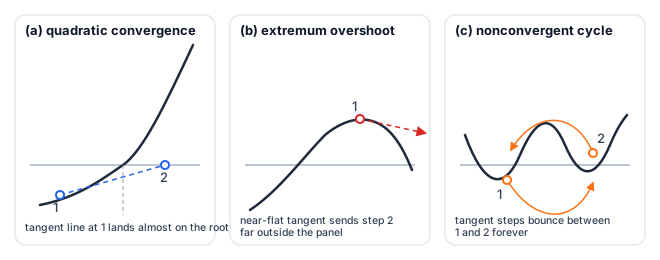
Far from the root, where the higher-order Taylor terms are no longer negligible, the tangent-line step can be
badly wrong — most dramatically when a trial point lands near a local extremum, where
sends the next estimate flying off toward infinity with no hope of recovery. The plain
NewtonRaphsonSingleRootEstimator in this package only rejects a step that would land outside the original
bracket; it does not otherwise protect against this failure mode.
The safe variant: Newton-Raphson with a bisection fallback
SafeNewtonRaphsonSingleRootEstimator fixes this by maintaining an actual bracket alongside the tangent-line
step, and taking a bisection step instead whenever the Newton-Raphson step would either land outside the
current bracket, or is not shrinking the bracket fast enough (specifically, when the previous step’s
magnitude was more than twice the size of the one before it):
Whichever step is taken, the bracket is then updated using the sign of the new function value, exactly as in Bisection Method. This guarantees the same unconditional convergence as plain bisection, while still taking the fast Newton-Raphson step whenever it is safe to do so.
Library implementation
Both classes extend DerivativeSingleRootEstimator (itself extending BracketedSingleRootEstimator), and
require a derivative listener in addition to the usual function listener:
| Class | Behavior |
|---|---|
|
Plain tangent-line iteration; only checks that the result stays within the original bracket. Up to
|
|
Falls back to bisection whenever the Newton-Raphson step is unsafe, maintaining a true bracket throughout. Up
to |
Both share getTolerance() / setTolerance(double) (the step-size tolerance to converge to; default 1e-6)
and use the automatic bracket search described in Bisection Method. After
estimate() completes, getRoot() returns the estimated root.
Press et al., 2007 recommends the safe variant (rtsafe) as the default
choice whenever a derivative is available — the plain iteration’s poor global convergence properties are
usually not worth the risk once a safe alternative costs almost nothing extra.
|
Example
final var listener = new SingleDimensionFunctionEvaluatorListener() {
    @Override
    public double evaluate(final double point) {
        return point * point - 4.0;
    }
};
final var derivativeListener = new SingleDimensionFunctionEvaluatorListener() {
    @Override
    public double evaluate(final double point) {
        return 2.0 * point;
    }
};

final var estimator = new SafeNewtonRaphsonSingleRootEstimator(
        listener, derivativeListener, 0.0, 10.0, 1e-9);
estimator.estimate();

final var root = estimator.getRoot(); // approximately 2.0| Class | Javadoc | Source |
|---|---|---|
|
||
|