Brent’s Method
| This documentation was generated with the assistance of AI. Please report any inaccuracies. |
Golden Section Search is designed for the worst possible case — a function that gives
no cooperation at all. Near a smooth minimum, though, a parabola fitted through three points usually jumps
straight to the minimum (or very close to it) in a single step. Brent’s method combines both ideas: it
attempts the fast parabolic step whenever the function seems to allow it, and falls back to the slow-but-sure
golden section step otherwise. It is described in Press et al., 2007, Section
10.3 (page 496), and implemented as BrentSingleOptimizer in the com.irurueta.numerical.optimization
package.
Inverse parabolic interpolation
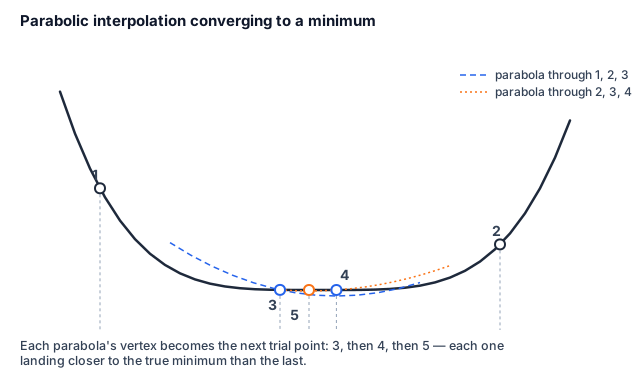
Given three points and their function values , , , the abscissa of the minimum of the parabola passing through them is:
This formula fails only when the three points are collinear (zero denominator), and it is just as happy jumping to a parabolic maximum as to a minimum — so no scheme relying on it alone can be trusted. The task is to detect, robustly, when the function is behaving cooperatively enough to make this step worthwhile, and to fall back to golden section search otherwise.
Brent’s bookkeeping
At each stage, the method tracks six points (not necessarily distinct): and bracket the minimum; is the point with the lowest function value found so far; is the point with the second-lowest; is the previous value of ; and is the most recently evaluated point. A parabolic step, fit through , , and , is accepted only if it:
-
falls within the bracket , and
-
moves less than half the distance moved on the step before last — this ensures the parabolic steps are actually converging, rather than settling into some non-convergent cycle.
In the worst case where parabolic steps are technically acceptable but useless, the method ends up alternating
between parabolic and golden-section steps, still converging by virtue of the latter. Neither step type is
ever allowed to move to a point closer than tolerance to an already-evaluated point — there is no usable
information in doing so, since the function there would differ only by roundoff.
A typical ending configuration has and about apart, with at their midpoint — accurate to within , fractionally.
Library implementation
BrentSingleOptimizer extends BracketedSingleOptimizer, inheriting the same downhill bracketing routine
described in Golden Section Search. It adds:
-
getTolerance()/setTolerance(double)— the fractional precision to isolate the minimum to; default3e-8.
Internally, up to ITMAX = 100 iterations are attempted before the optimizer reports failure to converge. As
with GoldenSingleOptimizer, call computeBracket(…) (or supply a bracket directly) before minimize(),
then read getResult() / getEvaluationAtResult().
| Press et al., 2007 recommends Brent’s method as the default choice for one-dimensional minimization without derivatives — reach for Golden Section Search instead only when the integrand’s low-order derivatives are discontinuous, since parabolic interpolation offers no benefit there. When the derivative is available, see Brent’s Method with Derivatives for a variant of this same method that uses it. |
Example
final var listener = new SingleDimensionFunctionEvaluatorListener() {
    @Override
    public double evaluate(final double point) {
        return (point - 2.0) * (point - 2.0);
    }
};

final var optimizer = new BrentSingleOptimizer();
optimizer.setListener(listener);
optimizer.computeBracket(0.0, 1.0);
optimizer.minimize();

final var xmin = optimizer.getResult();          // approximately 2.0
final var fmin = optimizer.getEvaluationAtResult(); // approximately 0.0| Class | Javadoc | Source |
|---|---|---|
|
||
|