Fundamental matrix estimation
| This documentation was generated with the assistance of AI. Please report any inaccuracies. |
The fundamental matrix is a , rank-2 matrix that encodes the epipolar geometry between a pair of uncalibrated views: it is the only piece of information needed to constrain where a point in one image can match in the other, without knowing anything about the cameras' intrinsic parameters.
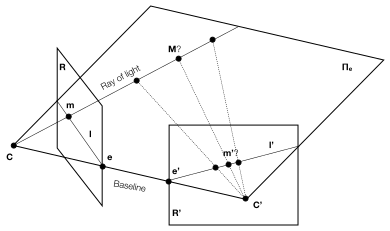
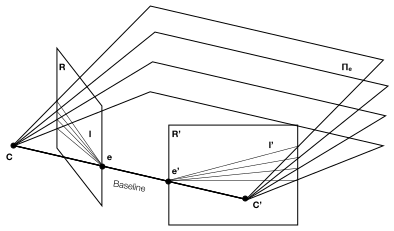
Given a 3D world point , its projections and on the left and right views, the camera centers , and always define a plane — the epipolar plane . Its intersection with each image plane is an epipolar line ( on the left view, on the right), and the projection of one camera’s center onto the other view is that view’s epipole ( , ). As varies, every epipolar plane still contains the baseline , so all epipolar lines in a view pass through that view’s epipole — a pencil of lines:
The epipolar constraint
Because lies on epipolar line and passes through epipole , , where is the skew-symmetric cross-product matrix of . Back-projecting epipolar lines to the (shared) epipolar plane and forward-projecting to the other view yields the linear map
so any matched pair must satisfy the epipolar constraint
is defined up to scale (8 DOF from ) and, since and , its left/right null-spaces are exactly the two epipoles — forcing and leaving 7 true
degrees of freedom. Given the SVD , the epipoles are recovered directly as the singular
vectors of the zero singular value: (last column of ), (last column of
) Irurueta, PhD thesis §3.2.1
(FundamentalMatrix.computeEpipoles(), getLeftEpipole()/getRightEpipole()). When the pair of cameras
, is already known, new FundamentalMatrix(leftCamera, rightCamera) computes
directly from .
Linear estimation and the 8-point algorithm
Expanding the constraint for inhomogeneous coordinates gives one linear equation per correspondence in the 9 unknowns of stacked as a vector :
With 8 or more correspondences, is the right singular vector of for its smallest singular value (exact null-space for exactly 8 points, LMSE fit for more). The resulting matrix is not guaranteed to have rank 2, so the 8-point algorithm enforces it by zeroing the smallest singular value of 's own SVD: if , the closest rank-2 matrix in Frobenius norm is . Point coordinates are normalized beforehand (centroid at the origin, RMS distance ) to keep the linear system well conditioned Irurueta, PhD thesis §3.2.2.1, matching the normalized-DLT practice in Hartley & Zisserman Hartley & Zisserman, 2003 §11.2.
Maps to com.irurueta.ar.epipolar.estimators.EightPointsFundamentalMatrixEstimator (setPointsNormalized
toggles normalization).
The 7-point algorithm
Seven correspondences make a matrix whose null-space has dimension 2, spanned by and (the two smallest-singular-value right singular vectors). The true is some combination ; enforcing the rank-2 constraint gives a cubic in whose real root(s) are found via the companion-matrix/eigenvalue technique. One real root means a unique, non-degenerate solution; three distinct real roots signal a geometrically degenerate configuration (e.g. all points near-coplanar, or the two camera centers too close together) Irurueta, PhD thesis §3.2.2.2.
Maps to SevenPointsFundamentalMatrixEstimator (estimateAll() returns every real solution; estimate()
picks the single valid one).
Two additional non-robust variants exist for restricted motions: AffineFundamentalMatrixEstimator (for
affine cameras) and PlanarFundamentalMatrixEstimator (when all points lie on a common plane, using the
plane-induced homography relation ).
Robust estimation
With many, possibly mismatched correspondences, a robust wrapper repeatedly draws a minimal sample (7 or 8 points), fits with the corresponding non-robust estimator, and scores the fit by the epipolar distance of every correspondence to its generated epipolar line:
This is exactly the two-tier pattern described in Robust vs. non-robust estimation: pick
FundamentalMatrixEstimatorMethod.SEVEN_POINTS_ALGORITHM or EIGHT_POINTS_ALGORITHM as the inner non-robust
solver, and RobustEstimatorMethod.{RANSAC,LMEDS,MSAC,PROSAC,PROMEDS} as the outlier-rejection strategy. A
threshold of 1-2 pixels on works well in practice
Irurueta, PhD thesis §3.2.3.
Maps to {RANSAC,LMedS,MSAC,PROSAC,PROMedS}FundamentalMatrixRobustEstimator, all subclasses of the abstract
FundamentalMatrixRobustEstimator (factory: FundamentalMatrixRobustEstimator.create(…)).
Example
// Exact 7-point solve (7 correspondences)
var sevenPoint = new SevenPointsFundamentalMatrixEstimator(leftPoints, rightPoints);
List<FundamentalMatrix> candidates = sevenPoint.estimateAll(); // 1 or 3 real solutions

// Robust estimation over many (possibly wrong) correspondences
var ransac = (RANSACFundamentalMatrixRobustEstimator) FundamentalMatrixRobustEstimator.create(
        leftPoints, rightPoints, RobustEstimatorMethod.RANSAC);
ransac.setThreshold(1.0); // pixels of epipolar distance
FundamentalMatrix fundamentalMatrix = ransac.estimate();

Point2D leftEpipole = fundamentalMatrix.getLeftEpipole();
Point2D rightEpipole = fundamentalMatrix.getRightEpipole();Next
Essential matrix shows how combines with known intrinsic calibration to give the essential matrix and an initial metric camera pair; Point correction shows how to correct noisy correspondences so they lie exactly on the epipolar geometry before triangulating them.