Attitude Estimators: Leveling, Gyrocompassing, and Magnetic Heading
| This documentation was generated with the assistance of AI. Please report any inaccuracies. |
Classes: LevelingEstimator, LevelingEstimator2, AttitudeEstimator, BodyMagneticFluxDensityEstimator.
The alignment problem
Before an INS can start integrating IMU measurements, it needs an initial attitude. Self-alignment (Groves §5.5.2, see [book-groves]) splits this into two steps: leveling (roll and pitch, from the sensed reaction to gravity) and gyrocompassing/magnetic heading (yaw, from either the Earth’s rotation sensed by high-grade gyros, or a magnetometer).
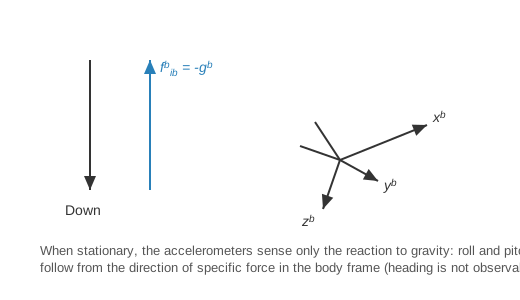
|
Every formula on this page assumes (and the angular rate) follow Groves' body-frame convention: = forward, = right, = down (FRD — see the estimators overview for the full explanation and the conversion to apply if your IMU instead reports an ENU-aligned body convention). Getting this wrong will not throw an exception — it will silently produce a wrong roll/pitch/heading, since e.g. swapping / or flipping the sign of changes which formula below computes which angle. |
LevelingEstimator
The simplest form. When the body is stationary, the only specific force sensed is the reaction to gravity, ; roll and pitch follow directly (equation 5.88/5.89 — this implementation neglects Earth rotation and the small north component of gravity, so it is accurate to about rad / 0.05°):
If sufficiently accurate (aviation-grade) gyroscope measurements are also available, LevelingEstimator
can additionally derive yaw through direct gyrocompassing, sensing the Earth-rotation vector itself
(equation 5.90/5.91):
Because rad/s is tiny, this only works with aviation- or
marine-grade gyros (drift well under about 0.01°/hr); consumer-grade MEMS gyros cannot gyrocompass at
all, which is why AttitudeEstimator exists as a magnetometer-based alternative.
// specific force sensed while stationary (m/s^2)
double fx = 0.1, fy = -0.2, fz = -9.81;

// roll/pitch only
CoordinateTransformation attitude = LevelingEstimator.getAttitude(fx, fy, fz, 0.0, 0.0, 0.0);

// roll/pitch + gyrocompassed yaw (requires aviation-grade angular rate, rad/s)
double angularRateX = 1e-7, angularRateY = -3e-8, angularRateZ = 5e-8;
CoordinateTransformation attitudeWithYaw = LevelingEstimator.getAttitude(
        fx, fy, fz, angularRateX, angularRateY, angularRateZ);

double roll = attitudeWithYaw.getRollEulerAngle();
double yaw = attitudeWithYaw.getYawEulerAngle();
LevelingEstimator2
A refinement of LevelingEstimator that no longer assumes the Earth is spherical: it uses
NEDGravityEstimator to obtain the true NED gravity vector at the device’s actual latitude and height
(which has a small north component because the Earth is flattened), then computes the rotation that
aligns the normalized measured specific force with the normalized true gravity direction, via the
axis-angle (Rodrigues) form:
The resulting quaternion only fixes roll and pitch — yaw is left arbitrary and must be resolved
separately (e.g. by AttitudeEstimator or gyrocompassing), exactly as with LevelingEstimator.
double latitude = Math.toRadians(41.3851);
double height = 0.0;
double fx = 0.1, fy = -0.2, fz = -9.81;

// yaw in the result is arbitrary; only roll/pitch are meaningful here
CoordinateTransformation attitude = LevelingEstimator2.getAttitude(
        latitude, height, fx, fy, fz, 0.0, 0.0, 0.0);
AttitudeEstimator
Combines a leveling solution (roll/pitch, via LevelingEstimator2) with a magnetometer measurement to
resolve yaw as well — the practical option for consumer-grade IMUs where the gyroscopes are not accurate
enough for gyrocompassing:
Magnetic heading and yaw (true heading = magnetic heading + declination):
Declination and dip can come from the WMM package
(WMMEarthMagneticFluxDensityEstimator) or from a directly measured
NEDMagneticFluxDensity (EarthMagneticFluxDensityEstimator).
double latitude = Math.toRadians(41.3851);
double height = 0.0;
double fx = 0.1, fy = -0.2, fz = -9.81;   // measured specific force (m/s^2)
double bx = 2.3e-5, by = 1.1e-5, bz = 4.2e-5; // measured magnetic flux density (T)

// declination for this position/date, e.g. from WMMEarthMagneticFluxDensityEstimator
double declination = Math.toRadians(1.2);

CoordinateTransformation attitude = AttitudeEstimator.getAttitude(
        latitude, height, fx, fy, fz, bx, by, bz, declination);

double yaw = attitude.getYawEulerAngle(); // true heading (rad)
BodyMagneticFluxDensityEstimator
The inverse of the attitude problem above: given the Earth’s magnetic flux density (magnitude, declination, dip — typically from the WMM package) and a known body attitude, it predicts what a magnetometer would measure in body-frame axes. This is used both to generate synthetic magnetometer test data and, internally, wherever a NED-to-body magnetic-field transform is needed:
where is yaw (true heading), is declination, is the field magnitude, and is the NED-to-body coordinate transformation matrix built from roll/pitch/yaw.
double magnitude = 4.8e-5;             // Earth field magnitude (T)
double declination = Math.toRadians(1.2);
double dip = Math.toRadians(58.0);
double roll = 0.0, pitch = 0.0, yaw = Math.toRadians(30.0); // known body attitude

BodyMagneticFluxDensity b = new BodyMagneticFluxDensity();
BodyMagneticFluxDensityEstimator.estimate(magnitude, declination, dip, roll, pitch, yaw, b);

double bx = b.getBx(); // predicted magnetometer reading, body x-axis (T)
Where to go next
-
World Magnetic Model (WMM) — Earth magnetic field model supplying declination/dip/magnitude.
-
Navigators — where the resulting attitude is used to initialize a navigator.
-
reference.adoc#bibliography — bibliography.