Singular Value Decomposition
| This documentation was generated with the assistance of AI. Please report any inaccuracies. |
SingularValueDecomposer factors any M-by-N matrix A, singular or not, square or not, into:
where U is M-by-N and column-orthogonal ( ), S is an N-by-N
diagonal matrix of non-negative singular values, and V is N-by-N and orthogonal
( ). It is the most robust decomposer in this library: where
LU or Gauss-Jordan elimination can
only report failure on a singular or ill-conditioned matrix, SVD diagnoses precisely what is wrong
and, in most cases, still produces a useful answer.
Numerical Recipes shows the shapes of the three factors as tableaus (eq. 2.6.1-2.6.2), which differ
depending on whether A has more rows than columns (the overdetermined case, M > N) or fewer
(the underdetermined case, M < N):
| Case | U |
S |
V^T |
|---|---|---|---|
|
|
|
|
|
|
|
|
Range, nullspace and rank
A maps its N-dimensional input space into (at most) an M-dimensional output space; the
subspace it actually reaches is its range, and its dimension is the rank of A. Vectors that
A maps to zero form its nullspace, with dimension the nullity. The rank-nullity theorem
relates the two: rank(A) + nullity(A) = N.
SVD constructs orthonormal bases for both subspaces directly: the columns of U whose matching
singular value is non-negligible span the range (getRange()), and the columns of V whose
matching singular value is negligible span the nullspace (getNullspace()). "Negligible" is
decided against a threshold (getRank(threshold), getNullity(threshold)); by default,
SingularValueDecomposer derives one from the matrix size, largest singular value and machine
precision (getNegligibleSingularValueThreshold()), which is adequate for most situations.
The ratio of the largest to the smallest singular value is the matrix’s condition number
(getConditionNumber(), or its reciprocal getReciprocalConditionNumber()), which measures how
much a small error in the right-hand side of a linear system can be amplified in the solution. The
largest singular value alone is the matrix’s 2-norm (getNorm2()).
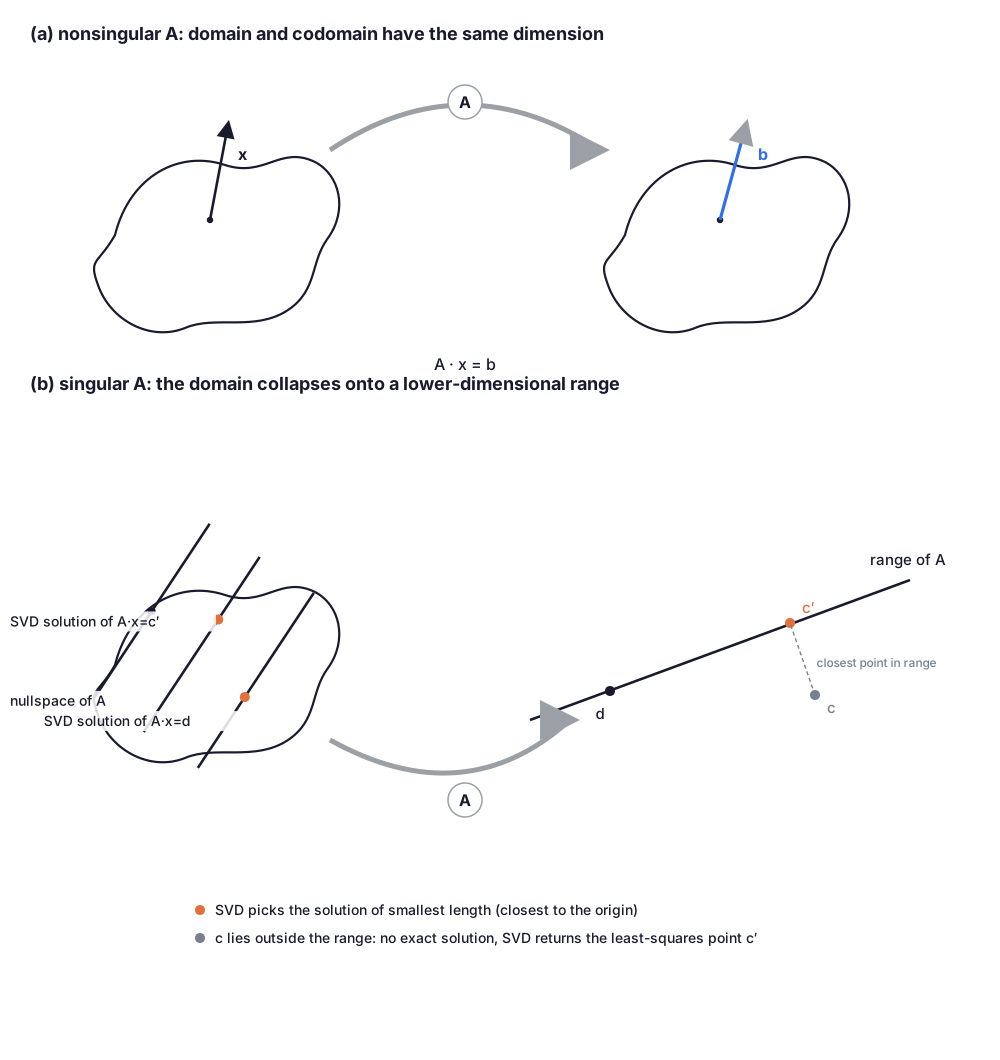
Numerical Recipes' Figure 2.6.1 illustrates what happens when solving A * x = b as A becomes
singular: a nonsingular matrix maps its whole domain onto a codomain of the same dimension, but a
singular matrix maps the domain onto a lower-dimensional range, collapsing its nullspace onto
zero. A right-hand side inside the range (d below) still has a solution — in fact a whole family
of them, differing by any vector in the nullspace, of which SVD’s solve picks the one closest to
zero — while a right-hand side outside the range (c below) has no exact solution at all, and
solve instead returns the least-squares solution of the closest reachable point c':
Solving linear systems with the pseudoinverse
For a square, full-rank A, the inverse follows directly from the orthogonality of U and V
and the diagonal shape of S:
When some singular values are zero (or negligible), this expression is generalized into the Moore-Penrose pseudoinverse by replacing with zero wherever is negligible:
This single formula, implemented by solve, covers every case: if A is nonsingular, it is the
exact solution; if A * x = b has infinitely many solutions (a homogeneous or rank-deficient
system with b in the range of A), it returns the one of smallest length; and if A * x = b has
no exact solution at all, it returns the least-squares best approximation, minimizing
. Zeroing small-but-nonzero singular values before solving, rather than
leaving them in, often improves the accuracy of the solution on ill-conditioned matrices: those
tiny singular values are usually dominated by roundoff error, and dividing by them amplifies that
error rather than any genuine signal.
Usage
import com.irurueta.algebra.SingularValueDecomposer;
import com.irurueta.algebra.Matrix;

Matrix a = new Matrix(3, 2);
// ... fill a with data ...

final var decomposer = new SingularValueDecomposer(a);
decomposer.decompose();

Matrix u = decomposer.getU();
Matrix v = decomposer.getV();
double[] singularValues = decomposer.getSingularValues();
Matrix s = decomposer.getW(); // diagonal matrix of singular values

int rank = decomposer.getRank();
int nullity = decomposer.getNullity();
Matrix range = decomposer.getRange();
Matrix nullspace = decomposer.getNullspace();

double conditionNumber = decomposer.getConditionNumber();
double norm2 = decomposer.getNorm2();

Matrix b = Matrix.newFromArray(new double[]{1.0, 2.0, 3.0});
Matrix x = decomposer.solve(b); // least-squares / pseudoinverse solution
decompose() may take an optional maxIters constructor argument (default 30) bounding the
number of iterations allowed for singular values to converge; getRank, getNullity, getRange,
getNullspace and solve all accept an optional explicit threshold instead of the automatically
derived one. Utils.pseudoInverse and Utils.norm2 build on this decomposer directly.
Error handling
decompose() throws NotReadyException if no input matrix has been set, LockedException if the
instance is already decomposing, and DecomposerException (specifically,
NoConvergenceException) if singular values fail to converge within maxIters iterations. Result
accessors throw NotAvailableException if called before decompose(). solve throws
WrongSizeException if b does not have a matching number of rows.
Reference
SingularValueDecomposer is based on the algorithm described in Numerical
Recipes, 3rd Edition, section 2.6, "Singular Value Decomposition".