QR Decomposition
| This documentation was generated with the assistance of AI. Please report any inaccuracies. |
QRDecomposer factors a matrix A with at least as many rows as columns into an orthogonal
matrix Q and an upper triangular matrix R (eq. 2.10.1-2.10.2):
Solving A * x = b with a QR factorization involves forming and then solving
the triangular system by backsubstitution (eq. 2.10.3-2.10.4). QR
decomposition takes about twice as many operations as LU
decomposition, so it is not the preferred method for typical square linear systems; its
usefulness comes from the fact that it also works, in a least-squares sense, when A has more
rows than columns (an overdetermined system), and from the fact that Q provides an orthonormal
basis for the column space of A.
The algorithm
Numerical Recipes builds Q and R through a sequence of N-1 Householder reflections, each
written in the form (with ):
chosen so that zeroes all entries below the diagonal in column 0 of A,
zeroes all entries below the diagonal in column 1, and so on, so that (eq. 2.10.5-2.10.6):
QRDecomposer in this library instead builds the factorization through Gram-Schmidt
orthogonalization: starting from a copy of A seeded with small random values in any extra rows
(needed only when A has more rows than columns), each column is made orthogonal to every
previous column and then normalized to unit length, directly producing the orthonormal columns of
Q; the dot products computed along the way are exactly the entries of R, which is
diagonal-and-above by construction.
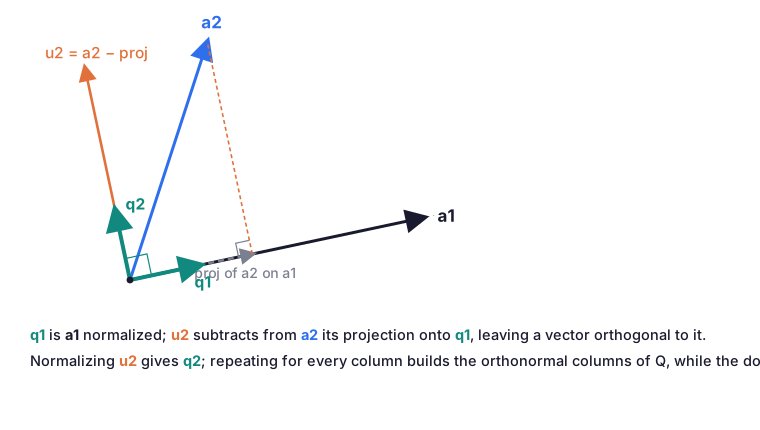
The diagram below shows one step of this process for two columns a1 and a2: a1 is normalized
directly into q1, while a2 has its projection onto q1 subtracted away, leaving a residual
u2 that is orthogonal to q1 and normalizes into q2:
isFullRank() inspects the diagonal of R: since up to sign for
the square part of A, a diagonal entry that is (numerically) zero indicates that A is rank
deficient, in which case solve throws RankDeficientMatrixException rather than returning a
meaningless answer.
For a faster factorization based on Householder reflections applied directly to A (matching the
algorithm described in Numerical Recipes) see
EconomyQRDecomposer, which is generally the better choice unless the full, square Q is
specifically required.
Usage
import com.irurueta.algebra.QRDecomposer;
import com.irurueta.algebra.Matrix;

Matrix a = new Matrix(3, 2);
a.setElementAt(0, 0, 1.0);
a.setElementAt(1, 0, 1.0);
a.setElementAt(2, 0, 0.0);
a.setElementAt(0, 1, 0.0);
a.setElementAt(1, 1, 1.0);
a.setElementAt(2, 1, 1.0);

final var decomposer = new QRDecomposer(a);
decomposer.decompose();

Matrix q = decomposer.getQ(); // 3x3 orthogonal matrix
Matrix r = decomposer.getR(); // 3x2 upper triangular matrix

boolean fullRank = decomposer.isFullRank();

Matrix b = Matrix.newFromArray(new double[]{1.0, 2.0, 3.0});
Matrix x = decomposer.solve(b); // least-squares solution when a has more rows than columns
isFullRank and solve accept an optional roundingError argument to relax the default
(DEFAULT_ROUND_ERROR, 1e-8) tolerance used to decide whether a diagonal entry of R is
effectively zero.
Error handling
decompose() throws NotReadyException if no input matrix has been set, LockedException if the
instance is already decomposing, and DecomposerException if the input matrix has fewer rows than
columns. Result accessors throw NotAvailableException if called before decompose(). solve
throws WrongSizeException if b does not have a matching number of rows or if the input matrix
has fewer rows than columns, and RankDeficientMatrixException if the input matrix is not full
rank.
Reference
QRDecomposer implements the factorization described in Numerical Recipes,
3rd Edition, section 2.10, "QR Decomposition", using Gram-Schmidt orthogonalization instead of
the Householder reflections described there; see also
Wikipedia, "QR decomposition".