Economy QR Decomposition
| This documentation was generated with the assistance of AI. Please report any inaccuracies. |
EconomyQRDecomposer factors a matrix A with at least as many rows as columns into an
orthogonal matrix Q and an upper triangular matrix R, exactly like
QRDecomposer:
The "economy" in the name refers to how the factorization is computed and represented internally,
not to the shape of Q and R returned by getQ() and getR() (both classes return a full
square Q and an upper triangular R sized like A). EconomyQRDecomposer is the faster of the
two and is generally the better default choice, unless the alternative Gram-Schmidt-based
QRDecomposer is specifically preferred.
The algorithm
Unlike QRDecomposer, which uses Gram-Schmidt orthogonalization,
EconomyQRDecomposer follows the classical Numerical Recipes approach of successive Householder
reflections. For each column k, letting be the sub-column at and below the
diagonal, the Householder vector v and the reflection H it defines are:
where is the first standard basis vector of the sub-column. H is symmetric and
orthogonal, and reflecting x through the hyperplane it defines zeroes every entry below the
diagonal in that column while leaving its norm unchanged; the same reflection is then applied to
the remaining columns to the right. After n such reflections (one per column), the upper
triangle of the working matrix holds R, and the accumulated Householder vectors implicitly
represent Q.
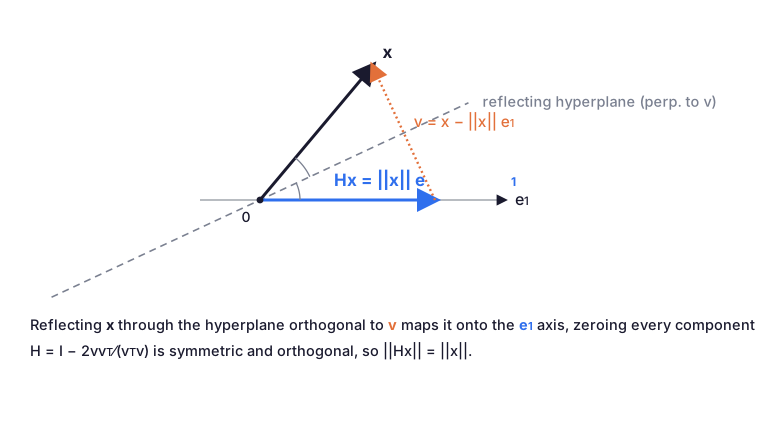
The diagram below shows this geometrically for a single sub-column x: reflecting it through the
hyperplane orthogonal to the Householder vector v maps it onto the e1 axis, so every component
except the first becomes zero.
EconomyQRDecomposer stores only these Householder vectors (in a lower trapezoidal matrix
retrievable through getH()) and the diagonal of R (rDiag), rather than materializing Q
eagerly. getQ() and getR() reconstruct the explicit matrices from this compact representation
on demand, and solve applies the Householder reflections directly to the right-hand side instead
of ever forming Q explicitly, which is both faster and more memory-efficient than the
Gram-Schmidt approach used by QRDecomposer.
As with QRDecomposer, isFullRank() inspects the diagonal of R (rDiag) to detect rank
deficiency, and solve throws RankDeficientMatrixException when the input matrix is not full
rank.
Usage
import com.irurueta.algebra.EconomyQRDecomposer;
import com.irurueta.algebra.Matrix;

Matrix a = new Matrix(3, 2);
a.setElementAt(0, 0, 1.0);
a.setElementAt(1, 0, 1.0);
a.setElementAt(2, 0, 0.0);
a.setElementAt(0, 1, 0.0);
a.setElementAt(1, 1, 1.0);
a.setElementAt(2, 1, 1.0);

final var decomposer = new EconomyQRDecomposer(a);
decomposer.decompose();

Matrix q = decomposer.getQ(); // 3x2 orthogonal factor
Matrix r = decomposer.getR(); // 2x2 upper triangular factor
Matrix h = decomposer.getH(); // Householder vectors

boolean fullRank = decomposer.isFullRank();

Matrix b = Matrix.newFromArray(new double[]{1.0, 2.0, 3.0});
Matrix x = decomposer.solve(b); // least-squares solution when a has more rows than columns
isFullRank and solve accept an optional roundingError argument to relax the default
(DEFAULT_ROUND_ERROR, 0.0) tolerance used to decide whether a diagonal entry of R is
effectively zero.
This is the decomposer that Utils.solve and Utils.inverse use for non-square
matrices.
Error handling
decompose() throws NotReadyException if no input matrix has been set and LockedException if
the instance is already decomposing. Result accessors throw NotAvailableException if called
before decompose(). getQ, isFullRank and solve throw WrongSizeException if the input
matrix has fewer rows than columns (solve additionally if b does not have a matching number of
rows), and solve throws RankDeficientMatrixException if the input matrix is not full rank.
Reference
EconomyQRDecomposer implements the Householder-based algorithm described in
Numerical Recipes, 3rd Edition, section 2.10, "QR Decomposition"; see also
Wikipedia, "QR decomposition".