Shell sort
| This documentation was generated with the assistance of AI. Please report any inaccuracies. |
ShellSorter sorts an array using Shell’s method, a "diminishing increment sort" and a powerful
variant of straight insertion. Rather than comparing only
adjacent elements, it first sorts, by straight insertion, sub-arrays made of elements that are far
apart (separated by some increment), then repeats the process with progressively smaller
increments, until a final pass with increment 1 completes an ordinary straight insertion. The
earlier passes let elements travel long distances toward their final position cheaply, so that the
last, most expensive pass rarely has to move an element more than a few places.
Increment sequence
The spacings between the elements compared on each pass are called the increments. Numerical Recipes notes that the naive sequence 8, 4, 2, 1 (halving each time) performs poorly, especially when N is a power of two, and recommends instead the sequence (eq. 8.1.1):
which is generated from the largest term down to 1 by the recurrence (eq. 8.1.2):
ShellSorter builds the sequence by repeatedly applying this recurrence upward until the increment
exceeds the array length, then walks it back down, sorting sub-arrays with straight insertion at
each increment until it reaches 1. For a worst-case ordering of the input, the number of operations
with this sequence is of order N1.5; for randomly ordered data it is closer to N1.25, at least
for N below a few tens of thousands. This makes ShellSorter competitive with
Quicksort for N roughly below 50, while remaining almost as simple to
implement as straight insertion.
Example
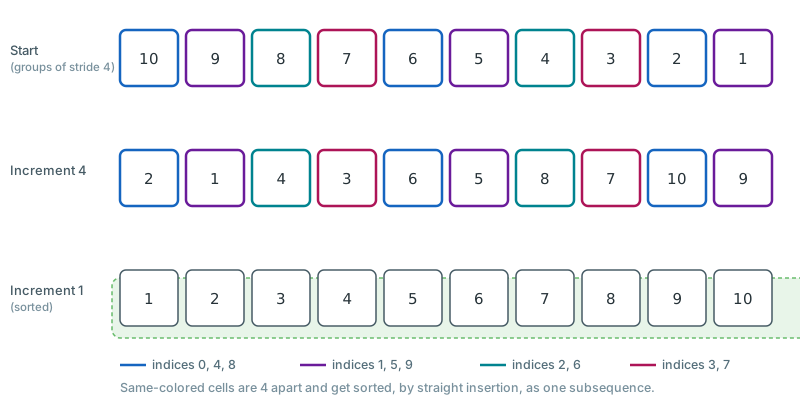
For an array of 10 elements, the recurrence above yields the increments 4 and then 1. The diagram
below sorts the reverse-ordered array {10, 9, 8, …, 1}: the first pass sorts, by straight
insertion, the four interleaved subsequences of elements 4 apart (shown in matching colors); the
final pass, an ordinary straight insertion, only has to move each element a short distance because
of the earlier pass.
Usage
import com.irurueta.sorting.ShellSorter;

ShellSorter<Double> sorter = new ShellSorter<>();

double[] values = {5.0, 3.0, 8.0, 1.0, 9.0};
sorter.sort(values);
It can also be selected dynamically through the Sorter factory:
import com.irurueta.sorting.Sorter;
import com.irurueta.sorting.SortingMethod;

Sorter<Double> sorter = Sorter.create(SortingMethod.SHELL_SORTING_METHOD);
Like every Sorter, it also supports sortWithIndices, select and median, as described in
Usage.
Reference
This class is based on the algorithm described in Numerical Recipes, 3rd Edition, section 8.1.1, "Shell’s Method".