Heapsort
| This documentation was generated with the assistance of AI. Please report any inaccuracies. |
HeapsortSorter sorts an array using Heapsort, a true in-place sort that requires no auxiliary
storage. Heapsort first rearranges the array into a "heap": a binary tree, stored contiguously in
the array, in which every element is greater than or equal to its two children. Once the array
forms a heap, the largest element sits at the root; it is swapped to the end of the array (its
final sorted position), and the remaining heap is repaired ("sifted down") so that its new root is
again the largest remaining element. Repeating this pull-and-repair step from the last element back
to the first sorts the whole array.
The heap property
A set of N numbers , , is said to form a heap if it satisfies the relation (eq. 8.3.1):
Viewing the array as a binary tree, with element 0 at the root and each element having children at positions and , this says that every "supervisor" is greater than or equal to its two "supervisees", all the way down the hierarchy. The illustration below reproduces Figure 8.3.1 from Numerical Recipes: a heap of 12 elements. Elements connected by a downward path are ordered with respect to one another, but there is no guaranteed ordering between elements that are only related laterally (for example, and ); the dashed lines stand for further, unlabeled descendants continuing the same way.
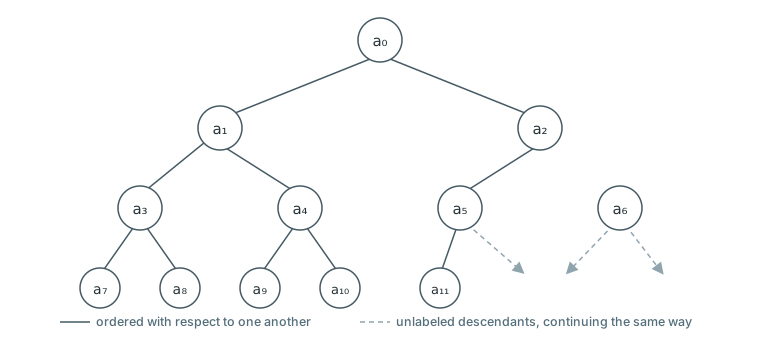
HeapsortSorter builds this structure with a "sift-down" pass over the second half of the array
(the internal, non-leaf nodes), then repeatedly swaps the root with the last unsorted element and
sifts the new root down, shrinking the heap by one element each time.
Heapsort is an N log2 N algorithm both on average and in the worst case, unlike
Quicksort, whose worst case is O(N2). In practice, Heapsort is slower than
Quicksort by a roughly constant factor, so Sorter.DEFAULT_SORTING_METHOD favors Quicksort-based
sorting; HeapsortSorter remains a good choice when a guaranteed worst-case running time or
sorting fully in place matters more than average-case speed.
HeapsortSorter is not stable: elements that compare as equal may be reordered relative to each
other.
Usage
import com.irurueta.sorting.HeapsortSorter;

HeapsortSorter<Double> sorter = new HeapsortSorter<>();

double[] values = {5.0, 3.0, 8.0, 1.0, 9.0};
sorter.sort(values);
It can also be selected dynamically through the Sorter factory:
import com.irurueta.sorting.Sorter;
import com.irurueta.sorting.SortingMethod;

Sorter<Double> sorter = Sorter.create(SortingMethod.HEAPSORT_SORTING_METHOD);
Like every Sorter, it also supports sortWithIndices, select and median, as described in
Usage.
Reference
This class is based on the algorithm described in Numerical Recipes, 3rd Edition, section 8.3, "Heapsort".